Technical Dossier
Product Details And Specifications
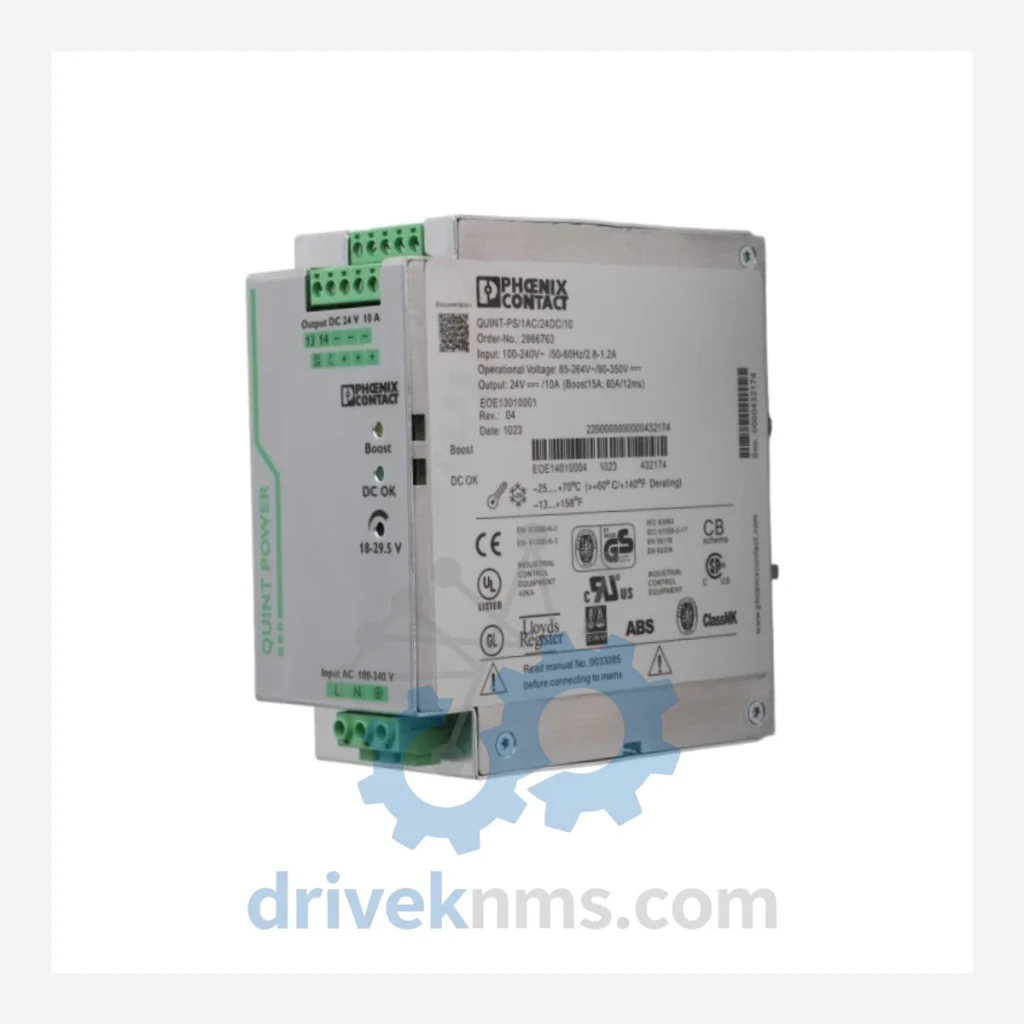
Phoenix Contact QUINT-PS/1AC/24VDC/10 Power Supply Module – Obsolete QUINT Power Spare Part
When a QUINT-PS/1AC/24VDC/10 fails inside a running production line, the decision facing plant management is rarely simple. The module itself is discontinued. Its replacement within the existing cabinet layout is not a matter of swapping a component — it is the beginning of a system re-engineering project. New DIN-rail power supply platforms carry different footprints, different diagnostic interfaces, and different firmware handshake requirements. Integrating them into a legacy PLC or SCADA environment — whether Siemens S7, Allen-Bradley ControlLogix, or a Modbus-based supervisory layer — demands engineering hours, validation cycles, and in regulated industries, re-certification. Conservative estimates place the total cost of a forced platform migration triggered by a single power supply failure at USD 200,000 to over USD 1,000,000, depending on line complexity and downtime duration.
DriveKNMS holds verified physical stock of the Phoenix Contact QUINT-PS/1AC/24VDC/10 (Article No. 2866763). This is not a catalog listing. Inventory is finite and allocated on a first-confirmed basis.
Technical Specifications
| Manufacturer | Phoenix Contact |
| Series | QUINT Power |
| Part Number / Article No. | QUINT-PS/1AC/24VDC/10 / 2866763 |
| Input Voltage | 1-phase AC, 100–240 V AC (wide-range input) |
| Output Voltage | 24 V DC |
| Output Current | 10 A |
| Output Power | 240 W |
| Mounting | DIN rail (35 mm) |
| Country of Origin | Germany |
| Discontinuation Status | Discontinued / Obsolete – no longer in standard production |
| Typical System Compatibility | Siemens S7-300/400, Allen-Bradley ControlLogix/SLC, legacy Modbus RTU panels, distributed I/O cabinets |
Solving the Discontinued Hardware Crisis
The QUINT Power series established a benchmark for industrial power supply reliability through the 1990s and 2000s. Its SFB (Selective Fuse Breaking) technology, active current limiting, and integrated load monitoring made it the default choice for cabinet builders supplying automotive, chemical, water treatment, and discrete manufacturing facilities. Thousands of these units remain embedded in operational control cabinets worldwide — not because engineers have forgotten to upgrade, but because the cost and risk of replacing a functioning system architecture outweighs any theoretical benefit.
The QUINT-PS/1AC/24VDC/10 specifically powers 24 V DC field device buses: sensors, solenoid valves, distributed I/O modules, and communication gateways. In a typical S7-300 or ControlLogix installation, this power supply feeds the 24 V rail that keeps the entire field layer alive. A failure here does not merely stop one machine — it collapses the field bus, triggering cascading faults across the PLC rack and halting the line. The mean time to restore production without a direct replacement part, accounting for engineering assessment, procurement of an alternative, and re-wiring or re-configuration, routinely exceeds 72 hours in facilities that have not maintained a spare parts inventory.
Maintaining a stock of two to three QUINT-PS/1AC/24VDC/10 units per production line is not a luxury. It is the lowest-cost insurance policy available against a failure mode that carries a defined and substantial financial consequence.
How to Extend Automation Asset Life by 5–10 Years: A Practical Strategy for Plant Management
Facilities operating legacy control architectures face a structural pressure: OEM support windows close, spare parts disappear from distribution channels, and internal engineering knowledge of older platforms erodes as staff turns over. The standard response — full system replacement — is often presented as inevitable. It is not.
A disciplined spare parts strategy can extend the operational life of a legacy automation asset by five to ten years at a fraction of the capital cost of replacement. The approach rests on four pillars:
1. Critical path identification. Map every component whose failure would halt production. Power supplies, communication modules, and CPU cards sit at the top of this list. The QUINT-PS/1AC/24VDC/10 is a critical path component in any installation where it is present.
2. Minimum stock levels. For critical path components, maintain a minimum of two units on-site. One in service, one on the shelf. For high-criticality lines, three units. The carrying cost of two power supply modules is measured in hundreds of dollars. The cost of a 72-hour unplanned outage is measured in hundreds of thousands.
3. Condition-based rotation. Electrolytic capacitors in switch-mode power supplies have a defined service life, typically 10–15 years at rated temperature. Proactively replace units approaching this threshold rather than waiting for failure. Rotate shelf stock into service and replenish the shelf.
4. Sourcing discipline. As parts move deeper into obsolescence, the secondary market becomes the only source. Establish relationships with verified obsolete parts suppliers before the need becomes urgent. Emergency procurement under production pressure produces poor outcomes: inflated prices, unverified provenance, and compressed inspection timelines.
DriveKNMS operates specifically within this supply chain segment. Our inventory is sourced, inspected, and held for customers who manage legacy assets with the seriousness those assets deserve.
Condition & Reliability Assurance
Every QUINT-PS/1AC/24VDC/10 unit shipped by DriveKNMS passes a five-stage inspection protocol before dispatch:
Stage 1 – Visual and mechanical inspection. Housing integrity, DIN rail clip condition, terminal block seating, and label legibility are verified. Units with physical damage are rejected.
Stage 2 – Electrolytic capacitor assessment. Capacitor aging is the primary failure mode in switch-mode power supplies of this generation. Each unit is assessed for capacitor bulge, electrolyte leakage, and ESR deviation. Units showing capacitor degradation are quarantined.
Stage 3 – Firmware and hardware revision verification. Hardware revision and any embedded firmware version are documented and disclosed to the customer prior to shipment. Revision mismatches that could affect system compatibility are flagged.
Stage 4 – Pin and connector integrity check. Output terminals, input terminals, and signal contacts are inspected for corrosion, oxidation, and mechanical deformation. Contact surfaces are cleaned where required.
Stage 5 – Functional load test. Units are powered under load and output voltage stability, current limiting behavior, and SFB response are verified against published specifications.
Condition grade (New / Refurbished-Grade A / Tested-Used) is disclosed on every order confirmation. We do not ship units whose condition grade cannot be verified.
Key Features for System Maintenance
The QUINT-PS/1AC/24VDC/10 is a direct, drop-in replacement for any existing installation of the same part number. No re-wiring of the 24 V DC output bus is required. No PLC program modification is needed. No re-configuration of downstream field devices is involved. The unit mounts on the existing 35 mm DIN rail, connects to the existing terminal blocks, and restores the 24 V rail to specification.
This matters because engineering re-work is not free. Every hour of panel modification, every PLC program change, and every re-validation cycle carries a labor cost and a production risk. A direct replacement eliminates all of these. The line returns to service in the time it takes to swap the module and verify output voltage — typically under 30 minutes for a trained technician.
For facilities operating under IEC 62443, ISO 13849, or sector-specific functional safety frameworks, a direct replacement also avoids the re-assessment obligations that accompany hardware design changes. This is a compliance consideration that is frequently underweighted in the initial cost comparison between replacement parts and platform migration.
FAQ
Q: What warranty applies to obsolete parts?
A: DriveKNMS provides a 90-day warranty covering functional defects on all tested and refurbished units. New old stock units carry a 180-day warranty. Warranty terms are confirmed in writing on the order confirmation.
Q: How do I know the unit is genuine and not counterfeit?
A: All units are sourced from verifiable industrial channels — decommissioned plant equipment, authorized liquidation, and long-term storage inventories. Physical markings, PCB construction, and component profiles are cross-referenced against known-genuine units. We do not source from unverified grey-market aggregators.
Q: Should I buy more than one unit?
A: For any production-critical installation, yes. The QUINT-PS/1AC/24VDC/10 is discontinued. Each unit sold from existing stock reduces the available pool. Customers managing multiple lines or multiple sites are advised to consolidate procurement now rather than return to the market under emergency conditions.
Q: Can you source units not currently in stock?
A: Contact us with your requirement. We maintain active sourcing networks for obsolete Phoenix Contact components and can often locate additional units within 5–15 business days.