
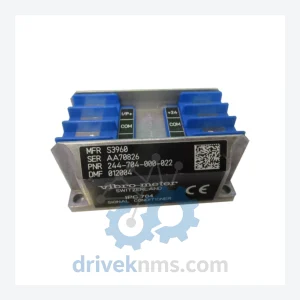
VIBRO-METER IPC704P Modules
VIBRO-METER IPC704P Series: Comprehensive Module Range and Technical Overview The VIBRO-METER IPC704P is a modular vibration monitoring platform developed by…
Model: 244-704-000-042
Product Overview
Commercial availability is handled through direct RFQ, model verification and export-oriented follow-up rather than public cart checkout.
Datasheet Preview
Use attached product manuals when available. If the manual is not public yet, request the full file directly through RFQ.
Commercial Path
Product pages on DRIVEKNMS are designed to verify model, brand and series first, then move the buyer into one clean quotation path.
Technical Dossier
When a signal conditioner module fails inside a Vibro-Meter IPC 704 turbomachinery protection system, the consequences extend far beyond a line-item repair cost. A single unplanned shutdown on a gas turbine or compressor train can cost an operating facility USD $50,000–$500,000 per day in lost production. If the failed module is no longer manufactured, the pressure to retire the entire protection system — and re-engineer the control architecture around a modern replacement — can push total project costs into the millions. The Vibro-Meter 244-704-000-042 is that exact category of component: a precision signal conditioner tied to a discontinued product line, with no direct off-the-shelf substitute. DriveKNMS maintains verified physical stock of this module for facilities that cannot afford to treat a spare part shortage as a capital project trigger.
| Parameter | Detail |
|---|---|
| Part Number | 244-704-000-042 |
| Manufacturer | Vibro-Meter SA (now Meggitt SA) |
| Series | IPC 704 |
| Function | Signal Conditioner for vibration / proximity measurement channels |
| Country of Origin | Switzerland |
| Product Status | Discontinued / Obsolete – No longer in active production |
| Compatible Systems | Vibro-Meter IPC 704 turbomachinery protection rack systems |
| Typical Application | Gas turbines, steam turbines, compressors, rotating machinery protection |
Note: Electrical parameters specific to this sub-variant are not published in open documentation. DriveKNMS will provide full datasheet and test records upon request. No parameters are assumed or fabricated.
The Vibro-Meter IPC 704 platform was deployed extensively across power generation, oil & gas, and petrochemical facilities from the 1980s through the early 2000s. Its modular rack architecture allowed individual signal conditioner cards — including the 244-704-000-042 — to be replaced without disturbing the broader protection logic. That design philosophy was sound engineering. The problem is that Vibro-Meter SA was absorbed into Meggitt's sensing systems division, and the IPC 704 card range was progressively discontinued as the product roadmap shifted to newer platforms.
Facilities still running IPC 704 racks face a structural dilemma: the protection system itself remains functional and certified, but sourcing replacement cards through official channels is no longer possible. The alternative — migrating to a current-generation protection system — requires new sensors, new cabling, new engineering documentation, updated safety certification, and extended commissioning downtime. For a single turbine train, that migration routinely costs USD $300,000–$1,500,000 and takes 6–18 months to execute safely.
A verified replacement 244-704-000-042 module, by contrast, restores full system function in hours. For plant managers and reliability engineers operating under asset-life-extension mandates, maintaining a strategic spare inventory of IPC 704 cards is not a workaround — it is a defensible, cost-documented maintenance strategy.
The following framework applies directly to facilities operating Vibro-Meter IPC 704 systems and other legacy turbomachinery protection platforms:
1. Conduct a card-level criticality audit. Map every populated slot in your IPC 704 rack. Identify which card types — signal conditioners, power supplies, output modules — have no remaining manufacturer support. The 244-704-000-042 is typically among the highest-criticality items because it sits directly in the measurement signal path.
2. Establish a minimum spare holding. For a single-train installation, one spare per critical card type is a minimum. For multi-train facilities or remote sites with long logistics lead times, two to three units per card type is standard practice. The carrying cost of three signal conditioner modules is negligible against the cost of one unplanned shutdown.
3. Source from traceable channels only. Obsolete industrial electronics sourced from unverified brokers carry real risk: counterfeit boards, undisclosed repairs, firmware mismatches, and degraded passive components. Insist on documented provenance and incoming inspection records.
4. Implement condition-based rotation. Spare cards should be bench-tested annually and rotated into service on a planned basis. This prevents the scenario where a stored spare has itself degraded by the time it is needed.
5. Document the business case for continued operation. Plant management and asset owners respond to numbers. A one-page cost comparison — spare card procurement cost versus system migration cost — is a straightforward document to prepare and a powerful tool for securing maintenance budget approval.
Facilities that execute this strategy consistently report 5–10 additional years of reliable operation from legacy protection systems, with maintenance costs that remain a fraction of the capital expenditure required for full system replacement.
DriveKNMS applies a 5-step incoming inspection protocol to all obsolete industrial modules before they are offered for sale:
Step 1 – Visual and mechanical inspection. Board surfaces, connector pins, and housing are examined for physical damage, corrosion, and evidence of prior repair or rework.
Step 2 – Electrolytic capacitor assessment. Aged electrolytic capacitors are the primary failure mode in electronics stored beyond 10 years. Each board is inspected for capacitor bulging, leakage, and ESR deviation. Units with suspect capacitors are segregated and not offered as functional spares.
Step 3 – Connector and pin integrity check. Edge connectors and backplane pins are inspected under magnification for oxidation, fretting corrosion, and mechanical deformation. Pin contact surfaces are cleaned where required.
Step 4 – Firmware and label verification. Where version markings are present, firmware and hardware revision labels are recorded and cross-referenced against known IPC 704 compatibility matrices.
Step 5 – Functional bench test. Where test fixtures are available for the specific card type, a powered functional test is performed. Test results are documented and provided with the unit on request.
Units that do not pass all applicable steps are not listed for sale. Condition grade (New Surplus, Tested Refurbished, or As-Removed) is disclosed clearly for each unit at time of quotation.
Q: What warranty applies to an obsolete spare part?
A: DriveKNMS provides a 90-day warranty covering functional performance against the original specification for tested and refurbished units. New surplus units carry a 180-day warranty. Warranty terms are confirmed in writing at time of sale.
Q: How do I know the unit is genuine and not counterfeit?
A: All units sourced by DriveKNMS are inspected for label authenticity, board markings, and construction quality consistent with Vibro-Meter SA manufacturing standards. Provenance documentation is provided where available. We do not source from unverified secondary markets.
Q: Should I buy more than one unit?
A: For any facility where the IPC 704 system is critical to operations, holding at least one spare 244-704-000-042 on-site is a minimum prudent position. Given that stock of discontinued modules is finite globally, procurement of two to three units while stock is available is a defensible asset protection decision.
Q: Can you supply other IPC 704 cards?
A: DriveKNMS specializes in obsolete and hard-to-find industrial automation components. Contact us with your full card list and we will advise on current stock availability across the IPC 704 range.
Q: What is the lead time?
A: In-stock units ship within 2–3 business days of order confirmation. Contact us to confirm current availability before placing an order.
© 2026 DriveKNMS. (Status: DRAFT)
Related Paths
VIBRO-METER IPC704P Series: Comprehensive Module Range and Technical Overview The VIBRO-METER IPC704P is a modular vibration monitoring platform developed by…
VIBRO-METER IPC704P-CP237 244-704-000-042 Protection Unit: Global Sourcing Strategy & Asset Return Value The VIBRO-METER IPC704P-CP237 (P/N: 244-704-000-042) is a precision…
Vibro-Meter IPC704 244-704-000-042 Signal Processor – Obsolete VM Series Spare Part When a signal processor module fails inside a turbomachinery…