Technical Dossier
Product Details And Specifications
Phoenix Contact TRIO-DIODE Series: Comprehensive Module Range and Technical Overview
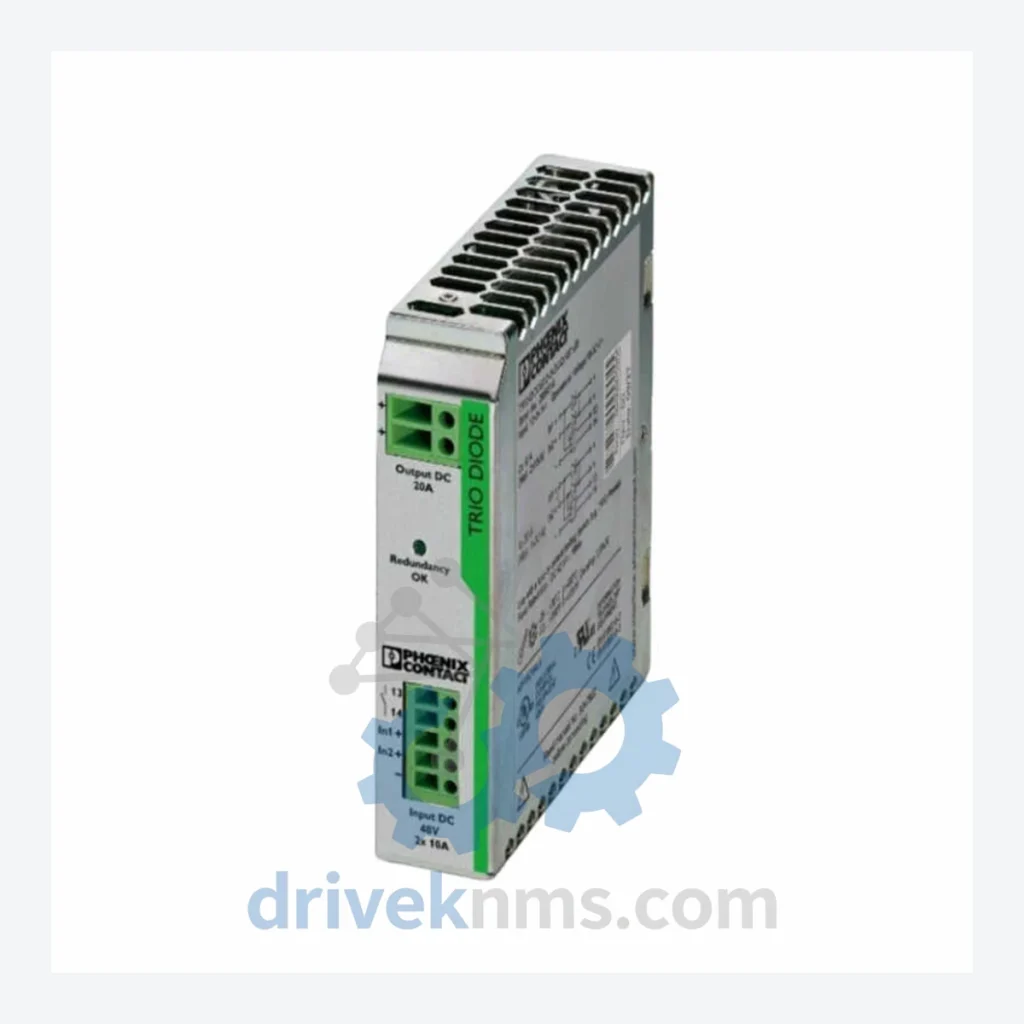
The Phoenix Contact TRIO-DIODE series is a dedicated line of redundancy modules engineered for decoupling parallel power supply circuits in mission-critical industrial environments. Deployed extensively across chemical processing plants, oil refineries, nuclear facilities, offshore platforms, and continuous-process manufacturing lines, TRIO-DIODE modules serve as the backbone of fault-tolerant 24 VDC and 48 VDC power distribution architectures. Their primary function is to prevent reverse current flow between parallel-connected power supply units, enabling N+1 redundancy without single-point failure risk. The series is fully compatible with Phoenix Contact's TRIO-PS and QUINT-PS power supply families and integrates directly into standard DIN rail assemblies. Global installed base spans IEC 61511 (functional safety), ATEX-rated enclosures, and IEC 60364-compliant panel builds across Europe, North America, and Asia-Pacific industrial sectors.
The Evolution of TRIO-DIODE Architecture
Phoenix Contact introduced the TRIO-DIODE series as a companion product line to the TRIO-PS modular power supply range, targeting the growing demand for redundant 24 VDC bus architectures in process automation during the early 2000s. Initial variants focused on 24 VDC systems with single-channel decoupling at 10 A and 20 A ratings. As industrial power demands scaled — particularly in DCS-heavy environments running Honeywell, Emerson DeltaV, and ABB 800xA — Phoenix Contact expanded the TRIO-DIODE range to cover 48 VDC bus voltages and higher current configurations (2×10 A, 1×20 A, 2×20 A, 1×40 A).
The internal architecture uses Schottky diode technology to minimize forward voltage drop (typically 0.5 V or less), reducing thermal dissipation compared to conventional silicon diodes. Later revisions introduced improved heat sink geometries and wider operating temperature ranges (−25 °C to +70 °C), addressing deployment in outdoor cabinets and harsh-environment enclosures. Current-generation TRIO-DIODE modules maintain backward mechanical compatibility with earlier DIN rail footprints, allowing direct replacement in legacy panel builds without rewiring. For systems originally designed around early TRIO-DIODE variants now reaching end-of-production status, DriveKNMS maintains a verified inventory of both current and discontinued part numbers to support long-term maintenance contracts.
TRIO-DIODE Full Catalog & Functionalities (SKU List)
The following SKUs represent the confirmed TRIO-DIODE product range. Each entry includes the article number (Phoenix Contact order code) and a precise functional description.
TRIO-DIODE/12-24DC/2X10/1X20 (2866514): Redundancy module, 12–24 VDC input, 2×10 A + 1×20 A output decoupling.
TRIO-DIODE/24DC/2X10/1X20 (2866527): Redundancy module, 24 VDC, 2×10 A input channels, 1×20 A decoupled output — current listing SKU.
TRIO-DIODE/48DC/2X10/1X20 (2866530): Redundancy module, 48 VDC bus, 2×10 A inputs, 1×20 A output, Schottky decoupling.
TRIO-DIODE/24DC/2X20/1X40 (2866543): High-current redundancy module, 24 VDC, 2×20 A inputs, 1×40 A combined output.
TRIO-DIODE/48DC/2X20/1X40 (2866556): High-current redundancy module, 48 VDC, 2×20 A inputs, 1×40 A output for heavy-load bus rails.
TRIO-DIODE/12DC/2X10/1X20 (2866501): Redundancy module optimized for 12 VDC telecom and SCADA panel applications.
TRIO-DIODE/24DC/1X10 (2866569): Single-channel decoupling module, 24 VDC, 10 A, compact footprint for space-constrained enclosures.
TRIO-DIODE/24DC/1X20 (2866572): Single-channel decoupling module, 24 VDC, 20 A, direct DIN rail mount.
TRIO-DIODE/48DC/1X10 (2866585): Single-channel 48 VDC decoupling, 10 A, suited for telecom power bus redundancy.
TRIO-DIODE/48DC/1X20 (2866598): Single-channel 48 VDC decoupling, 20 A, for mid-range redundant bus configurations.
TRIO-DIODE/24DC/2X10/1X20/PT (2866610): TRIO-DIODE with integrated push-in terminal technology for tool-free wiring.
TRIO-DIODE/48DC/2X10/1X20/PT (2866623): 48 VDC push-in terminal variant, 2×10 A + 1×20 A, reduced installation time.
TRIO-DIODE/24DC/2X20/1X40/PT (2866636): High-current push-in terminal variant, 24 VDC, 40 A output, for high-density panel builds.
TRIO-DIODE/48DC/2X20/1X40/PT (2866649): High-current push-in terminal variant, 48 VDC, 40 A output.
TRIO-DIODE/12-24DC/2X20/1X40 (2866662): Wide-range input (12–24 VDC), 2×20 A inputs, 1×40 A output, dual-voltage plant compatibility.
TRIO-DIODE/24DC/3X10/1X30 (2866675): Three-input redundancy module, 24 VDC, 3×10 A inputs, 1×30 A output for triple-redundant architectures.
Sourcing Hard-to-Find & Obsolete TRIO-DIODE Parts
Several early TRIO-DIODE variants — particularly those with screw-terminal connections and legacy article numbers below 2866520 — have transitioned to end-of-life or limited-availability status through Phoenix Contact's standard distribution channels. Plants operating continuous processes (refineries, chemical reactors, power generation) cannot afford extended lead times for replacement modules during unplanned shutdowns.
DriveKNMS maintains a dedicated inventory of TRIO-DIODE modules sourced through verified secondary market channels, including surplus from decommissioned plant upgrades and authorized distributor overstock. All units are catalogued by article number, date code, and condition grade (new-in-box, tested-surplus, refurbished). For obsolete variants no longer manufactured, DriveKNMS provides cross-reference analysis to identify compatible current-generation replacements with equivalent electrical specifications, minimizing panel modification requirements. Customers operating under long-term maintenance agreements (LTMA) or multi-year service contracts are encouraged to establish blanket purchase orders to secure stock against future availability constraints.
Quality Control for the TRIO-DIODE Range
TRIO-DIODE modules are passive power components with no firmware or programmable logic, but their internal Schottky diode assemblies and bus bar connections require specific validation procedures before deployment in safety-instrumented systems. DriveKNMS applies the following test protocol to all TRIO-DIODE units processed through its facility:
Forward Voltage Drop Test: Each input channel is loaded to rated current (10 A or 20 A) and forward voltage drop is measured. Acceptable threshold: ≤0.6 V per channel at rated load, consistent with Schottky diode specification.
Reverse Leakage Current Test: Reverse bias is applied to each diode channel to verify isolation integrity. Leakage current must remain below 1 mA at rated reverse voltage.
Thermal Imaging: Units are operated at 100% rated load for 30 minutes. Infrared thermal scan identifies hot spots indicating degraded diode junctions or compromised internal connections.
Insulation Resistance Test: 500 VDC megohmmeter test between input terminals and chassis ground. Minimum acceptable: 100 MΩ.
DIN Rail Clip Integrity: Mechanical retention force of DIN rail mounting clip is verified to prevent vibration-induced displacement in mobile or high-vibration installations.
Terminal Torque Verification: Screw-terminal variants are checked for correct torque (per Phoenix Contact specification) to ensure low-resistance connections under thermal cycling.
All test results are documented and available upon request with each shipment.