
SICK S30A-6011BA Safety Laser Scanner – Obsolete S30A Series Spare Part
SICK S30A-6011BA Safety Laser Scanner – Obsolete S30A Series Spare Part When a SICK S30A-6011BA fails on an active production…
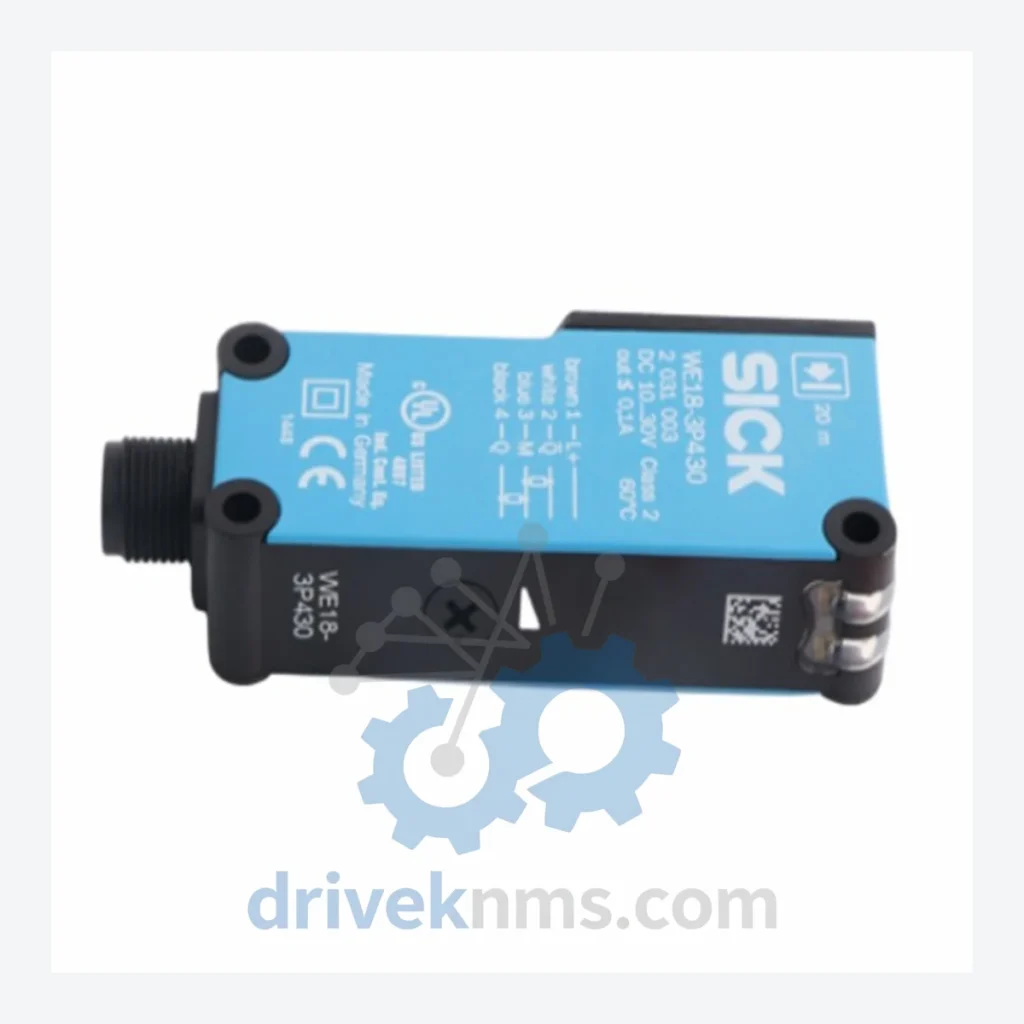
Model: WE18-3P430
Product Overview
Commercial availability is handled through direct RFQ, model verification and export-oriented follow-up rather than public cart checkout.
Datasheet Preview
Use attached product manuals when available. If the manual is not public yet, request the full file directly through RFQ.
Commercial Path
Product pages on DRIVEKNMS are designed to verify model, brand and series first, then move the buyer into one clean quotation path.
Technical Dossier
When a SICK WE18-3P430 fails on a production line, the immediate question is not where to find a replacement — it is whether the entire line must be re-engineered. This sensor is discontinued. SICK no longer manufactures it, and authorized distribution channels have long since exhausted their stock. For facilities running legacy automation architectures built around the W18 series, a single failed unit can trigger a forced migration decision that carries a price tag in the hundreds of thousands — or millions — of dollars when engineering labor, downtime, revalidation, and retraining are factored in. DriveKNMS maintains sourced inventory of the WE18-3P430 specifically to prevent that outcome. This is not a commodity listing. It is a targeted asset-protection resource for operations teams that cannot afford to let a discontinued sensor dictate a capital expenditure cycle.
| Parameter | Value |
|---|---|
| Part Number | WE18-3P430 |
| Brand | SICK |
| Series | W18 |
| Sensor Type | Photoelectric – Through-Beam (Emitter/Receiver) |
| Housing | M18 cylindrical |
| Supply Voltage | 10–30 V DC |
| Output Type | PNP |
| Protection Rating | IP65 |
| Connection | M12 connector |
| Country of Origin | Germany |
| Discontinuation Status | Obsolete – No longer in production |
Note: Only confirmed parameters are listed. Electrical parameters directly affect equipment safety — no values have been estimated or fabricated.
The SICK W18 series was a workhorse of industrial photoelectric sensing for decades. It was integrated into packaging lines, automotive assembly cells, material handling conveyors, and process control systems across multiple industries. Many of those systems were designed with the W18 form factor as a fixed constraint — the mounting geometry, cable routing, and PLC input logic were all built around it.
When SICK discontinued the W18 series, facilities faced a hard choice: source remaining stock from the secondary market, or commit to a full sensor migration project. Migration is not simply a matter of swapping hardware. It requires mechanical re-mounting, wiring changes, PLC parameter updates, safety revalidation, and operator retraining. For a single sensor position, that engineering effort can cost more than the original line installation. For a facility with dozens of W18 positions, the cost is prohibitive.
The WE18-3P430 specifically — the through-beam variant with PNP output — was widely deployed in applications requiring long sensing distances and high immunity to ambient light interference. Its absence from the market creates a genuine operational risk for any facility that has not yet addressed its spare parts exposure.
DriveKNMS sources WE18-3P430 units through verified industrial surplus and decommissioned equipment channels. Stock is finite. Once the secondary market is exhausted, no further supply will exist.
For plant managers and maintenance engineers facing system retirement pressure, the calculus is straightforward: the cost of a spare sensor is a fraction of the cost of a forced upgrade. A structured approach to legacy spare parts management can defer capital expenditure by five to ten years without compromising production reliability.
The core strategy involves three steps. First, conduct a full audit of all W18-series sensor positions in the facility and quantify the failure risk of each. Sensors in high-vibration, high-temperature, or high-cycle environments carry elevated failure probability and should be prioritized for spare stock. Second, establish a minimum buffer of two to three units per critical position — enough to cover immediate replacement and one additional failure before a sourcing decision must be made under pressure. Third, document the sensor position, wiring configuration, and PLC address for each unit so that replacement can be executed by maintenance staff without engineering involvement.
This approach converts a reactive crisis — a failed sensor halting production — into a managed maintenance event. The investment in spare stock is recoverable in a single avoided downtime incident.
Discontinued parts sourced from the secondary market carry inherent condition risk. DriveKNMS applies a five-step quality process to every WE18-3P430 unit before it is offered for sale:
1. Visual and mechanical inspection: Housing integrity, connector condition, and lens clarity are assessed. Units with physical damage are rejected.
2. Electrolytic capacitor assessment: Aging capacitors are a primary failure mode in stored electronics. Internal capacitor condition is evaluated as part of the inspection process.
3. Pin and contact corrosion check: M12 connector pins are inspected for oxidation and corrosion. Affected contacts are cleaned or the unit is rejected.
4. Firmware and configuration verification: Where applicable, output configuration and switching behavior are verified against the original specification.
5. Functional test: Each unit is powered and tested for correct switching response before dispatch.
Units are classified as New Old Stock (NOS), Tested Surplus, or Refurbished, and condition is disclosed at the time of quotation.
The WE18-3P430 is a direct, drop-in replacement for any existing W18 through-beam PNP installation. No mechanical modification is required. No PLC reprogramming is needed. The M18 housing fits existing mounting brackets, and the M12 connector mates with existing cables. Replacement is a maintenance task, not an engineering project.
This matters operationally. When a sensor fails during production, the window for repair is measured in minutes, not hours. A replacement that requires engineering sign-off, wiring changes, or software updates cannot meet that timeline. The WE18-3P430 can be swapped by a trained maintenance technician with no external support.
Avoiding engineering re-engagement on a sensor replacement also protects the facility's validation status. In regulated industries — food and beverage, pharmaceutical, automotive — any modification to a production line can trigger a revalidation requirement. A like-for-like replacement with an identical part number avoids that trigger entirely.
What warranty applies to discontinued parts?
DriveKNMS provides a 90-day functional warranty on all tested and refurbished units. New Old Stock units carry a 30-day warranty. Warranty terms are confirmed in writing at the time of sale.
How do I know the unit is genuine and not counterfeit?
All units are sourced from traceable industrial surplus channels — decommissioned equipment, verified distributor overstock, and factory closeout lots. SICK markings, date codes, and construction are verified during inspection. We do not source from unverified brokers.
Should I buy more than one unit?
For any critical sensor position, yes. Secondary market stock of the WE18-3P430 is finite and will not be replenished. Purchasing two to three units now eliminates sourcing risk for the foreseeable maintenance horizon. The cost of a second unit is negligible compared to the cost of an emergency sourcing effort when stock is exhausted.
Can you supply multiple units for a long-term spare parts program?
Contact us directly to discuss quantity availability and long-term supply agreements. We work with maintenance and procurement teams to structure spare parts programs for legacy automation assets.
© 2026 DriveKNMS. (Status: DRAFT)
Related Paths
SICK S30A-6011BA Safety Laser Scanner – Obsolete S30A Series Spare Part When a SICK S30A-6011BA fails on an active production…
SICK VL180-2P42436 Photoelectric Sensor – Obsolete W180 Spare Part When a SICK VL180-2P42436 fails on an active production line, the…
SICK LMS511 Series: Comprehensive Module Range and Technical Overview The SICK LMS511 is a long-range 2D LiDAR (Light Detection and…