Technical Dossier
Product Details And Specifications
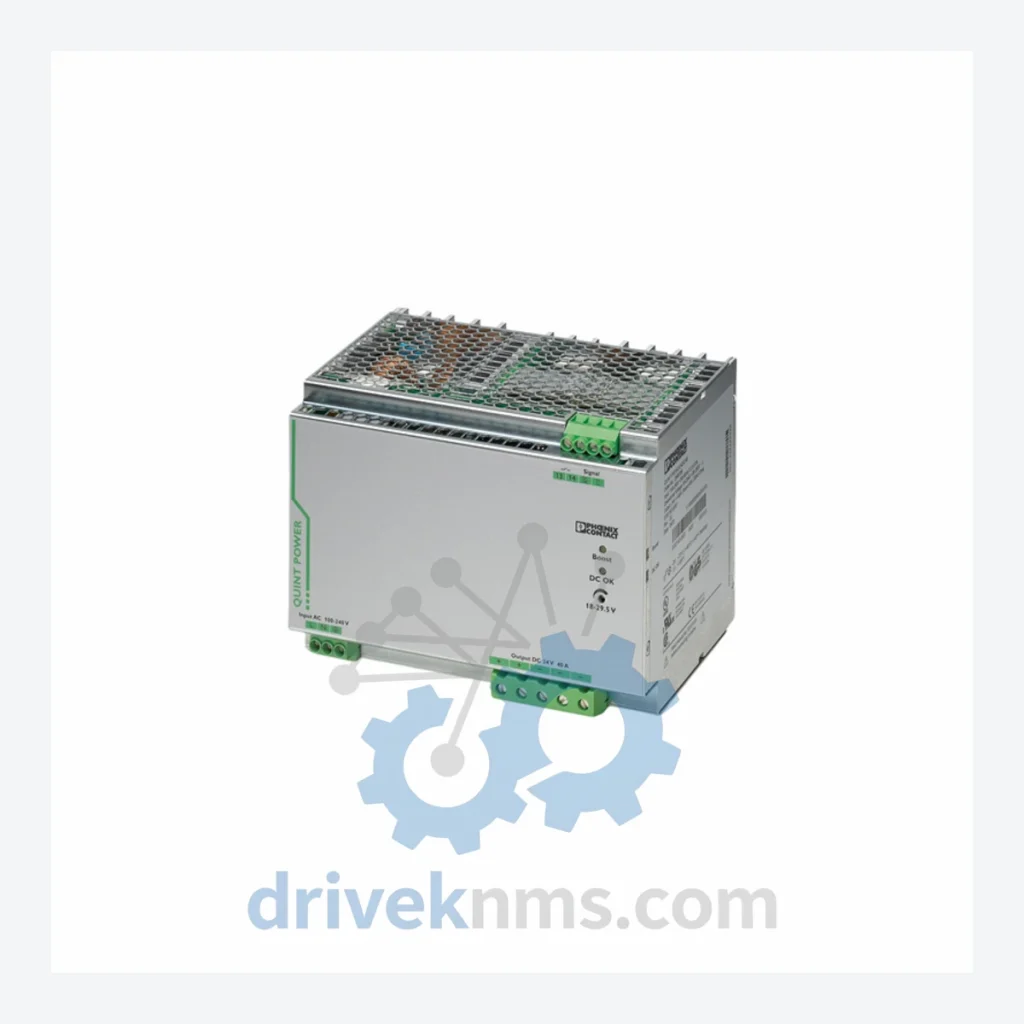
Phoenix Contact QUINT-PS/1AC/24DC/40 Power Supply – Obsolete QUINT POWER Spare Part
When a QUINT-PS/1AC/24DC/40 fails in a running production line, the consequences extend far beyond the cost of the component itself. A forced migration to a modern power supply architecture — with incompatible form factors, different diagnostic interfaces, and requalification requirements — can trigger engineering costs, PLC reprogramming, panel redesign, and weeks of unplanned downtime. For facilities running legacy 24 VDC control architectures, the true cost of a single failed power supply can reach six figures. DriveKNMS maintains verified stock of this discontinued unit specifically to prevent that outcome.
Technical Specifications
| Parameter | Value |
| Manufacturer | Phoenix Contact |
| Part Number | QUINT-PS/1AC/24DC/40 |
| Series | QUINT POWER |
| Input Voltage | 100–240 VAC (1-phase) |
| Output Voltage | 24 VDC |
| Output Current | 40 A |
| Output Power | 960 W |
| Country of Origin | Germany |
| Product Status | Discontinued / Obsolete |
| Typical System Compatibility | Legacy 24 VDC control panels, Siemens S5/S7 auxiliary power, Rockwell ControlLogix distributed I/O racks, Beckhoff CX series bus terminals |
Solving the Discontinued Hardware Crisis
The QUINT-PS/1AC/24DC/40 was a cornerstone power supply in industrial control panels built throughout the 2000s and early 2010s. Its SFB (Selective Fuse Breaking) technology and active current limiting made it the preferred choice for powering 24 VDC bus systems in demanding environments — from automotive body shops to chemical processing facilities.
Phoenix Contact has since transitioned to the QUINT4 and TRIO POWER product lines. While these successors offer improved diagnostics and communication capabilities, they are not dimensionally or electrically identical to the original QUINT series. Retrofitting a modern unit into a panel designed around the QUINT-PS/1AC/24DC/40 requires DIN rail space recalculation, potential rewiring of the DC OK relay output, and in some cases, reconfiguration of downstream load monitoring logic.
For plant managers operating equipment with a remaining service life of 5–10 years, the calculus is straightforward: sourcing a verified replacement unit at a fraction of the retrofit cost preserves capital, avoids production disruption, and defers a system-wide upgrade to a planned maintenance window rather than a crisis response. A single unit in strategic spare inventory can protect an asset worth hundreds of thousands of dollars.
How to extend your automation asset life by 5–10 years with critical spare parts:
- Audit your single points of failure. Power supplies are among the highest-failure-rate components in any control panel. Identify every QUINT-PS unit in your facility and cross-reference against available stock before the supply window closes permanently.
- Maintain a 1:5 spare ratio. For facilities with five or more units of the same model in service, holding at least one verified spare eliminates the risk of a production halt while sourcing a replacement under pressure.
- Document firmware and hardware revisions. Legacy QUINT units shipped across multiple hardware revisions. Ensure your spare matches the revision installed in your panel to avoid compatibility issues with existing DC OK relay wiring.
- Store in controlled conditions. Electrolytic capacitors in power supplies degrade in high-humidity or high-temperature storage. Proper storage in anti-static packaging at 15–25°C preserves shelf life for 7–10 years.
- Schedule proactive replacement. Rather than waiting for failure, replace aging QUINT units during planned shutdowns and retain the removed unit as a tested backup — extending your effective spare inventory at zero additional cost.
Condition & Reliability Assurance
Sourcing obsolete power supplies from the secondary market carries real risk. DriveKNMS applies a 5-step QA protocol to every QUINT-PS/1AC/24DC/40 unit before shipment:
- Electrolytic Capacitor Inspection: Capacitors are the primary failure mode in aged power supplies. Each unit is inspected for bulging, leakage, and ESR degradation. Units with suspect capacitors are recapped with equivalent-spec components before release.
- Firmware & Hardware Revision Verification: The hardware revision label is documented and cross-referenced against the original Phoenix Contact production records to confirm authenticity and revision consistency.
- Pin and Terminal Corrosion Check: All input/output terminals and DC OK relay contacts are inspected under magnification for oxidation, pitting, or mechanical damage. Corroded terminals are cleaned or the unit is rejected.
- Full Load Burn-In Test: Each unit is powered at rated load for a minimum burn-in period to screen for latent failures before shipment.
- Packaging Integrity: Units are shipped in anti-static foam-lined packaging with desiccant to prevent moisture ingress during transit.
Key Features for System Maintenance
- Drop-in replacement: Identical form factor and terminal layout to the original installed unit — no panel modification required.
- No reprogramming required: The DC OK relay output and SFB current limiting behavior are hardware-defined. Replacing the unit does not require any PLC or HMI configuration changes.
- Avoids engineering redesign costs: A direct replacement eliminates the need for a panel engineer to redesign the power distribution section, saving days of billable engineering time.
- Preserves system certification: In regulated industries (food & beverage, pharmaceutical, oil & gas), replacing a like-for-like component avoids triggering a full system revalidation that a design change would require.
FAQ
Q: What warranty applies to an obsolete unit?
A: DriveKNMS provides a 90-day warranty covering functional defects identified after installation. Units that fail within the warranty period are replaced or refunded. Extended warranty arrangements are available for volume orders — contact us to discuss.
Q: How do I know the unit is genuine and not counterfeit?
A: Every unit is inspected for Phoenix Contact OEM markings, label consistency, and PCB construction. We do not source from unverified brokers. Units with any indication of remarking or counterfeit construction are rejected and destroyed.
Q: Should I buy more than one unit?
A: For any facility with this model in active service, holding at least one spare is a minimum prudent position. Given that Phoenix Contact no longer manufactures this unit, secondary market availability will continue to decline. Facilities with multiple units in service should consider securing two to three spares now while verified stock remains available.
Q: What is the lead time?
A: In-stock units ship within 3–5 business days. Contact us to confirm current availability before placing an order.