
Honeywell XC Series Modules | XC5010C CPU Module
Honeywell XC Series: Comprehensive Module Range and Technical Overview The Honeywell XC Series represents a core control platform deployed across…
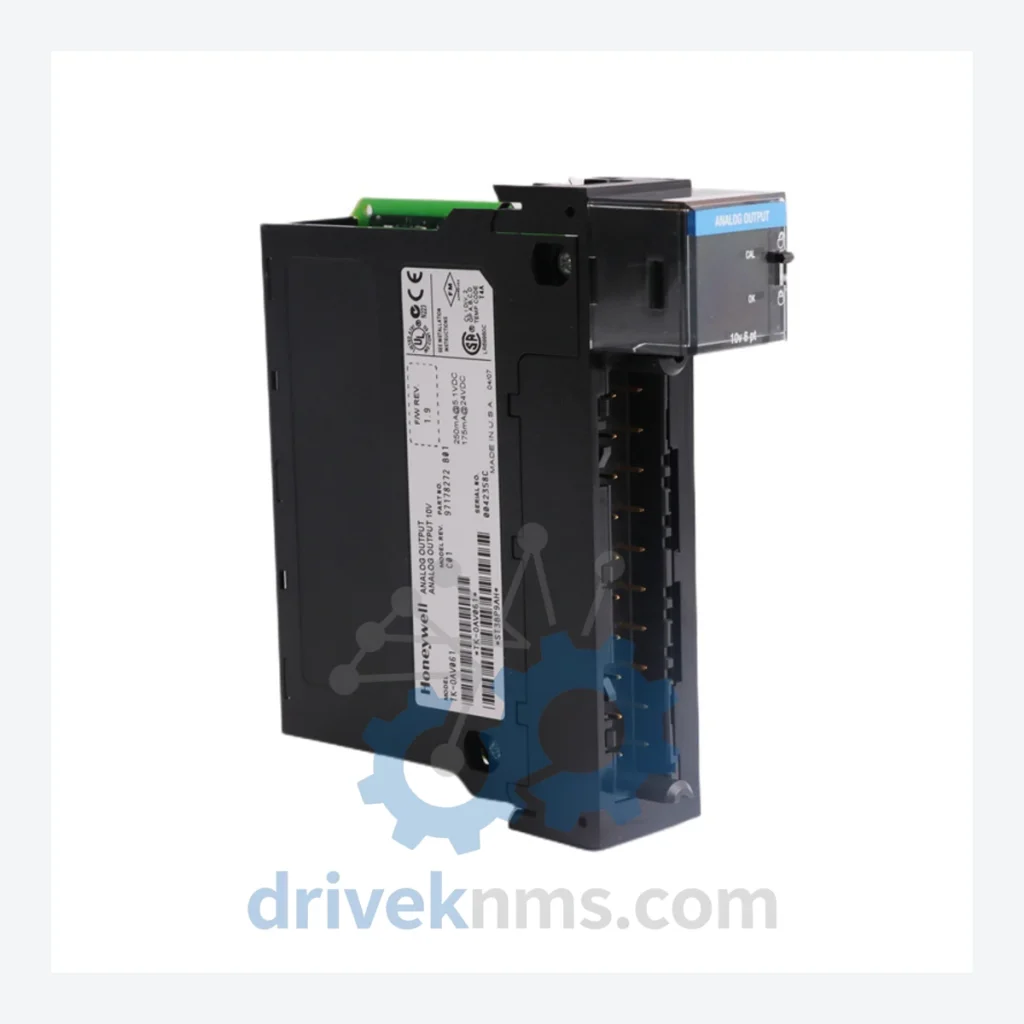
Model: TK-OAV061
Product Overview
Commercial availability is handled through direct RFQ, model verification and export-oriented follow-up rather than public cart checkout.
Datasheet Preview
Use attached product manuals when available. If the manual is not public yet, request the full file directly through RFQ.
Commercial Path
Product pages on DRIVEKNMS are designed to verify model, brand and series first, then move the buyer into one clean quotation path.
Technical Dossier
When a single analog output module fails inside a Honeywell TDC 3000 or TPS distributed control system, the consequences extend far beyond a line stoppage. A forced migration to a modern DCS platform — including engineering redesign, I/O rewiring, operator retraining, and production downtime — routinely costs manufacturing facilities between $500,000 and $3,000,000 USD per affected unit. The TK-OAV061 is no longer manufactured. Sourcing a verified replacement from the secondary market is not a workaround; it is the only financially rational path for facilities committed to protecting their existing automation investment.
DriveKNMS maintains a limited inventory of the Honeywell TK-OAV061. Once this stock is depleted, lead times from alternative channels are unpredictable.
| Parameter | Detail |
|---|---|
| Part Number | TK-OAV061 |
| Manufacturer | Honeywell |
| Module Type | Analog Output Module |
| Compatible Platform | Honeywell TDC 3000 / TPS (Total Plant Solution) |
| Country of Origin | United States |
| Production Status | Discontinued / Obsolete – No longer manufactured by Honeywell |
| Condition Available | New surplus / Refurbished (tested) |
Note: Electrical parameters such as output range, channel count, and bus interface are not published here to avoid inaccurate specifications. Please contact us with your system documentation for confirmation prior to ordering.
The Honeywell TDC 3000 and TPS platforms were the backbone of process control in refining, petrochemical, power generation, and pharmaceutical manufacturing for decades. Many of these systems remain in active service today — not because operators are unaware of their age, but because the cost and risk of replacement outweigh any operational benefit in the near term.
The TK-OAV061 analog output module sits at a critical junction in these architectures. It translates digital control commands from the High-Performance Process Manager (HPM) or Application Module into 4–20 mA field signals that drive control valves, variable speed drives, and other final control elements. There is no software patch, no firmware update, and no configuration change that compensates for a failed output module. The hardware must be replaced — with an identical or fully compatible unit.
Facilities that have not pre-positioned spare TK-OAV061 modules face a binary choice when failure occurs: accept unplanned downtime while sourcing a replacement through uncertain channels, or accelerate a capital project that was not budgeted for the current fiscal year. Neither outcome is acceptable to plant management under production pressure.
The professional approach is to treat critical obsolete modules as insured assets. A single spare unit held in a climate-controlled store room represents a fraction of one hour of lost production at most process facilities. The return on that investment, measured against avoided downtime, is not a matter of debate.
For plant managers and reliability engineers operating legacy Honeywell TDC or TPS systems, the following framework has been applied successfully at facilities across the refining, chemical, and power sectors to defer system retirement by a full decade or more:
1. Conduct a Critical Spares Audit. Map every module type in your TDC/TPS cabinets against current secondary market availability. Modules with fewer than three known sources globally should be classified as critical. The TK-OAV061 falls into this category.
2. Establish a Minimum Stock Level. For each critical module, calculate the mean time between failures based on your installed base and operating history. Hold a minimum of two units per system. For large installations with multiple HPM cabinets, scale accordingly.
3. Implement Condition-Based Monitoring. Legacy analog output modules degrade before they fail. Periodic loop calibration checks and output accuracy verification can identify modules approaching end of life before an unplanned trip occurs. This extends the useful service life of installed modules and provides lead time for sourcing replacements.
4. Negotiate Long-Term Supply Agreements. Reputable obsolete parts distributors with verified inventory can provide multi-year supply commitments for critical modules. This removes sourcing uncertainty from your maintenance planning horizon.
5. Document Firmware and Configuration Baselines. For modules that carry firmware or configuration data, maintain verified backups. A replacement module that cannot be correctly configured is not a spare — it is a delay. Ensure your engineering team has documented restoration procedures for every critical module type.
Applied consistently, this framework allows facilities to operate legacy Honeywell TDC and TPS systems reliably through their intended economic life — and beyond — without committing to premature capital expenditure on system replacement.
Every TK-OAV061 unit shipped by DriveKNMS passes a structured 5-step quality process before dispatch:
Step 1 – Visual and Physical Inspection: All connectors, backplane pins, and PCB surfaces are examined for corrosion, mechanical damage, and pin deformation. Units with compromised contacts are rejected.
Step 2 – Electrolytic Capacitor Assessment: Aging electrolytic capacitors are the primary failure mode in modules of this generation. Each unit is assessed for capacitor condition. Units showing evidence of electrolyte leakage or bulging are not shipped.
Step 3 – Firmware Version Verification: Where applicable, firmware revision is confirmed and documented. Customers are advised of the firmware version prior to shipment to ensure compatibility with their system configuration.
Step 4 – Functional Bench Test: Modules are powered and tested for basic operational response. Output channel integrity is verified where test equipment permits.
Step 5 – Packaging and ESD Protection: Units are packed in anti-static bags with appropriate cushioning. Shipping conditions are selected to prevent transit damage to sensitive components.
The TK-OAV061 is a direct drop-in replacement for the original installed module. No hardware modifications, no I/O rewiring, and no reprogramming of the control strategy are required. The module seats into the existing backplane and resumes operation under the existing configuration — eliminating the engineering hours and production risk associated with any alternative approach.
For facilities under pressure to justify continued operation of legacy systems to corporate asset management, this characteristic is significant. A like-for-like replacement demonstrates that the system can be maintained without engineering intervention, which supports the business case for deferring capital replacement expenditure.
Q: What warranty applies to obsolete parts?
A: DriveKNMS provides a 90-day warranty on all tested and refurbished units, covering functional failure under normal operating conditions. New surplus units carry a 180-day warranty. Warranty terms are confirmed in writing prior to order.
Q: How do I know the unit is genuine and not counterfeit?
A: All units are sourced from documented industrial decommissioning projects or authorized surplus channels. Physical markings, label formats, and PCB characteristics are verified against known-good references. We do not source from unverified brokers.
Q: Should I buy more than one unit?
A: For any facility with an active TDC 3000 or TPS installation, holding a minimum of two TK-OAV061 spares is a defensible maintenance position. The cost of a second unit is negligible relative to the cost of a single unplanned production stoppage. We recommend discussing your installed base size with our team so we can advise on an appropriate stock level.
Q: Can you source additional units if I need more than you have in stock?
A: We maintain active sourcing relationships across the global industrial surplus market. Contact us with your quantity requirement and timeline, and we will advise on availability.
Related Paths
Honeywell XC Series: Comprehensive Module Range and Technical Overview The Honeywell XC Series represents a core control platform deployed across…
Honeywell MP-DNCF02-200 Single-Phase Power Controller – Obsolete Limitrol Series Spare Part When a single-phase power controller fails inside a legacy…
Honeywell XDL Series: Comprehensive Module Range and Technical Overview The Honeywell XDL series is a core component family within the…