Technical Dossier
Product Details And Specifications
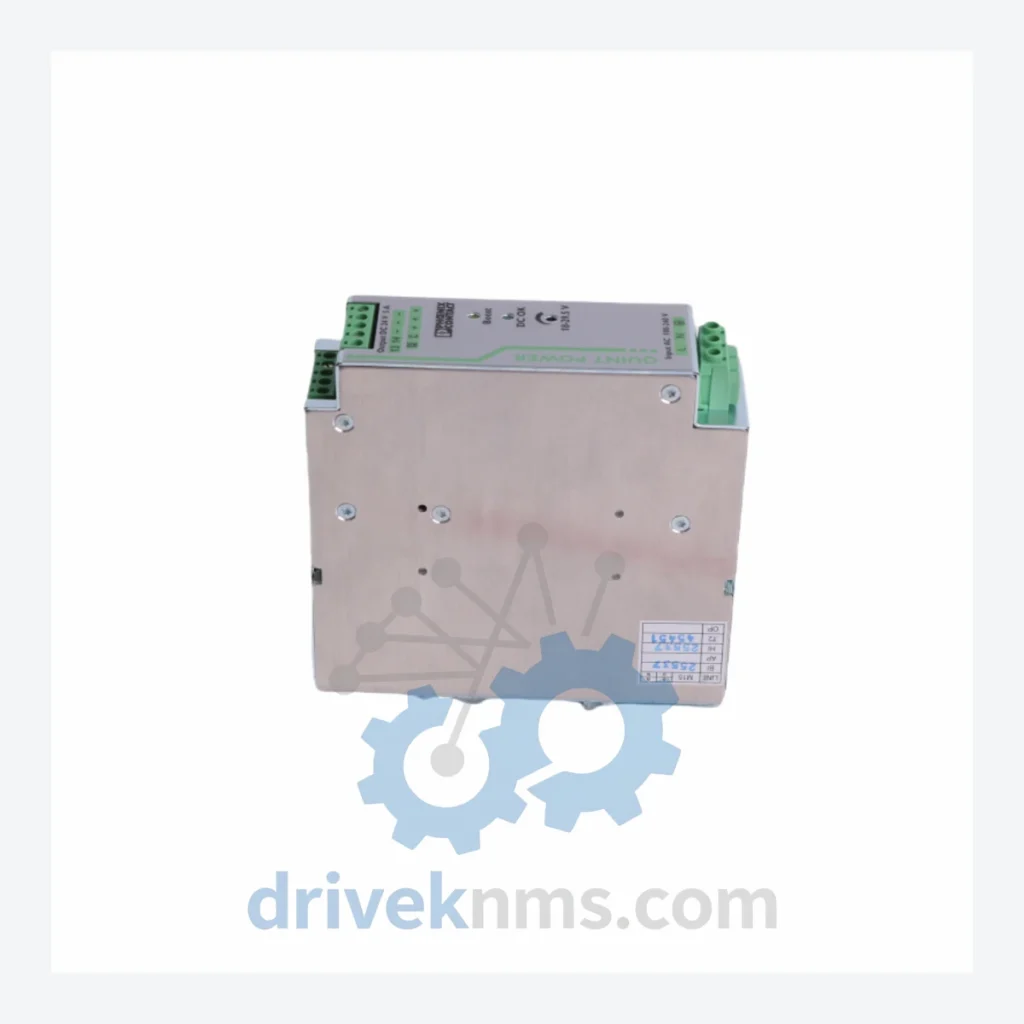
Phoenix Contact QUINT-PS/1AC/24DC/5 Power Supply – Obsolete QUINT Spare Part
When a QUINT-PS/1AC/24DC/5 fails on the production floor, the instinct is to call the OEM — only to be told the part is discontinued. What follows is a familiar but costly sequence: emergency engineering assessments, compatibility studies for a replacement platform, new cabinet layouts, updated wiring diagrams, and a revalidation cycle that can stretch months. For a single power supply module, the downstream cost of a forced system upgrade routinely reaches six figures. DriveKNMS maintains verified stock of the QUINT-PS/1AC/24DC/5 specifically to interrupt that sequence before it starts.
Technical Specifications
| Parameter | Value |
| Manufacturer | Phoenix Contact |
| Part Number | QUINT-PS/1AC/24DC/5 |
| Series | QUINT (Legacy / Discontinued) |
| Output Voltage | 24 VDC (adjustable) |
| Output Current | 5 A |
| Output Power | 120 W |
| Input Voltage | 85–264 VAC (single-phase) |
| Input Frequency | 45–65 Hz |
| Mounting | DIN rail (EN 60715 TH35) |
| Country of Origin | Germany |
| Discontinuation Status | Superseded by QUINT4 series; original QUINT line no longer in production |
| Successor Model | QUINT4-PS/1AC/24DC/5 (not a drop-in replacement without engineering review) |
Solving the Discontinued Hardware Crisis
The QUINT-PS/1AC/24DC/5 was a cornerstone module in distributed control and automation architectures built between the late 1990s and mid-2010s. It is commonly found powering 24 VDC field bus segments, I/O marshalling panels, and sensor loops in systems built around platforms such as Siemens S7-300/400, Allen-Bradley SLC 500, and Modicon Quantum — installations where the control philosophy, field wiring, and cabinet geometry were engineered around this exact form factor and signaling behavior.
Phoenix Contact's QUINT4 successor introduced a different housing width, revised diagnostic signaling, and altered SFB (Static Boost) characteristics. In practice, substituting a QUINT4 into an existing QUINT slot is not a straightforward swap: it requires cabinet modification, updated documentation, and in regulated industries, a formal change-control record. For a plant running 24-hour operations, that engineering window is expensive and operationally disruptive.
Holding verified spare stock of the original QUINT-PS/1AC/24DC/5 eliminates that engineering burden entirely. A failed unit is replaced in minutes, not months. The production line resumes. The upgrade decision — if it ever needs to be made — happens on the plant's schedule, not the OEM's.
Condition & Reliability Assurance
Obsolete power supply modules present specific failure risks that differ from current-production units. Our 5-step QA protocol addresses the failure modes most common in aged QUINT-series hardware:
- Electrolytic Capacitor Assessment: Primary and secondary bulk capacitors are inspected for ESR drift and physical deformation. Units showing capacitor degradation are quarantined.
- Firmware & Revision Verification: Hardware revision markings are cross-referenced against Phoenix Contact's internal revision history to confirm the unit matches the specified part number without undisclosed engineering changes.
- Pin and Terminal Inspection: All input/output terminals and DIN rail contacts are examined under magnification for oxidation, corrosion, and mechanical deformation. Affected contacts are treated or the unit is rejected.
- Functional Load Test: Each unit is bench-tested under rated load (5 A / 24 VDC) to verify output regulation, SFB activation, and signaling relay function.
- Packaging for Long-Term Storage: Units destined for spare inventory are packaged in anti-static, moisture-barrier materials with desiccant, suitable for warehouse storage of 2–5 years without re-inspection.
Key Features for System Maintenance
- Drop-in replacement: Identical mechanical footprint and terminal layout to the original installed unit — no cabinet modification required.
- No reprogramming required: The QUINT-PS/1AC/24DC/5 carries no user-configurable firmware. Replacement requires only physical installation and terminal reconnection.
- Avoids engineering change orders: Using the original part number preserves existing documentation, P&IDs, and maintenance records without triggering a formal design change.
- Extends asset life by 5–10 years: A single verified spare can defer a full panel upgrade cycle. For a 20-cabinet automation line, the cost avoidance of maintaining a 2–3 unit spare buffer versus executing a platform migration is typically measured in hundreds of thousands of dollars.
- Supports regulated-industry compliance: Replacing like-for-like avoids the revalidation burden imposed by IQ/OQ/PQ protocols in pharmaceutical, food processing, and other regulated manufacturing environments.
Extending Automation Asset Life: A Maintenance Strategy for Plant Management
The economic case for legacy spare parts procurement is straightforward but frequently underestimated at the budget level. Consider a production line with a replacement value of USD 3–8 million, built on a control platform that is 15 years old. The OEM has discontinued key modules. The options are: (1) execute a full migration to a current platform, or (2) maintain a curated spare parts buffer that covers the statistically highest-failure components for the next 5–10 years.
Option 2 consistently delivers lower total cost of ownership when the following conditions apply: the process is stable and not requiring functional expansion; the engineering team is familiar with the existing platform; and the cost of production downtime during a migration outweighs the cost of spare parts procurement. For most continuous-process industries — chemicals, pulp and paper, metals, food and beverage — these conditions are the norm, not the exception.
A structured obsolescence management program typically includes: identifying the 10–15 highest-criticality modules in the installed base; sourcing 2–3 units of each from verified distributors; establishing a re-inspection schedule (typically every 3 years for stored electronic components); and documenting the spare inventory within the plant's CMMS. The QUINT-PS/1AC/24DC/5 belongs on that list for any facility where it is installed.
FAQ
What warranty applies to obsolete parts?
We offer a 90-day functional warranty on all units that pass our QA protocol. The warranty covers failure under normal operating conditions and excludes damage from incorrect installation or electrical overstress.
How do I know the unit is genuine and not counterfeit?
All units are sourced through documented supply chains. Physical markings, label typography, and PCB construction are verified against known-good reference units. We do not sell units that fail authentication checks.
Should I buy more than one unit?
For critical applications, yes. Lead times on obsolete parts are unpredictable by definition. A second unit held in on-site storage costs a fraction of one hour of unplanned downtime on most production lines. We can discuss volume pricing for multi-unit orders.
Can you source other QUINT-series modules?
Yes. Contact us with your full part number list. We maintain relationships with multiple verified sources for Phoenix Contact legacy hardware.