Technical Dossier
Product Details And Specifications
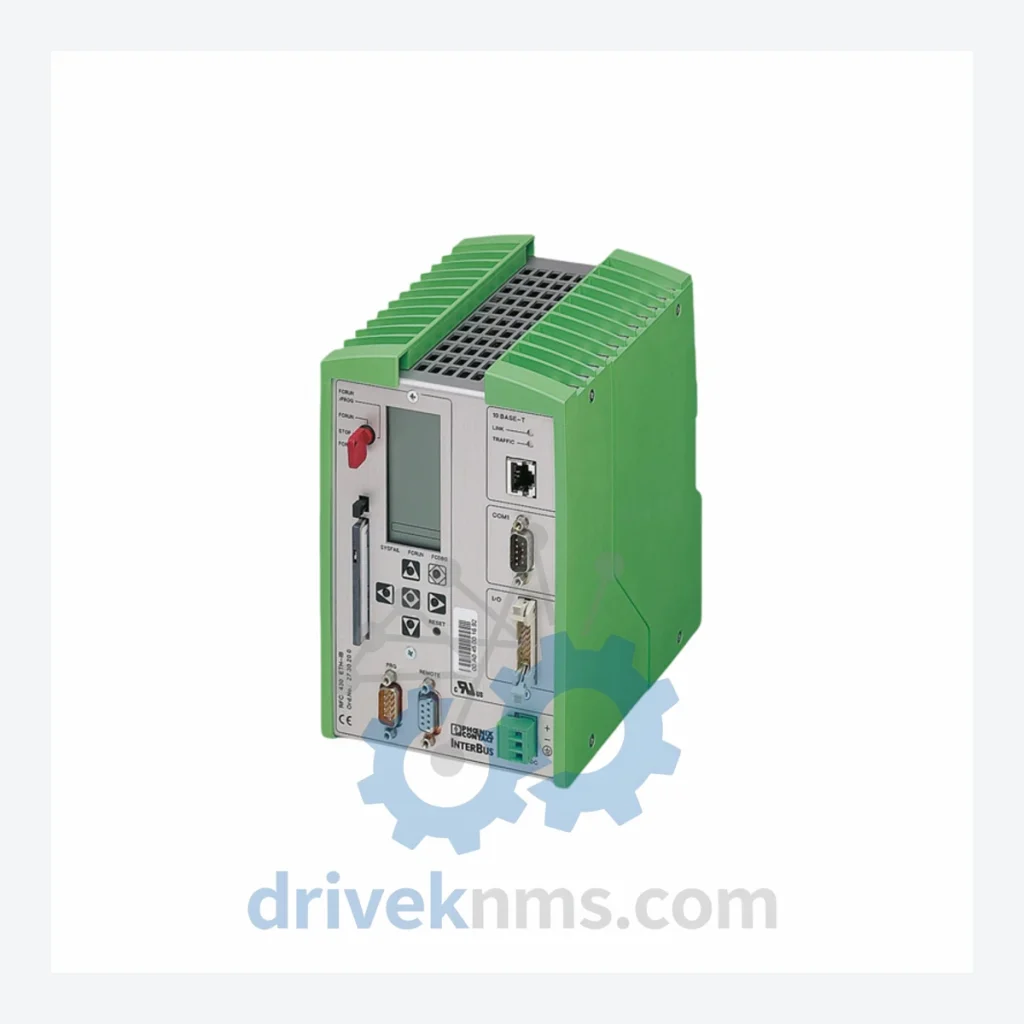
Phoenix Contact RFC 430 ETH-IB 2730190 Remote Field Controller – Obsolete ILC/RFC Series Spare Part
When the RFC 430 ETH-IB fails in a production environment, the consequences extend far beyond a single module replacement. This controller sits at the communication backbone of InterBus-based automation architectures. A forced migration away from an InterBus topology — driven solely by the unavailability of one discontinued controller — routinely triggers engineering redesign costs, new PLC licensing, field rewiring, and weeks of system revalidation. Conservative estimates place such unplanned upgrades in the range of several hundred thousand to over one million USD per production line, depending on system complexity. DriveKNMS maintains verified stock of the RFC 430 ETH-IB 2730190 specifically to prevent that scenario.
Technical Specifications
| Manufacturer | Phoenix Contact |
| Part Number | RFC 430 ETH-IB / 2730190 |
| Product Series | ILC/RFC Series |
| Function | InterBus Remote Field Controller with Ethernet interface |
| Fieldbus Protocol | InterBus (IBS) |
| Communication Interface | Ethernet (10/100 Mbps) |
| Country of Origin | Germany |
| Product Status | Discontinued / Obsolete – No longer manufactured by Phoenix Contact |
| Typical System Compatibility | Phoenix Contact InterBus master/slave topologies; compatible with IBS-based control architectures from the late 1990s through mid-2000s |
Note: Electrical parameters not listed here are not confirmed from verified datasheets. DriveKNMS does not publish unverified specifications. Contact us for detailed technical documentation.
Solving the Discontinued Hardware Crisis
The RFC 430 ETH-IB was designed to serve as the Ethernet-connected master controller within Phoenix Contact's InterBus remote I/O networks. In facilities where InterBus was the dominant fieldbus standard through the 2000s, this controller is not a peripheral component — it is the communication hub that every downstream I/O node depends on.
Phoenix Contact has long since transitioned its product portfolio toward newer fieldbus and Industrial Ethernet standards. The RFC 430 ETH-IB is no longer manufactured, and authorized distribution channels have been exhausted for years. For plant managers operating legacy InterBus systems, this creates a specific and serious risk: a single controller failure with no replacement available forces a system-wide fieldbus migration that was never budgeted, never planned, and cannot be executed without extended downtime.
Facilities running InterBus topologies with this controller typically include automotive body shop automation, packaging line control, and discrete manufacturing cells built during the 2000s capital investment cycle. These systems were engineered for 20–30 year service lives. The control hardware was never intended to be the limiting factor.
Holding one or two verified RFC 430 ETH-IB units as cold spares is the lowest-cost insurance policy available against an unplanned migration. The cost of a spare controller is a fraction of a single day of unplanned downtime on a modern production line.
Extending Automation Asset Life by 5–10 Years: A Maintenance Strategy for Plant Management
For operations management facing pressure to defer capital expenditure on control system upgrades, a structured spare parts strategy built around critical discontinued components can realistically extend the productive life of an InterBus-based system by five to ten years. The following approach applies directly to systems dependent on the RFC 430 ETH-IB:
1. Identify single points of failure. The RFC 430 ETH-IB is a non-redundant controller in most installations. If it fails, the entire InterBus segment it manages goes offline. Treat it as a Tier-1 critical spare — the same category as your main PLC CPU.
2. Secure verified stock before the market dries up. Secondary market availability for discontinued Phoenix Contact RFC-series controllers narrows every year. Units that exist in the market today may not be available in 18 months. Procurement decisions deferred are options permanently lost.
3. Maintain firmware version records. InterBus systems are sensitive to firmware mismatches between the RFC controller and connected I/O modules. Document the current firmware version running in your installed unit. When sourcing a replacement, verify the firmware version of the spare matches or is compatible with your existing configuration.
4. Implement a scheduled inspection cycle. Even in storage, electronic components age. Electrolytic capacitors in controllers from this era have a finite shelf life. A spare unit should be powered up and functionally tested annually to confirm it remains operational.
5. Negotiate a controlled migration timeline on your terms. With verified spares in hand, your engineering team can plan a fieldbus migration during a scheduled capital cycle — not under emergency conditions. The difference in project cost and execution quality between a planned and an emergency migration is substantial.
Condition & Reliability Assurance
DriveKNMS applies a structured five-step quality process to all discontinued industrial controllers before they are offered for sale:
Step 1 – Visual and mechanical inspection: Full external examination for physical damage, connector pin condition, and housing integrity. Units with bent or corroded pins are rejected at this stage.
Step 2 – Electrolytic capacitor assessment: Controllers from this production era are susceptible to capacitor degradation. We inspect for visible bulging, leakage, and where possible, perform ESR testing on critical capacitors.
Step 3 – Firmware version verification: The firmware version is read and documented. This information is provided to the buyer to confirm compatibility with their installed system before shipment.
Step 4 – Functional power-on test: The unit is powered and tested for normal initialization and communication response where test infrastructure permits.
Step 5 – Anti-static packaging and documentation: Units are packed in ESD-safe materials with full condition and firmware documentation included.
Units are offered as New Old Stock (NOS) where applicable, or as Tested & Refurbished with full disclosure of condition grade.
Key Features for System Maintenance
The RFC 430 ETH-IB 2730190 is a direct hardware replacement for the same part number in any existing installation. There is no hardware redesign required. Key maintenance advantages include:
- Drop-in replacement: Same form factor, same connector pinout, same mounting footprint as the original installed unit.
- No reprogramming of field devices: InterBus I/O modules and remote bus terminals retain their configuration. Only the controller-level configuration needs to be restored from backup.
- No fieldbus rewiring: The existing InterBus cable infrastructure remains fully intact.
- Avoids engineering redesign costs: A forced migration to a modern fieldbus standard requires new I/O hardware, new cabling, updated PLC programs, and full system revalidation — none of which is necessary when a verified spare controller is available.
- Preserves existing operator familiarity: Production staff and maintenance technicians continue working with a system they know. There is no retraining cost.
FAQ
Q: What warranty applies to a discontinued part like the RFC 430 ETH-IB?
A: DriveKNMS provides a 90-day warranty covering functional defects on all tested and refurbished units. New Old Stock units are offered with a 30-day DOA (Dead on Arrival) guarantee. Warranty terms are confirmed in writing prior to purchase.
Q: How do I know the unit is genuine and not a counterfeit?
A: All units sourced by DriveKNMS are inspected for manufacturer markings, label authenticity, and PCB construction consistency. We do not source from unverified channels. Buyers may request pre-shipment photos and documentation.
Q: Should I buy more than one unit?
A: For any production-critical system with no modern equivalent, holding a minimum of two spare units is standard practice. One unit covers an immediate failure; the second provides coverage during the lead time required to source a replacement after the first spare is consumed. Given the narrowing secondary market for RFC-series controllers, purchasing additional units now is a lower-risk position than relying on future availability.
Q: Can you source other Phoenix Contact RFC-series or InterBus components?
A: Yes. DriveKNMS specializes in hard-to-find and discontinued industrial automation components. Contact us with your full bill of materials for legacy system spares.
© 2026 DriveKNMS. (Status: DRAFT)