Technical Dossier
Product Details And Specifications
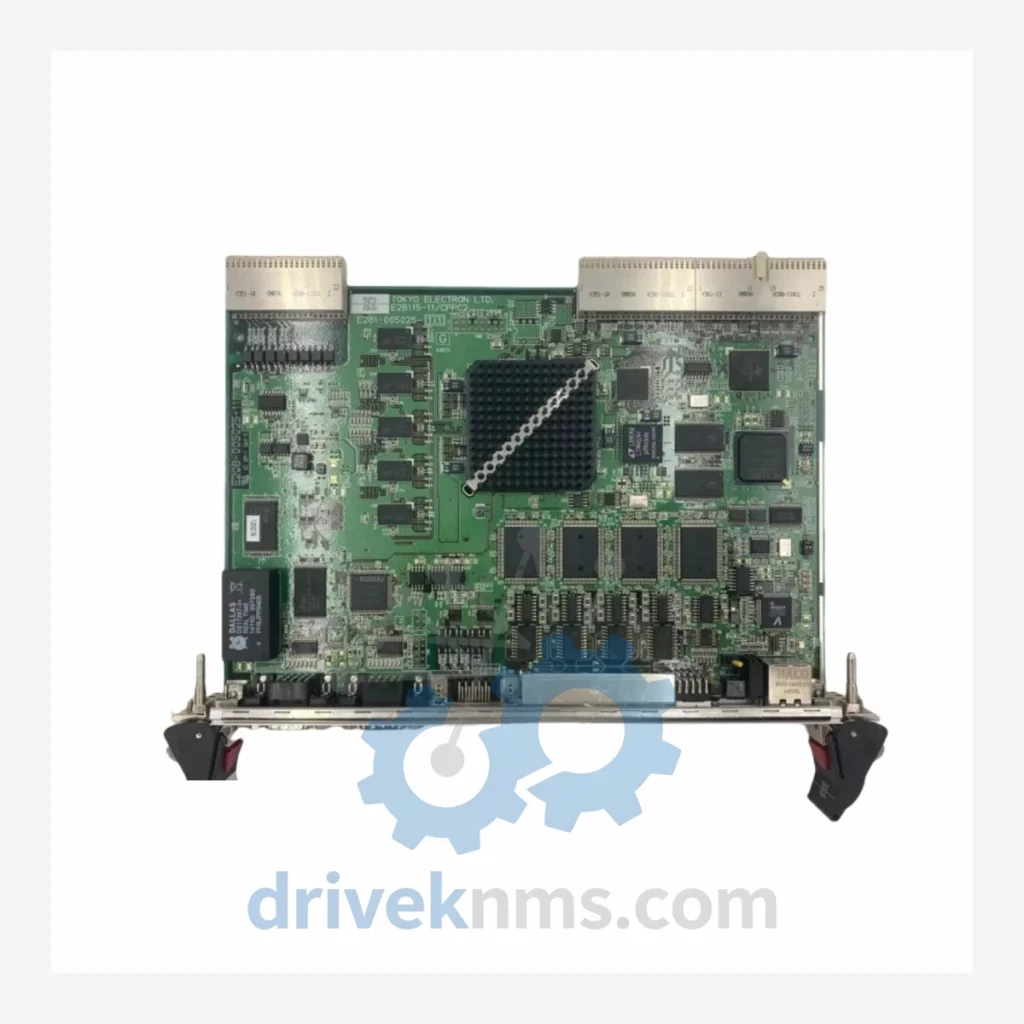
TOKYO E2B115-11/CPPC2 E281-005025-11 E208-005025-11 Telephone Control Panel – Obsolete TOKYO Series Spare Part
When a telephone control panel module fails inside an aging automation or building management system, the consequences extend far beyond a single component replacement. For facilities still operating legacy TOKYO-series control infrastructure, the failure of a unit such as the E2B115-11/CPPC2 — combined with its associated modules E281-005025-11 and E208-005025-11 — can trigger a forced system-wide migration. Engineering assessments, new controller procurement, panel rewiring, software reconfiguration, operator retraining, and production downtime during cutover routinely push total upgrade costs into the hundreds of thousands of dollars, and in complex multi-site installations, into the millions. DriveKNMS maintains verified physical stock of this discontinued assembly. Securing a replacement unit now is not a purchasing decision — it is an asset protection decision.
Technical Specifications
| Parameter | Detail |
| Brand | TOKYO |
| Part Number / SKU | E2B115-11/CPPC2 E281-005025-11 E208-005025-11 |
| Product Category | Telephone Control Panel Module |
| Series | TOKYO CPPC2 Series |
| Country of Origin | Japan |
| Discontinuation Status | Discontinued / Obsolete – No longer in active production |
| Condition Available | New Old Stock (NOS) / Professionally Refurbished |
| Compatibility | TOKYO legacy telephone control and building automation systems utilizing CPPC2 architecture |
Note: Electrical parameters specific to this assembly are not published here to prevent misapplication. Contact our technical team for verified datasheet confirmation prior to installation.
Solving the Discontinued Hardware Crisis
The TOKYO E2B115-11/CPPC2 assembly was designed as a core communication and control interface within TOKYO's legacy panel architecture. Systems built around this platform — particularly those installed in the 1990s through early 2000s — were engineered for decade-long operational cycles. Many remain in active service today precisely because the cost and disruption of replacing them outweighs any incremental efficiency gain from modern alternatives.
The problem is structural: TOKYO ceased production of this module series, and authorized distribution channels have been dry for years. When a unit fails, facility managers face a binary choice — locate a verified replacement from the secondary market, or commit to a full system overhaul. The overhaul path is rarely as straightforward as vendors suggest. Integration with existing field wiring, sensor networks, and operator interfaces introduces engineering complexity that compounds cost at every stage.
Sourcing a direct drop-in replacement from DriveKNMS eliminates that forced decision. The system continues operating. The capital expenditure is deferred. The production schedule is protected.
For plant managers and maintenance engineers responsible for facilities running TOKYO CPPC2-based control panels, maintaining a buffer stock of critical modules — including the E2B115-11/CPPC2, E281-005025-11, and E208-005025-11 — is the lowest-cost strategy available for extending asset service life by 5 to 10 years. The logic is straightforward: a single unplanned failure that forces emergency sourcing or system replacement costs orders of magnitude more than pre-positioning verified spare units. Facilities that have adopted a structured obsolete-parts inventory strategy consistently report deferred capital expenditure cycles and reduced unplanned downtime. This is not a theoretical benefit — it is a documented maintenance economics outcome across industrial and commercial building sectors.
Condition & Reliability Assurance
Every unit sourced through DriveKNMS undergoes a structured 5-step quality verification process before dispatch. This protocol is specifically designed for obsolete and aged components where standard shelf life assumptions do not apply.
Step 1 – Visual and Physical Inspection: Full external examination for mechanical damage, pin deformation, connector wear, and housing integrity.
Step 2 – Electrolytic Capacitor Assessment: Aged electrolytic capacitors are a primary failure mode in legacy electronics. Each unit is inspected for capacitor bulging, leakage, and ESR deviation. Units with degraded capacitors are either recapped with specification-matched components or rejected.
Step 3 – Pin and Contact Corrosion Check: All connector pins and PCB contact points are examined under magnification. Oxidation is treated; units with structural corrosion are excluded from inventory.
Step 4 – Firmware and Configuration Verification: Where applicable, firmware version is confirmed against known compatible releases for TOKYO CPPC2 systems. No unauthorized firmware modifications are present.
Step 5 – Functional Bench Test: Units are powered and tested for basic operational response prior to packaging. Test records are retained.
Units that do not pass all five stages are not offered for sale. Condition grade (New Old Stock or Professionally Refurbished) is disclosed at point of inquiry.
Key Features for System Maintenance
The E2B115-11/CPPC2 assembly is a direct hardware replacement for the original installed unit. No panel rewiring is required. No PLC reprogramming is necessary. No engineering reconfiguration of the host system is involved. The unit installs into the existing slot, connects to existing wiring, and resumes the function of the failed module.
This drop-in replacement characteristic is the defining maintenance advantage of sourcing original-specification obsolete parts versus pursuing system modernization. Modernization projects introduce new failure modes, require operator retraining, and carry integration risk that is difficult to quantify in advance. A verified original-specification replacement carries none of those risks. The system behavior after replacement is identical to pre-failure operation — which is precisely what maintenance teams and production schedulers require.
FAQ
Q: What warranty applies to discontinued parts?
A: DriveKNMS provides a 90-day warranty covering functional defects on all refurbished units. New Old Stock units carry a 180-day warranty. Warranty terms are confirmed in writing at point of sale.
Q: How do I confirm the unit is genuine and not counterfeit?
A: All units are sourced through verified secondary market channels. Physical markings, PCB revision codes, and component dating are cross-referenced against known authentic production records. We do not source from unverified brokers. Inspection documentation is available upon request.
Q: Should I purchase more than one unit?
A: For any system where this module is a single point of failure, holding a minimum of one additional unit in on-site inventory is a standard risk mitigation practice. Given that secondary market availability of this part is finite and declining, procurement teams managing multi-site installations are advised to assess total fleet exposure and secure accordingly. Once current stock is exhausted, lead times for sourcing additional units cannot be guaranteed.
Q: Can you source related modules in the same TOKYO CPPC2 family?
A: Yes. Contact our team with your full bill of materials for legacy TOKYO systems. We maintain sourcing networks for associated modules and can advise on availability.