Technical Dossier
Product Details And Specifications
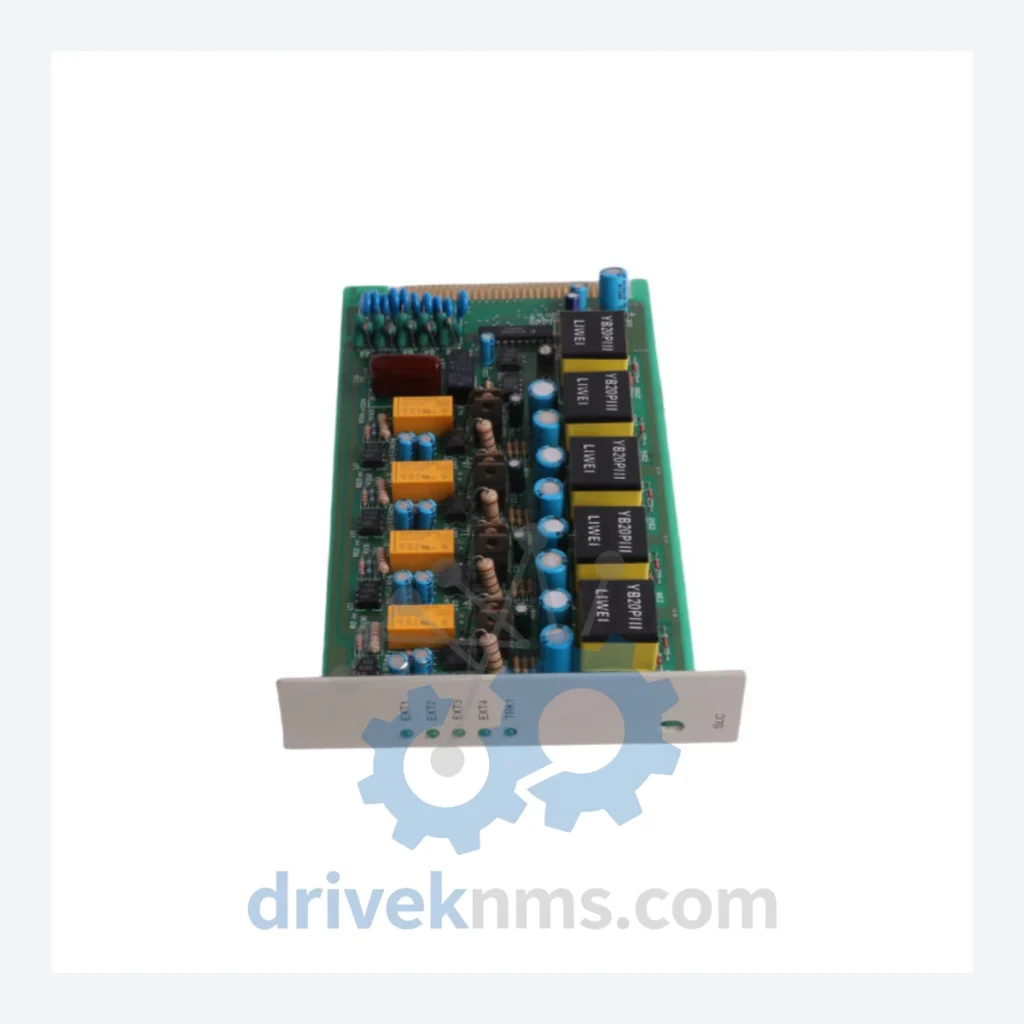
ABB SLC Transformer Connector – Obsolete Drive Series Spare Part
RFQ support for obsolete parts: Send the model number, required quantity and destination so DriveKNMS can confirm sourcing options before quotation.
Technical Specifications
Note: Electrical parameters specific to your installation should be verified against your original ABB system documentation. DriveKNMS does not publish unverified specifications.
Solving the Discontinued Hardware Crisis
The ABB SLC Transformer Connector is a coupling and signal interface component embedded in ABB's legacy drive architectures. In these systems, the transformer connector is not a peripheral — it is a load-bearing element of the power conversion and control chain. Its failure does not produce a degraded operating state. It produces a hard stop.
Q: How are RFQ terms confirmed?
A: Quantity, required condition, documentation needs, destination and sourcing route are confirmed during RFQ review before quotation.
DriveKNMS operates specifically in this segment of the supply chain. We source, inspect, and hold inventory of components like the ABB SLC precisely because the window for doing so is closing. Each year, fewer units exist in serviceable condition. Procurement teams that act now preserve options that will not exist in 18 months.
Condition & Reliability Assurance
Every ABB SLC Transformer Connector that leaves our facility passes a structured 5-step quality process designed around the failure modes specific to aged electromechanical components:
- Step 1 – Electrolytic Capacitor Assessment: Aged capacitors are the primary failure point in stored legacy components. Each unit is evaluated for capacitor swelling, leakage, and ESR deviation. Units with degraded capacitors are either reconditioned with verified-spec replacements or rejected.
- Step 2 – Firmware & Configuration Verification: Where applicable, firmware versions are confirmed against the original ABB release documentation to ensure compatibility with the target system revision.
- Step 3 – Pin and Connector Inspection: All connector pins are examined under magnification for oxidation, corrosion, mechanical deformation, and plating integrity. Corroded contacts are a silent cause of intermittent faults in legacy systems.
- Step 4 – Functional Bench Test: Units are powered and tested under controlled conditions to confirm baseline operational behavior prior to shipment.
- Step 5 – Packaging for Long-Term Storage: Units intended for shelf-spare inventory are packaged in anti-static, moisture-controlled packaging with desiccant to prevent degradation during storage.
Extending Your Automation Asset Life by 5–10 Years: A Practical Framework
For plant managers under pressure to justify continued operation of legacy ABB drive systems against capital proposals for full replacement, the following framework provides a defensible, low-cost maintenance strategy:
1. Identify your single points of failure. Map every component in your drive system that is obsolete, has no modern equivalent, and whose failure would cause a line stop. The ABB SLC Transformer Connector is a textbook example. These are your priority procurement targets.
4. Document your system configuration. Maintain records of firmware versions, parameter sets, and hardware revisions. This documentation is essential when sourcing replacement parts and becomes critical if the original system integrator is no longer available.
Facilities that execute this framework consistently extend the productive life of their automation assets by 5–10 years beyond the point at which the OEM has exited the market — deferring capital expenditure and preserving production continuity.
Q: Can you support multi-unit or repeat RFQ requests?
A: Yes. Send the model list, target quantity and destination so DRIVEKNMS can review sourcing options and quote the requirement as a project RFQ.
Q: What if my system uses a slightly different revision of this connector?
A: Provide your system model number and hardware revision when you contact us. Our technical team will confirm compatibility before dispatch review.