Technical Dossier
Product Details And Specifications
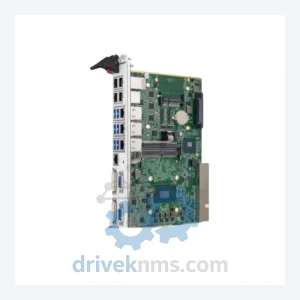
ADLINK cPCI-6210/510E/M4G/TEL CompactPCI Control Board – Obsolete cPCI-6210 Series Spare Part
When a cPCI-6210 control board fails in an active production environment, the consequences extend far beyond a single module replacement. Legacy CompactPCI-based control architectures — still running in telecommunications infrastructure, industrial automation lines, and defense test systems worldwide — cannot be swapped out for modern alternatives without triggering a full system re-engineering project. Conservative estimates place the cost of such a migration between $500,000 and several million USD, factoring in new hardware procurement, software re-qualification, downtime, and validation cycles. A single verified spare board at the right moment eliminates that exposure entirely.
DriveKNMS maintains a carefully sourced inventory of hard-to-find ADLINK cPCI-6210 series boards. Each unit is individually inspected before dispatch. Stock is finite and not replenishable through standard distribution channels.
Technical Specifications
| Parameter | Detail |
| Part Number | cPCI-6210/510E/M4G/TEL |
| Series | ADLINK cPCI-6210 |
| Form Factor | CompactPCI (cPCI), 6U |
| Bus Standard | PICMG 2.0 CompactPCI |
| Discontinuation Status | End-of-Life (EOL) – No longer manufactured or distributed by ADLINK |
| Typical System Compatibility | CompactPCI backplane systems; commonly deployed in telecom, industrial control, and defense test platforms |
| Country of Origin | Taiwan |
Note: Electrical parameters not independently verified. Specifications are based on published ADLINK documentation for the cPCI-6210 series. Buyers requiring exact electrical data should request the original datasheet prior to purchase.
Solving the Discontinued Hardware Crisis
The ADLINK cPCI-6210 series was deployed extensively in systems built during the late 1990s and 2000s — a period when CompactPCI represented the industrial standard for high-availability, hot-swap capable computing in demanding environments. Telecom carriers, power utilities, and defense contractors integrated these boards into platforms designed for 15–20 year operational lifespans.
The problem facing plant managers and system engineers today is structural: the original equipment manufacturers have exited this product line, authorized distributors have exhausted their buffer stock, and the engineering teams that specified these systems have often moved on. When a board fails, the organization faces a binary choice — source a verified replacement or commit to a full platform migration.
Platform migration is not a routine maintenance decision. It requires re-qualification of all interfacing software, re-certification in regulated industries, retraining of operations staff, and extended production downtime during cutover. For a single control node, this process routinely consumes 12–24 months of engineering effort.
Sourcing a verified cPCI-6210/510E/M4G/TEL spare from DriveKNMS defers that decision on your timeline, not the market's. It buys the operational continuity needed to plan a migration properly — or to run the existing system through its intended end-of-life without forced interruption.
Extending asset life by 5–10 years through strategic spare parts management is a documented practice in industrial asset management. The core principle: identify the three to five single-point-of-failure components in a legacy system, secure verified spares for each, and establish a documented replacement procedure. For a cPCI-6210-based platform, the control board itself is typically the highest-risk single point of failure — it is non-standard, non-interchangeable, and carries the longest lead time of any component in the chassis. Holding one verified spare unit reduces unplanned downtime risk to near zero for the remaining operational life of the system. The cost of that spare, amortized over a 5–10 year extension, is a fraction of one day of unplanned production stoppage.
Condition & Reliability Assurance
Obsolete hardware sourced outside authorized channels carries real risk. DriveKNMS applies a structured 5-step inspection protocol to every cPCI-6210 series board before it is offered for sale:
Step 1 – Visual and mechanical inspection: Full examination of the PCB surface, connector pins, and mounting hardware. Any unit showing physical damage, corrosion, or evidence of prior repair is rejected at this stage.
Step 2 – Electrolytic capacitor assessment: Capacitor aging is the primary failure mode in boards of this vintage. Each unit is assessed for capacitor bulging, leakage, and ESR degradation. Boards with compromised capacitors are not offered for sale.
Step 3 – Pin and connector integrity check: All edge connectors and rear I/O pins are inspected under magnification for oxidation, bending, and contact wear. Pin corrosion is a common failure mode in boards that have been stored improperly.
Step 4 – Firmware and label verification: Where accessible, firmware revision markings and board revision labels are documented and cross-referenced against known cPCI-6210 series revision history to confirm authenticity and configuration.
Step 5 – Functional verification (where test fixtures are available): Boards are powered and tested for basic operational response where compatible test infrastructure exists. Results are documented and available upon request.
Key Features for System Maintenance
The cPCI-6210/510E/M4G/TEL is a direct drop-in replacement for failed boards within the same cPCI-6210 series deployment. No re-programming of the host system is required in standard replacement scenarios. The board slots into the existing CompactPCI backplane without mechanical modification.
This matters operationally: a maintenance technician can execute the replacement during a scheduled maintenance window without requiring an automation engineer or software specialist on-site. There is no firmware re-flash procedure, no PLC re-configuration, and no I/O re-mapping. The system returns to service in the same state it was in before the failure.
Avoiding engineering re-configuration is not a minor convenience — it eliminates the risk of introducing new faults during the replacement process, reduces the required skill level for the maintenance task, and keeps the replacement within the scope of a standard corrective maintenance work order rather than a capital project.
FAQ
What warranty applies to obsolete parts?
DriveKNMS provides a 90-day warranty against defects identified through our inspection process. Given the end-of-life status of this product, warranty terms are confirmed in writing at the time of purchase. Extended warranty arrangements are available for volume orders — contact us to discuss.
How do I know the unit is genuine and not counterfeit?
Each board is inspected for physical authenticity markers consistent with genuine ADLINK manufacturing. Revision labels, PCB markings, and component placement are cross-referenced against known authentic units. We do not source from unverified brokers. Provenance documentation is provided where available.
Should I buy more than one unit?
For any system where this board is a single point of failure and no migration is planned within the next three years, holding a minimum of one additional spare is standard practice. For multi-chassis deployments or systems with no viable migration path, two to three units is a defensible position. Stock of end-of-life components does not recover once exhausted — the decision to secure spares is time-sensitive.
Can you source additional units if I need more?
We maintain active sourcing channels for cPCI-6210 series components. Contact us with your quantity requirement and we will advise on availability and lead time.
© 2026 DriveKNMS. (Status: DRAFT)