Technical Dossier
Product Details And Specifications
Basler Electric DECS-250 Series Technical Notes
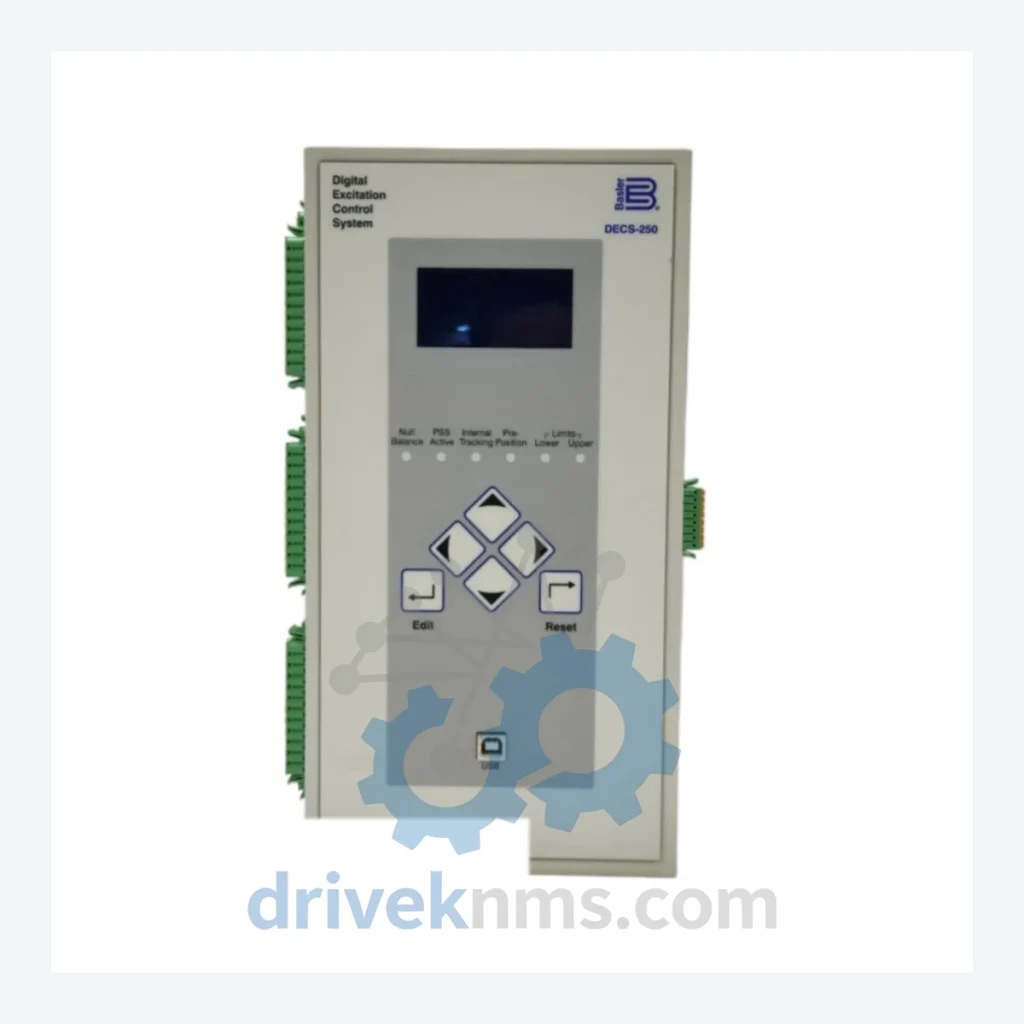
The Basler Electric DECS-250 is a microprocessor-based Digital Excitation Control System (DECS) designed for synchronous generators operating in power generation facilities, including fossil fuel power plants, hydroelectric stations, nuclear auxiliary systems, and petrochemical co-generation units. The DECS-250 platform holds a significant installed base across North American and Southeast Asian heavy industrial sites, where it replaced legacy analog voltage regulators (AVRs) from the 1980s and 1990s. Its modular architecture supports both brushless and static excitation systems, making it a cross-platform solution for OEM turbine-generator packages from GE, Siemens, and Mitsubishi.
The Evolution of DECS-250 Architecture
Basler Electric introduced the DECS-200 platform in the mid-1990s as a successor to the analog SSB and SCP series regulators. The DECS-250 represents the second-generation digital architecture, incorporating a 32-bit DSP core, expanded I/O capacity, and IEEE 421.5-compliant PID excitation control loops. Key architectural milestones include:
- DECS-200 (1995–2002): First-generation digital platform; limited communication options; RS-232 only.
- DECS-250 (2003–present): Expanded analog I/O, dual-channel redundancy options, Modbus RTU/TCP support, and BESTCOMS PC software integration.
- DECS-250E / DECS-250N variants: Enhanced EMC shielding for nuclear-adjacent and offshore environments.
- DECS-400 (successor): Introduced Ethernet-native communication and IEC 61850 GOOSE messaging; backward-compatible with DECS-250 wiring harnesses in most configurations.
Compatibility note: DECS-250 firmware versions prior to 1.06.xx are not compatible with BESTCOMS Plus software. Sites running legacy firmware must use BESTCOMS for Windows v4.x or earlier.
DECS-250 Full Catalog & Functionalities (SKU List)
The following SKUs represent the verified active and legacy catalog for the DECS-250 platform, classified by functional category. All models listed below are genuine Basler Electric part numbers.
Base Control Units
- DECS-250-LN1SN1N: Standard base unit, 120/240 VAC input, no redundancy, Modbus RTU
- DECS-250-LN1SN1E: Base unit with Ethernet port, Modbus TCP enabled
- DECS-250-LN2SN1N: Dual-channel sensing input, single output, no Ethernet
- DECS-250-LN2SN2N: Dual-channel sensing, dual output configuration, no Ethernet
- DECS-250-HN1SN1N: High-voltage sensing input (up to 600 VAC), single output
- DECS-250-HN1SN1E: High-voltage sensing with Ethernet, Modbus TCP
Redundant & Enhanced Configurations
- DECS-250-LR1SR1N: Redundant sensing and output channels, no Ethernet, for critical generation
- DECS-250-LR1SR1E: Redundant channels with Ethernet, full BESTCOMS Plus support
- DECS-250-HR1SR1N: High-voltage redundant configuration, nuclear-adjacent rated
- DECS-250-HR1SR1E: High-voltage redundant with Ethernet, IEC 61850 optional
Communication & Accessory Modules
- DECS-250-COMM-MB: Modbus RTU expansion card for legacy base units
- DECS-250-COMM-DN: DeviceNet communication adapter module
- DECS-250-COMM-PB: PROFIBUS DP communication interface card
- DECS-250-IO-EXP: Analog I/O expansion module, 4 additional analog inputs
- DECS-250-PSU-24: 24 VDC auxiliary power supply module for DECS-250 chassis
- DECS-250-PANEL-KIT: Panel-mount hardware kit, NEMA 4X enclosure rated
- DECS-250-CABLE-RS: RS-232 programming cable for BESTCOMS legacy software
Sourcing Hard-to-Find & Obsolete DECS-250 Parts
Several DECS-250 communication modules and early base unit variants (pre-2008 manufacture dates) have been discontinued by Basler Electric. DriveKNMS maintains a dedicated inventory of tested surplus and refurbished DECS-250 units to support lifecycle extension for sites that cannot migrate to the DECS-400 platform due to control room integration constraints or capital expenditure limitations.
DriveKNMS sourcing capabilities for the DECS-250 range include:
Quality Control for the DECS-250 Range
The DECS-250 platform uses a proprietary backplane bus for inter-module communication. Standard bench testing procedures are insufficient to validate backplane integrity and DSP firmware state. DriveKNMS applies the following test protocol to all DECS-250 units prior to dispatch: