Technical Dossier
Product Details And Specifications
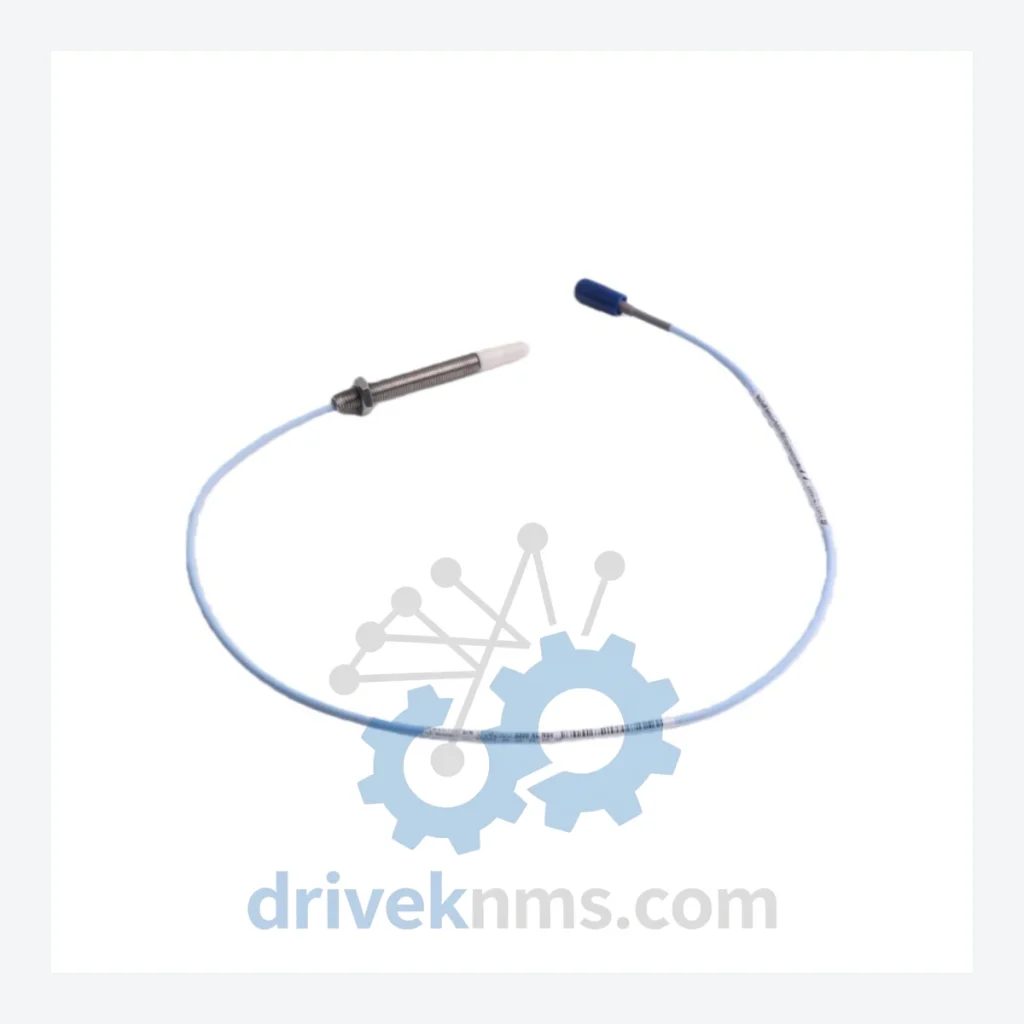
Bently Nevada 330903-00-09-05-02-CN Extension Cable – Obsolete NSv Spare Part
When a Bently Nevada proximity probe extension cable fails in a live rotating machinery protection system, the consequences are not limited to a single sensor. The entire vibration monitoring loop — covering shaft displacement, phase reference, and axial position — can go dark. For a plant running gas turbines, steam turbines, or large centrifugal compressors, that means either operating blind against API 670 requirements or initiating an unplanned shutdown. Either path carries a cost measured in hundreds of thousands of dollars per day, before any engineering assessment or hardware procurement begins.
RFQ support for obsolete parts: Send the model number, required quantity and destination so DriveKNMS can confirm sourcing options before quotation.
Technical Specifications
Note: Electrical parameters such as cable impedance and capacitance are system-matched values. Do not substitute with non-OEM cables without full recalibration of the probe-cable-driver chain. DriveKNMS does not publish unverified specifications.
Solving the Discontinued Hardware Crisis
The Bently Nevada 3300 and 3500 machinery protection platforms have been installed in critical rotating equipment worldwide since the 1980s and 1990s. Many of these systems remain in active service protecting assets with replacement values in the range of USD 5–30 million per machine train. The extension cable is not a passive component — it is a precision-matched element of a three-part transducer system (probe, extension cable, driver). Substituting a non-matched cable changes the system's total electrical length and directly affects the output voltage calibration, which governs trip setpoints.
How to Extend Automation Asset Life by 5–10 Years with Strategic Spare Parts
Plant managers facing pressure to retire legacy control and protection systems often underestimate the total cost of migration versus the cost of a structured spare parts program. The following approach has been used by maintenance engineering teams to defer capital expenditure while maintaining system integrity:
1. Conduct a criticality-ranked bill of materials audit. Identify every component in the protection system that is either discontinued or approaching end-of-life. Rank by failure consequence, not by failure frequency. A single failed extension cable that takes a turbine offline outweighs dozens of low-consequence failures.
3. Source from verified distributors, not open marketplaces. Counterfeit and mismarked legacy parts are a documented problem in the industrial spare parts market. A cable with incorrect electrical characteristics installed in a machinery protection system will not trip correctly. The cost of that failure is not the cable — it is the machine.
A structured program along these lines typically extends the viable service life of a legacy protection system by 5–10 years, deferring a capital project that may cost USD 500,000–2,000,000 per machine train when engineering, installation, and lost production are included.
Condition & Reliability Assurance
Every 330903-00-09-05-02-CN cable that leaves DriveKNMS has passed a five-step inspection protocol developed specifically for legacy coaxial transducer cables:
Step 1 – Visual and mechanical inspection. Outer jacket, connector bodies, and strain relief points are examined for cracking, deformation, or evidence of prior field damage.
Step 2 – Connector pin and socket inspection. Coaxial connectors are inspected under magnification for corrosion, pin recession, and contact surface condition. Corroded contacts are a primary failure mode in cables that have been stored or used in humid environments.
Step 3 – Electrical continuity and insulation resistance check. Center conductor continuity and shield integrity are verified. Insulation resistance is checked to confirm the dielectric has not degraded.
Step 4 – Capacitance verification. The cable's electrical length, expressed as capacitance, is measured and compared against the expected range for this part number. A cable outside specification will affect driver output and trip calibration.
Step 5 – Packaging and documentation. Cables that pass all checks are repackaged in anti-static, moisture-barrier packaging with an inspection record. Lot traceability is maintained where available.
Units that do not pass all five steps are not sold as functional spares.
Key Features for System Maintenance
Drop-in replacement: The 330903-00-09-05-02-CN is a direct replacement for the same part number in any installed Bently Nevada NSv transducer system. No reconfiguration of the driver or monitoring system is required, provided the replacement cable matches the original part number exactly.
No reprogramming required: Because the cable is a passive, matched component, replacing a like-for-like cable does not require changes to trip setpoints, calibration records, or control system configuration. This is a critical distinction from upgrading to a current-generation transducer system, which requires full recalibration and documentation updates.
Avoids engineering rework costs: A full transducer system upgrade on a single machine train — including engineering assessment, procurement, installation, calibration, and documentation — typically costs USD 15,000–80,000 depending on system complexity and regulatory requirements. A verified spare cable eliminates that cost for the duration of the asset's remaining service life.
Q: How do I confirm the part is new or certified refurbished, not a counterfeit?
A: We provide an inspection record with each unit. Where original OEM packaging is intact, it is preserved. For refurbished units, we document the inspection steps completed and the results. We do not sell parts that cannot be traced to a verifiable source.
Q: Should I hold multiple units as long-term spares?
A: For a machine train where this cable is a single-point-of-failure component, holding a minimum of one spare per machine is standard practice. For facilities with multiple identical machine trains, a shared pool of two to three units is a reasonable starting position. Given the declining availability of this part number, procurement decisions are better made before a failure occurs.
Q: Can this cable be used with current-generation Bently Nevada drivers?
A: Compatibility depends on the specific driver model and the total electrical length of the transducer chain. This question should be directed to your machinery protection system engineer before installation. DriveKNMS can provide the cable's measured capacitance to support that assessment.