
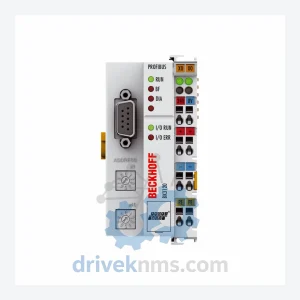
Beckhoff BK3120 DeviceNet Bus Coupler – Fieldbus Module
Beckhoff BK3120 DeviceNet Bus Coupler: Global Sourcing Strategy & Asset Return Value The Beckhoff BK3120 is a DeviceNet-compatible bus coupler…
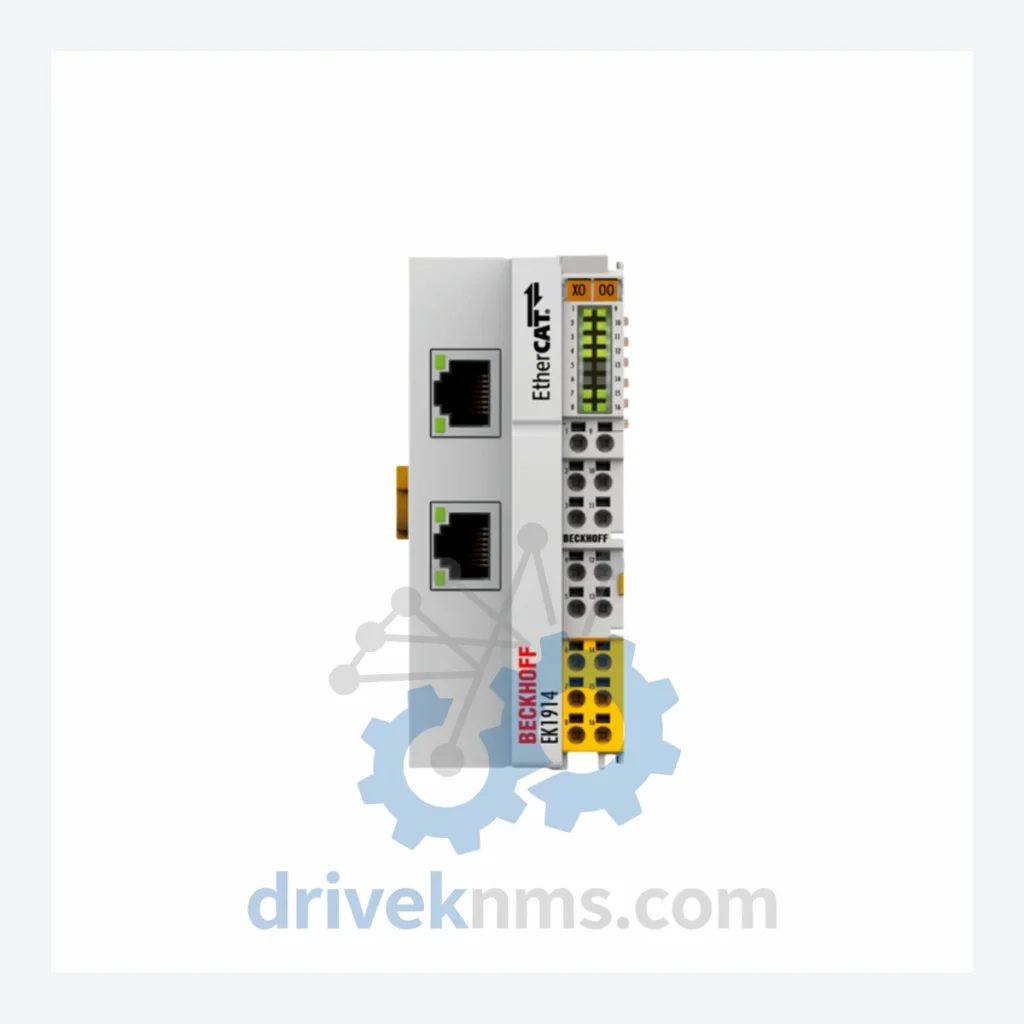
Model: EK1914
Product Overview
Commercial availability is handled through direct RFQ, model verification and export-oriented follow-up rather than public cart checkout.
Datasheet Preview
Use attached product manuals when available. If the manual is not public yet, request the full file directly through RFQ.
Commercial Path
Product pages on DRIVEKNMS are designed to verify model, brand and series first, then move the buyer into one clean quotation path.
Technical Dossier
The Beckhoff EK1914 is a 4-channel digital safety input / 4-channel digital safety output EtherCAT coupler that implements the Functional Safety over EtherCAT (FSoE) protocol. It is classified under IEC 61508 SIL 3 and EN ISO 13849-1 Performance Level e (PLe / Category 4), making it a primary safety bus node in high-consequence process environments including chemical plants, nuclear auxiliary systems, offshore platforms, and petroleum refining units. The EK1914 connects directly to the EtherCAT segment as a standalone safety coupler without requiring a separate EK1100 bus coupler, reducing cabinet footprint and wiring complexity in safety-instrumented systems (SIS). Its integrated TwinSAFE logic capability allows local safety programs to execute on-device, independent of the PLC scan cycle, which is a critical architectural requirement in IEC 61511-compliant SIS designs. Global installed base spans Siemens TIA-integrated hybrid lines, Yokogawa CENTUM VP co-existence architectures, and standalone Beckhoff TwinCAT 3 safety controller deployments.
The EK1xxx coupler family originated with the EK1100, a standard EtherCAT bus coupler introduced in the early 2000s as Beckhoff expanded its EtherCAT I/O ecosystem. The EK1100 provided the foundational E-bus segment interface but carried no safety logic. As functional safety requirements tightened under IEC 61508 Ed.2 (2010) and the proliferation of machinery directive 2006/42/EC, Beckhoff introduced the EK1960 TwinSAFE compact controller — a coupler-form-factor device capable of hosting safety programs locally. The EK1914 represents the next architectural step: a coupler that combines FSoE slave communication, local TwinSAFE logic execution, and mixed safe I/O (4 DI + 4 DO) in a single 12 mm housing. Compatibility considerations are significant for retrofit projects: EK1914 requires TwinCAT 3.1 Build 4022 or higher for TwinSAFE project integration, and FSoE master functionality must reside in a TwinSAFE controller (EK1960, EL6910, or CX-series with TF6910 license). Legacy EK1100-based segments can coexist on the same EtherCAT ring but cannot participate in the FSoE safety domain. Migration from relay-based SIS to EK1914-based architectures typically involves re-validation under IEC 61511-1 Clause 11 and updated FMEA documentation.
The following SKUs represent the verified Beckhoff EK1xxx coupler and related TwinSAFE terminal product range. Each entry reflects a distinct hardware function within the EtherCAT safety I/O architecture.
EK1100: Standard EtherCAT bus coupler, E-bus power supply, no safety logic, 2A E-bus current.
EK1101: EtherCAT coupler with ID switch for topology-based addressing in distributed cabinet layouts.
EK1110: EtherCAT extension, extends E-bus segment over EtherCAT infrastructure to remote I/O islands.
EK1122: 2-port EtherCAT junction coupler for star topology wiring without managed switches.
EK1521: EtherCAT coupler with single-mode fiber optic interface, 1310 nm, for electrically isolated long-distance segments.
EK1541: EtherCAT coupler with plastic optical fiber (POF) interface for short-range EMI-immune segments.
EK1818: EtherCAT coupler with 8 digital inputs and 8 digital outputs integrated, standard (non-safety) I/O.
EK1828: EtherCAT coupler with 8 digital outputs integrated, 24 VDC, 0.5 A per channel, standard I/O.
EK1914: EtherCAT coupler with 4 FSoE digital safety inputs + 4 FSoE digital safety outputs, TwinSAFE logic, SIL 3 / PLe.
EK1960: TwinSAFE compact controller, FSoE master/slave, up to 128 safety addresses, local safety program execution.
EL1904: 4-channel digital safety input terminal, FSoE, 24 VDC, IEC 61131-2 Type 3, SIL 3 / PLe.
EL2904: 4-channel digital safety output terminal, FSoE, 24 VDC / 0.5 A per channel, SIL 3 / PLe.
EL6910: TwinSAFE logic terminal, FSoE master, up to 128 connections, replaces EL6900 in new designs.
EL6900: TwinSAFE logic terminal (legacy), FSoE master, up to 63 connections, EOL — long-term spare support only.
EL1918: 8-channel digital safety input terminal, FSoE, 24 VDC, for high-density SIS panel designs.
EL2918: 8-channel digital safety output terminal, FSoE, 24 VDC / 0.5 A, for high-density actuator wiring.
EL1988: 8-channel digital input terminal, standard, 24 VDC, used alongside safety terminals for non-SIL diagnostics.
EK1501: EtherCAT coupler with multimode fiber optic interface for medium-distance segment isolation.
EK1914 and associated TwinSAFE terminals undergo a structured incoming quality control process at DriveKNMS that addresses the specific failure modes of EtherCAT safety couplers. Each unit is powered at 24 VDC nominal and subjected to E-bus enumeration verification using a reference EK1100 segment to confirm coupler identity, firmware version, and hardware revision register values. FSoE communication integrity is validated by establishing a live FSoE connection to a TwinSAFE controller and confirming safe state transitions across all 4 DI and 4 DO channels. Output channel current limiting and short-circuit protection response are tested per IEC 61131-2 load conditions. For units with TwinSAFE logic capability (EK1914, EK1960, EL6910), the internal safety CPU is exercised through a standardized diagnostic safety program that verifies watchdog response time within the 1–10 ms configurable range. Backplane E-bus signal integrity is measured at the coupler output connector to confirm impedance matching within Beckhoff specification. Units that fail any test stage are quarantined and not returned to inventory. Test records are retained for 5 years and are available to customers upon request.
Related Paths
Beckhoff BK3120 DeviceNet Bus Coupler: Global Sourcing Strategy & Asset Return Value The Beckhoff BK3120 is a DeviceNet-compatible bus coupler…
Beckhoff AM227M-0000 Servo Motor – Obsolete AX5000 / AX2000 Series Spare Part When a Beckhoff AM227M-0000 servo motor fails on…
Beckhoff CX2500 / CX2030 / CX2550 / CX2100 / EL6070 / EK1110 – Embedded PC & EtherCAT Module Sourcing Strategy…