
ALSTOM MVAJ105RA0802A Protection Relay – MiCOM Series
ALSTOM MVAJ105RA0802A Protection Relay: Supply Continuity Strategy for a Discontinued Critical Component The ALSTOM MVAJ105RA0802A is a numerical protection relay…
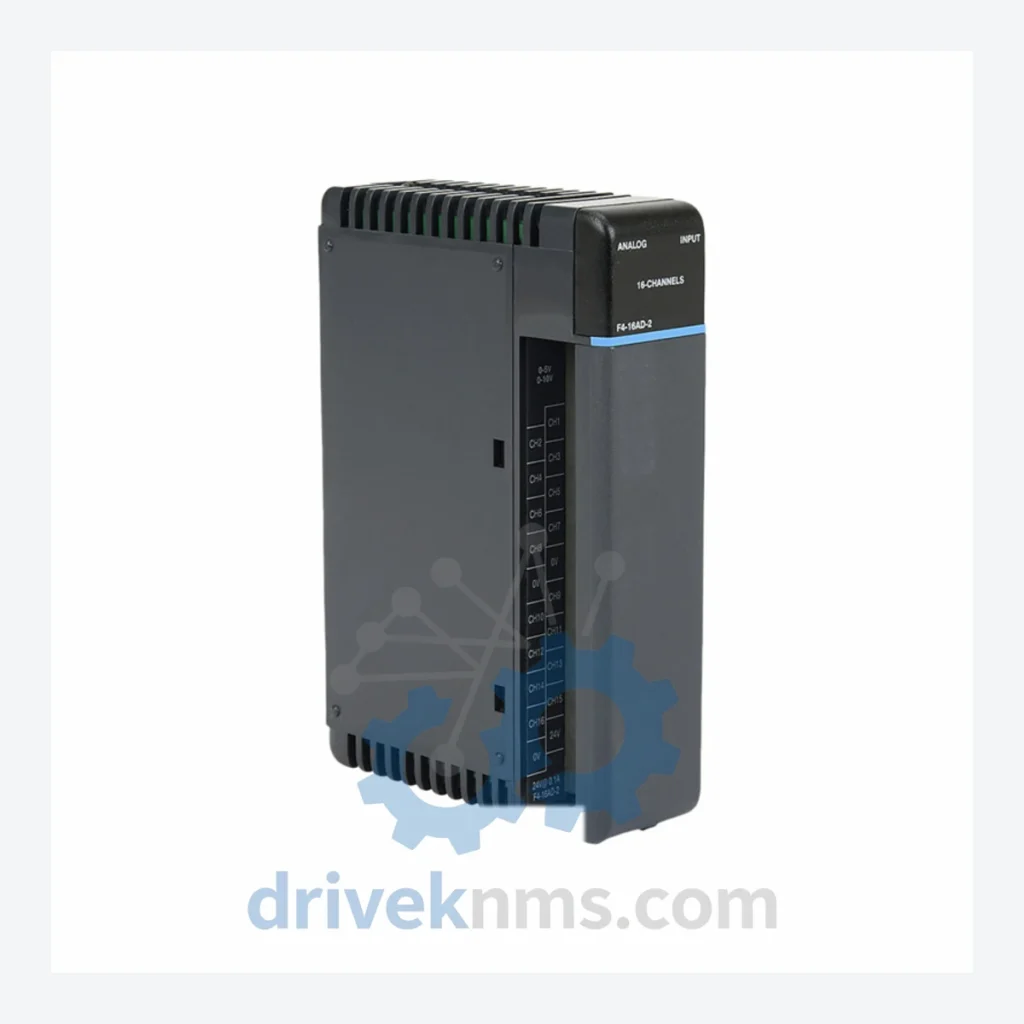
Model: F4-16AD-2
Product Overview
Commercial availability is handled through direct RFQ, model verification and export-oriented follow-up rather than public cart checkout.
Datasheet Preview
Use attached product manuals when available. If the manual is not public yet, request the full file directly through RFQ.
Commercial Path
Product pages on DRIVEKNMS are designed to verify model, brand and series first, then move the buyer into one clean quotation path.
Technical Dossier
The FACTS Engineering F4 Series is a modular programmable controller platform deployed across continuous-process industries including petrochemical refineries, water treatment facilities, pulp and paper plants, and discrete manufacturing lines. Built on a fixed-rack backplane architecture, the F4 system integrates CPU, analog I/O, discrete I/O, and communications modules into a unified control node. Its 16-slot and 8-slot rack configurations have made it a standard control platform in North American industrial installations from the late 1980s through the 2000s. The F4 Series is now in the mature-to-end-of-life phase of its product lifecycle; however, installed base density remains high, making spare parts availability a critical operational concern for maintenance engineers and reliability teams.
The FACTS Engineering F4 platform was introduced as a mid-range PLC targeting applications that required higher analog channel density than entry-level controllers but did not justify the cost of large DCS installations. The original F4 architecture used a parallel backplane bus with a proprietary rack interconnect, supporting up to 16 I/O modules per rack and multiple rack expansion via remote I/O adapters.
Early F4 deployments used 12-bit analog resolution across input and output modules. Subsequent hardware revisions introduced 16-bit resolution variants and expanded the supported signal ranges to include 4–20 mA, 0–10 VDC, ±10 VDC, and thermocouple/RTD inputs on dedicated modules. The CPU module line evolved from the F4-CPU to enhanced variants with expanded memory and faster scan times.
Compatibility across F4 hardware generations is generally maintained at the rack and backplane level; however, firmware dependencies between CPU versions and specific I/O modules must be verified before substitution. As FACTS Engineering was acquired and its product lines transitioned, direct manufacturer support for F4 hardware has been discontinued. Third-party maintenance suppliers and independent parts distributors now represent the primary sourcing channel for F4 spare modules.
Analog Input Modules
Analog Output Modules
Discrete Input Modules
Discrete Output Modules
CPU & Controller Modules
Communications & Networking Modules
Power Supply Modules
The FACTS Engineering F4 Series has been out of active production for over a decade. OEM replacement channels are no longer available, and the installed base is supported exclusively through the secondary market. DriveKNMS maintains a dedicated inventory of F4 Series modules sourced from decommissioned plant equipment, controlled-environment warehouses, and verified industrial surplus channels.
For end-users operating F4-based control systems in long-lifecycle applications — including water infrastructure, chemical batch processing, and legacy discrete manufacturing — DriveKNMS provides lifecycle extension support including: verified used modules with functional test documentation, cross-reference assistance for identifying compatible substitute modules where direct replacements are unavailable, and bulk lot procurement for facilities maintaining multi-year spare parts buffers.
F4 Series modules present specific test challenges due to their backplane-dependent initialization sequence and proprietary bus protocol. DriveKNMS applies a structured verification process to all F4 inventory prior to shipment.
Each analog module — including the F4-16AD-2 and related AD/DA variants — is bench-tested using a dedicated F4 rack with a known-good CPU module. Analog input channels are verified across the full signal range (0–20 mA and 0–10 VDC) using calibrated signal sources, and output linearity is confirmed against reference measurements. Channel-to-channel isolation is checked for leakage. Discrete I/O modules are cycled through all points under load. CPU modules are powered and subjected to a full memory read/write cycle and communication port verification. Modules that fail any test point are quarantined and not offered for sale. All passing units are labeled with a test date and technician ID before packaging.
Related Paths
ALSTOM MVAJ105RA0802A Protection Relay: Supply Continuity Strategy for a Discontinued Critical Component The ALSTOM MVAJ105RA0802A is a numerical protection relay…
MOORE 16137 Series: Comprehensive Module Range and Technical Overview The MOORE 16137 Series represents a core component family within Moore…
FUJI EP-3364B-CA-Z2 Inverter Control Board: Supply Continuity Strategy for a Discontinued Critical Spare The FUJI EP-3364B-CA-Z2 is a control board…