
GE PACSystems RX3i Modules
GE PACSystems RX3i Series: Comprehensive Module Range and Technical Overview The GE PACSystems RX3i platform is one of the most…
Model: IC660EBA026
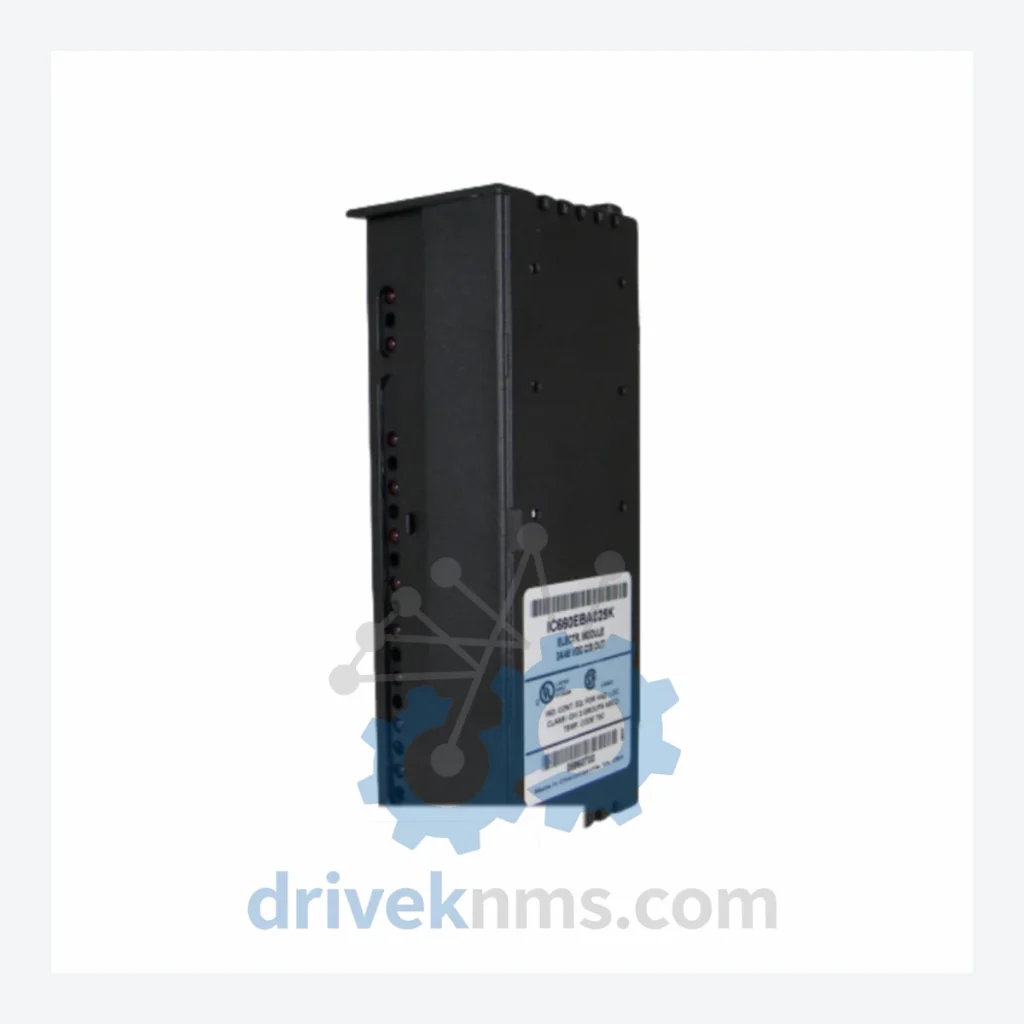
Product Overview
Commercial availability is handled through direct RFQ, model verification and export-oriented follow-up rather than public cart checkout.
Datasheet Preview
Use attached product manuals when available. If the manual is not public yet, request the full file directly through RFQ.
Commercial Path
Product pages on DRIVEKNMS are designed to verify model, brand and series first, then move the buyer into one clean quotation path.
Technical Dossier
The GE IC660 series, commercially designated as the Genius I/O system, is a distributed I/O platform developed by General Electric Automation & Controls as an integral subsystem of the Series Six and Series 90 PLC architectures. Deployed across heavy industrial sectors including petrochemical refining, nuclear power generation, offshore platforms, pulp and paper mills, and continuous-process chemical plants, the IC660 bus system operates on a single-cable Genius Bus (a token-passing serial network at 153.6 kbps) capable of supporting up to 32 devices per segment. Its deterministic scan cycle and fault-tolerant bus architecture made it a preferred choice for safety-instrumented and high-availability control loops throughout the 1980s and 1990s. Installed base estimates place IC660-series hardware in tens of thousands of process control nodes globally, many of which remain in active service under long-term maintenance agreements due to the prohibitive cost of full DCS migration.
The IC660 platform was introduced in the mid-1980s as GE's answer to the growing demand for distributed I/O in large-scale process automation. The original Genius Bus architecture separated field I/O from the CPU backplane, reducing wiring costs and enabling modular expansion across geographically distributed control cabinets. Early-generation blocks such as the IC660BBA020 and IC660BBD020 used discrete 24 VDC I/O with fixed terminal configurations. By the late 1980s, GE introduced analog-capable blocks (e.g., IC660BBA100, IC660BBA104) supporting 4–20 mA and 0–10 V field signals, expanding applicability to flow, pressure, and temperature loops.
The transition to the Series 90-70 and Series 90-30 PLC families in the early 1990s introduced Bus Controller modules (e.g., IC660BBA020, IC660CBB902) that bridged the Genius Bus to VME and rack-based backplanes. The IC660EBA026 represents the Bus Interface Unit (BIU) generation — a block-level controller that manages local I/O scanning and communicates upstream to the host PLC via the Genius Bus, eliminating the need for a dedicated rack-mounted bus controller in smaller node configurations. As GE transitioned its automation portfolio to Emerson (via the GE Intelligent Platforms acquisition and subsequent rebranding to Emerson Automation Solutions), the IC660 series entered end-of-life status, with last-time-buy notices issued for most catalog numbers. Replacement migration paths include the Emerson RX3i (IC695) and VersaMax (IC200) platforms, though direct I/O-for-I/O substitution is not possible without bus conversion hardware.
The following catalog numbers represent verified, commonly stocked IC660-series components. SKUs are classified by functional category.
Bus Interface Units (BIU) / Block Controllers
Discrete Input Blocks (DI)
Discrete Output Blocks (DO)
Analog I/O Blocks (AI/AO)
Bus Controllers & Communication Adapters
IC660-series blocks present specific test challenges due to their integrated Genius Bus transceiver circuitry, onboard microcontroller firmware, and field-terminal isolation barriers. DriveKNMS applies the following verification protocol to all IC660 units prior to shipment: (1) Bus communication test — each block is connected to a live Genius Bus segment and verified for correct device address assignment, data table read/write integrity, and fault reporting via a Series 90-70 host controller; (2) I/O point-level functional test — all discrete and analog channels are exercised at rated voltage/current with pass/fail logging per channel; (3) Isolation resistance test — field terminal-to-bus isolation is verified at 500 VDC per IEC 61010 guidelines; (4) Firmware version check — onboard firmware revision is documented and disclosed to the buyer, as certain IC660 firmware versions have known compatibility constraints with specific Series 90 CPU revisions; (5) Thermal burn-in — units are operated at rated load for a minimum of 4 hours to screen for latent component failures. All test records are retained and available upon request.
Related Paths
GE PACSystems RX3i Series: Comprehensive Module Range and Technical Overview The GE PACSystems RX3i platform is one of the most…
GE IC697CMM711 Communications Coprocessor Module – Obsolete Series 90-70 Spare Part When a GE IC697CMM711 fails in an active production…
GE Series 90-30: Comprehensive Module Range and Technical Overview The GE Series 90-30 (IC693 prefix) is one of the most…