
Panasonic 581B740C Circuit Board – Obsolete MINAS Series Spare Part
Panasonic 581B740C Circuit Board – Obsolete MINAS Series Spare Part A single failed circuit board should not force a plant-wide…
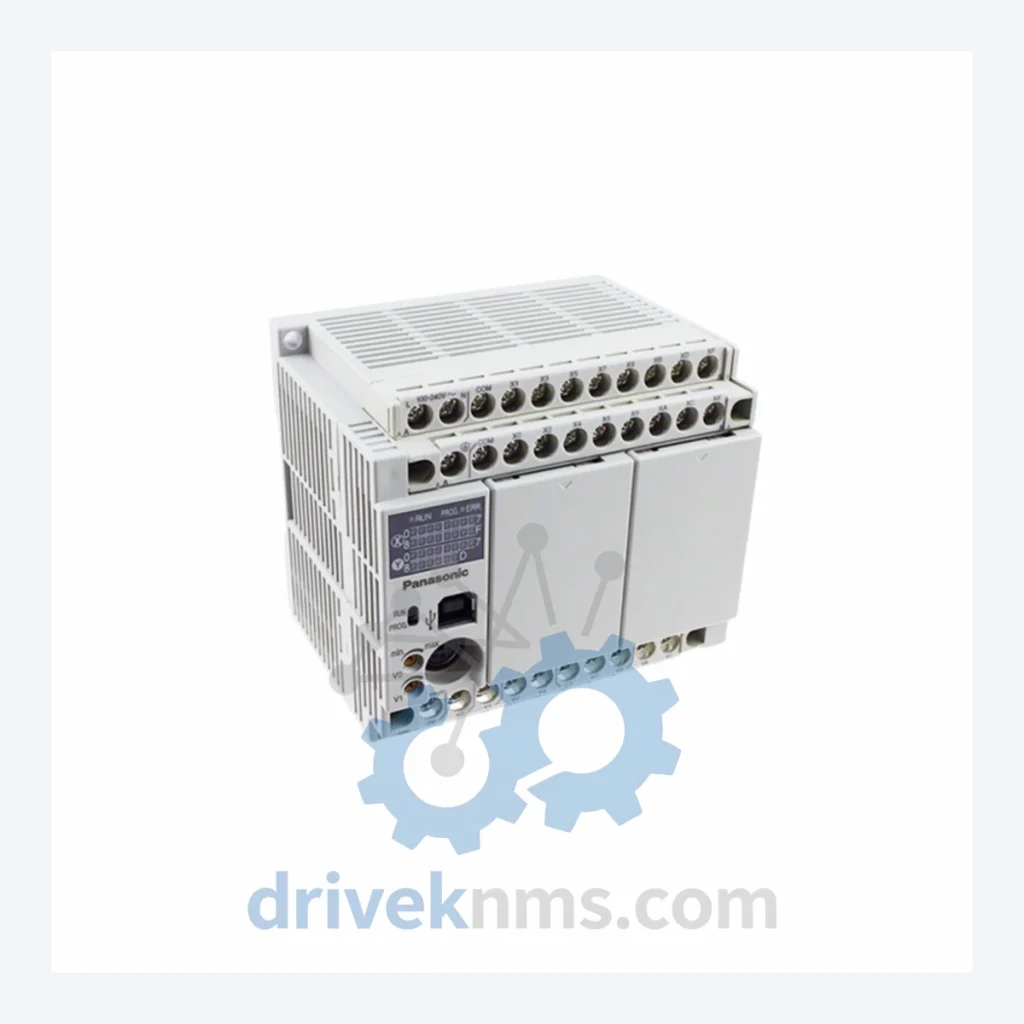
Model: FP-X C30T AFPX-C30T
Product Overview
Commercial availability is handled through direct RFQ, model verification and export-oriented follow-up rather than public cart checkout.
Datasheet Preview
Use attached product manuals when available. If the manual is not public yet, request the full file directly through RFQ.
Commercial Path
Product pages on DRIVEKNMS are designed to verify model, brand and series first, then move the buyer into one clean quotation path.
Technical Dossier
The Panasonic FP-X Series represents one of the most widely deployed compact PLC platforms in global light-to-medium industrial automation. Since its introduction in the early 2000s, the FP-X has accumulated a substantial installed base across food and beverage processing, automotive assembly lines, textile machinery, packaging equipment, and building automation systems throughout Asia, Europe, and the Americas. Its combination of high-speed instruction execution (up to 0.08 μs/step), compact DIN-rail form factor, and extensive expansion capability made it a default specification for machine builders requiring deterministic control without the overhead of a full-rack PLC system.
In facilities where FP-X controllers govern production-critical sequences — conveyor indexing, servo coordination, vision trigger logic — a failed CPU or I/O module does not merely halt one machine; it can idle an entire production cell. Replacement with a modern equivalent requires re-engineering the program, re-commissioning motion profiles, and re-validating the line — a process that routinely costs more in downtime and engineering hours than a decade of spare part procurement.
The FP-X Series was developed as a successor to Panasonic's FP1 and FP-e compact PLC lines, inheriting the MEWTOCOL-COM communication protocol while introducing a significantly faster CPU core and a modular expansion bus. The original FP-X C-type controllers (C14, C30, C60) established the baseline architecture: a fixed I/O count integrated into the CPU unit, expandable via FP-X Expansion Units connected through a proprietary high-speed bus. The T-suffix variants (e.g., AFPX-C30T) denote transistor output configurations, while R-suffix units carry relay outputs — a distinction critical for replacement sourcing, as the two output types are not interchangeable in most applications.
The FP-X L-type sub-series introduced a slimmer housing and reduced I/O density for space-constrained installations. The FP-X0 variant further simplified the architecture for cost-sensitive OEM applications. Communication options evolved from RS232C and RS485 in early units to Ethernet (AFPX-COM5) and PROFIBUS-DP (AFPX-COM3) adapters, reflecting the platform's adaptation to fieldbus-integrated factory environments. As of 2024, Panasonic has transitioned its primary development focus to the FP7 Series, placing the FP-X in a sustained-availability phase. Firmware updates are no longer issued; toolchain support is maintained through FPWIN Pro7 with legacy compatibility mode. Machine builders and end-users operating FP-X-based systems should treat this platform as entering its end-of-active-support window and plan spare part reserves accordingly.
CPU / Controller Units
Digital I/O Expansion Units
Analog I/O Modules
Communication Adapter Modules
As the FP-X platform transitions out of active production support, procurement of specific models — particularly low-volume variants such as the AFPX-COM3 PROFIBUS adapter or AFPX-A22 analog combo module — becomes progressively more difficult through standard distribution channels. Panasonic's authorized distributors typically maintain stock only for the highest-volume SKUs; niche expansion units and communication cassettes are frequently listed as order-on-request with lead times exceeding 16 weeks, or are discontinued outright.
DriveKNMS maintains a dedicated inventory of FP-X Series components sourced through verified industrial surplus channels, estate liquidations, and OEM overstock. Each unit undergoes condition assessment before listing. For facilities operating multiple FP-X-based machines, DriveKNMS recommends a structured spare part reserve strategy: a minimum of one CPU unit per machine type, one of each I/O expansion variant in active use, and at least two units of any communication cassette that interfaces with a fieldbus network — as these are statistically the highest-failure-risk components in aging PLC installations.
Extending the operational life of an FP-X installation by 5–7 years through proactive spare part procurement costs a fraction of the engineering effort required to migrate to a current-generation PLC platform. Migration requires not only hardware replacement but full program re-validation, HMI re-mapping, and in many cases re-certification of the machine under applicable safety standards. For production environments where the FP-X controls a validated or regulated process, the regulatory re-qualification cost alone can exceed the value of the equipment being controlled.
FP-X units sourced outside of new-in-box condition are subject to a structured inspection protocol at DriveKNMS before dispatch. The process addresses the specific failure modes common to this platform after extended field service:
Units that pass all five stages are classified as Tested Used (TU) or New Surplus (NS) depending on physical condition and packaging. Classification is disclosed on each order confirmation.
© 2026 DriveKNMS. All trademarks belong to their respective owners. Specifications are for reference only and subject to change without notice. Verify all parameters against official documentation before installation.
Related Paths
Panasonic 581B740C Circuit Board – Obsolete MINAS Series Spare Part A single failed circuit board should not force a plant-wide…
Panasonic DV80X180MB5 Servo Driver: Global Sourcing Strategy & Asset Return Value The Panasonic DV80X180MB5 is a high-performance AC servo driver…
Panasonic MDDDT3530 AC Servo Driver – Obsolete MINAS A Series Spare Part When a Panasonic MDDDT3530 servo driver fails on…