Technical Dossier
Product Details And Specifications
PHOENIX CONTACT FL HUB Series: Comprehensive Module Range and Technical Overview
The PHOENIX CONTACT FL HUB series represents a standardized range of industrial Ethernet hub and switch modules engineered for deployment in process-critical environments including chemical processing plants, nuclear power facilities, petroleum refineries, and heavy manufacturing installations. These modules operate within the PHOENIX CONTACT Automation Infrastructure and are designed for DIN-rail mounting in control cabinets, providing IEEE 802.3 compliant 10/100 Mbps Ethernet connectivity across star and cascaded topologies. The FL HUB series has achieved widespread adoption in distributed control system (DCS) architectures globally, particularly in applications requiring deterministic network segmentation and robust EMC performance under IEC 61000 standards.
The Evolution of FL HUB Architecture
The FL HUB product line was introduced by PHOENIX CONTACT as part of its Factory Line (FL) networking portfolio during the late 1990s, targeting the transition from proprietary fieldbus systems to open Ethernet-based industrial networks. Early variants such as the FL HUB 4TX and FL HUB 8TX provided basic 10BASE-T/100BASE-TX port aggregation with no managed switching capability, functioning as pure Layer 1 repeater hubs. These units were designed to extend collision domains within legacy CSMA/CD environments common in early SCADA and PLC network segments.
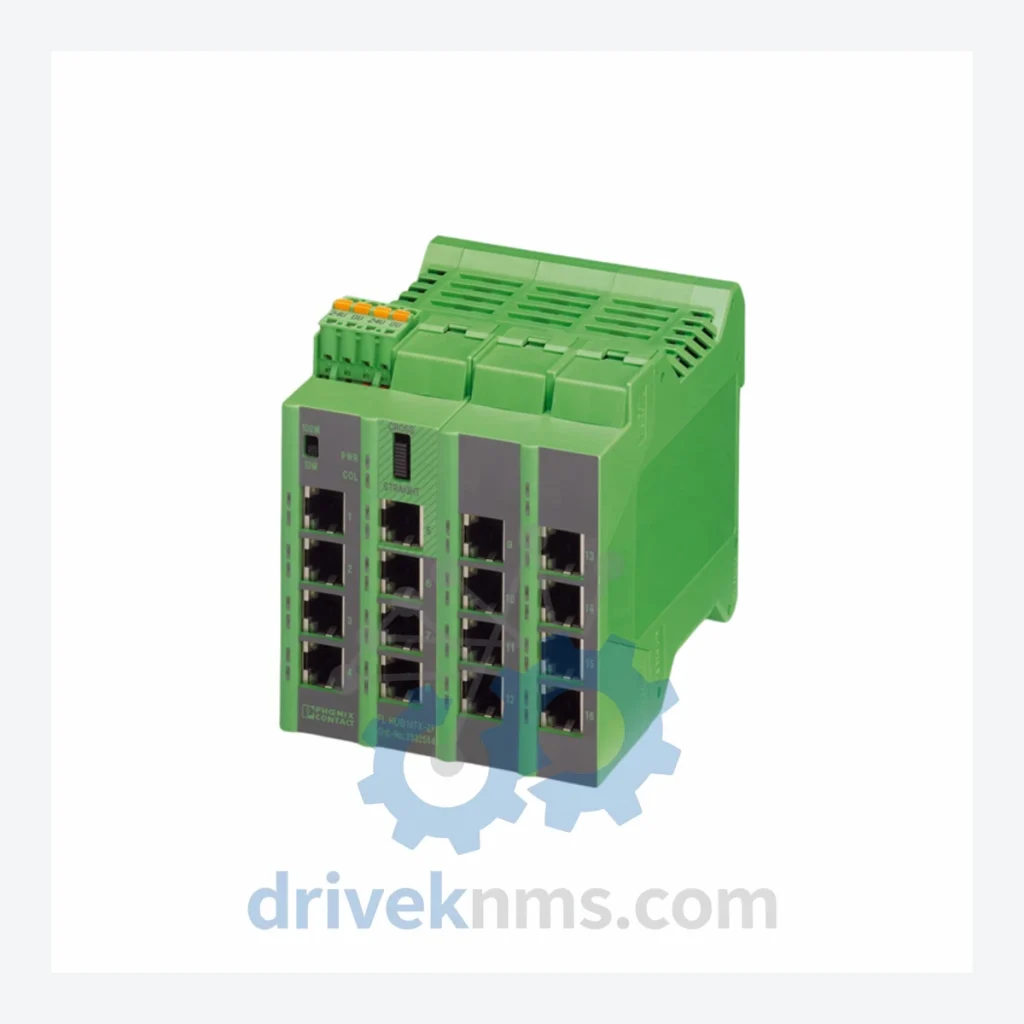
As industrial Ethernet matured through the 2000s, PHOENIX CONTACT expanded the FL HUB range to include zero-delay forwarding variants (ZF suffix) and fiber-optic uplink models (FX suffix), addressing latency-sensitive motion control and long-distance backbone requirements. The ZF (Zero-delay Forwarding) architecture introduced cut-through forwarding to reduce store-and-forward latency, a critical parameter in time-sensitive automation protocols such as PROFINET and EtherNet/IP. The 16-port TX-ZF configuration, represented by the 2832564 FL HUB 16TX-ZF, became the preferred high-density hub for large panel installations requiring centralized port aggregation without managed switching overhead.
By the 2010s, the FL HUB series entered its maturity phase as managed switches from the FL SWITCH family began displacing unmanaged hubs in new installations. However, the FL HUB range remains in active service across thousands of legacy DCS and SCADA installations where replacement with managed switches would require network re-architecture. PHOENIX CONTACT has formally discontinued several FL HUB variants, making third-party lifecycle support essential for ongoing plant operations.
FL HUB Full Catalog & Functionalities (SKU List)
Unmanaged TX Hub Modules (Copper, 10/100BASE-TX)
- FL HUB 4TX: 4-port 10/100BASE-TX unmanaged Ethernet hub, DIN-rail mount, 24 VDC supply
- FL HUB 8TX: 8-port 10/100BASE-TX unmanaged hub, standard collision domain extension
- FL HUB 16TX: 16-port 10/100BASE-TX unmanaged hub, high-density panel aggregation
- FL HUB 4TX-ZF: 4-port TX hub with zero-delay cut-through forwarding, reduced latency
- FL HUB 8TX-ZF: 8-port TX hub with zero-delay forwarding, PROFINET-compatible timing
- 2832564 FL HUB 16TX-ZF: 16-port 10/100BASE-TX hub with zero-delay forwarding, high-density star topology, 24 VDC, DIN-rail, operating temp -10°C to +60°C
Fiber Optic Uplink Variants (FX Suffix)
- FL HUB 4TX/1FX: 4 copper TX ports + 1 multimode fiber uplink (ST connector), backbone extension
- FL HUB 8TX/1FX: 8 copper TX ports + 1 multimode fiber uplink, segment isolation
- FL HUB 4TX/1FX SM: 4 TX ports + 1 single-mode fiber uplink, long-distance inter-cabinet links
- FL HUB 8TX/1FX SM: 8 TX ports + 1 single-mode fiber uplink, extended reach up to 15 km
Compact and Slim-Line Variants
- FL HUB 4TX COMPACT: Reduced-width 4-port hub for space-constrained DIN-rail installations
- FL HUB 8TX COMPACT: Slim-line 8-port hub, 22.5 mm housing width
Power Supply and Accessory Modules
- FL HUB PS 24VDC: Dedicated 24 VDC redundant power supply module for FL HUB rail segments
- FL HUB TERMINATION: Bus termination plug for FL HUB backplane cascade connectors
- FL HUB PATCH CABLE RJ45: Industrial-grade shielded patch cable, rated for FL HUB port density
Managed Transition / Successor Modules (FL SWITCH Family)
- FL SWITCH SFN 16TX: 16-port managed Layer 2 switch, direct functional successor to FL HUB 16TX-ZF in new installations
Sourcing Hard-to-Find & Obsolete FL HUB Parts
Multiple variants within the PHOENIX CONTACT FL HUB series have reached end-of-life (EOL) status, with PHOENIX CONTACT having ceased production on several 4-port and 8-port TX models. For plant operators running legacy DCS or SCADA networks built on FL HUB infrastructure, sourcing replacement units through the original manufacturer's channel is no longer viable for discontinued part numbers.
Quality Control for the FL HUB Range
The PHOENIX CONTACT FL HUB series presents specific test requirements due to its backplane cascade bus architecture and the zero-delay forwarding logic implemented in ZF-suffix variants. DriveKNMS applies the following test protocol to all FL HUB units processed through its facility:
- Power-on and supply voltage verification: Units are energized at 24 VDC nominal and tested across the specified operating range (18–30 VDC) to confirm power LED indication and internal regulator stability.
- Port-by-port link integrity test: Each RJ45 port is connected to a calibrated Ethernet test instrument to verify 10/100BASE-TX auto-negotiation, link LED activation, and absence of CRC errors under sustained traffic load.
- Zero-delay forwarding validation (ZF models): Cut-through forwarding latency is measured using a network analyzer to confirm sub-10 µs frame forwarding consistent with PHOENIX CONTACT factory specification.
- Cascade bus continuity check: For multi-unit rail installations, the backplane cascade connectors are tested for signal continuity and correct bus termination impedance.
- Thermal soak: Units are operated at elevated ambient temperature (50°C) for a minimum of 2 hours to screen for latent thermal failures in switching regulators and port transceivers.
- Visual and mechanical inspection: Housing, DIN-rail clip, port labeling, and connector integrity are inspected against PHOENIX CONTACT reference units.