Technical Dossier
Product Details And Specifications
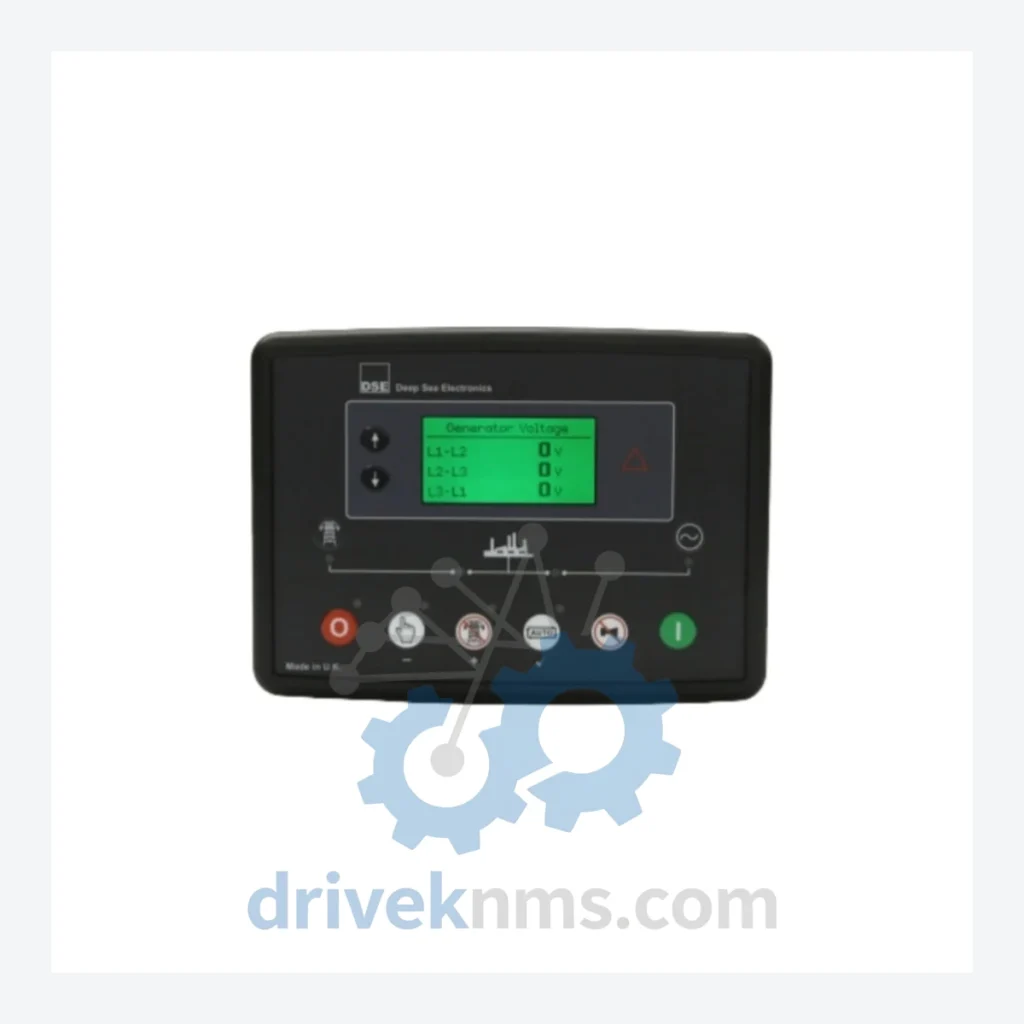
Deep Sea Electronics DSE6120 MKII AMF Control Module – Obsolete DSE6000 Series Spare Part
RFQ support for obsolete parts: Send the model number, required quantity and destination so DriveKNMS can confirm sourcing options before quotation.
Technical Specifications
| Parameter | Detail |
| Manufacturer | Deep Sea Electronics (DSE) |
| Part Number | DSE6120 MKII |
| Series | DSE6000 |
| Function | Auto Mains (Utility) Failure Control – AMF |
| Country of Origin | United Kingdom |
| Product Status | Discontinued / Obsolete – superseded by DSE6120 MKII (later revisions) and DSE6110 MKII in current lineup; original MKII production units are no longer manufactured |
| Compatible Systems | DSE6000-series AMF panels; legacy single diesel generator sets with mains monitoring |
| Communication | RS232 configuration port (DSE Configuration Suite compatible) |
| Display | LCD with LED status indicators |
| Mounting | Panel front-face mount, DIN-compatible cutout |
Note: Electrical parameters such as input voltage range, output relay ratings, and CAN bus specifications vary by firmware revision. DriveKNMS does not publish unverified parameters. Confirmed specifications are provided upon request with unit documentation.
Solving the Discontinued Hardware Crisis
The DSE6120 MKII was deployed extensively throughout the 2000s and 2010s in AMF generator control panels across utilities, manufacturing, and mission-critical facilities. Its logic architecture — handling mains sensing, generator start sequencing, load transfer timing, and fault annunciation — is deeply integrated into the electrical design of the panels it controls. Unlike modern modular controllers, the DSE6120 MKII operates within a fixed wiring and communication framework that does not accommodate drop-in substitution with current DSE product lines without panel redesign.
Extending Automation Asset Life by 5–10 Years: A Practical Strategy for Plant Management
The pressure to retire legacy generator control systems is rarely driven by technical failure of the system as a whole. It is driven by the unavailability of a single failed component. A structured spare parts strategy can defer that pressure indefinitely — or at minimum, buy the time needed to plan a controlled, budgeted migration rather than an emergency one.
1. Identify single points of failure. In DSE6000-series AMF panels, the control module itself is the highest-risk component. Electromechanical relays and the LCD assembly are secondary wear items. Map these before a failure occurs.
3. Document firmware versions. DSE6120 MKII units shipped across multiple firmware revisions. Ensure replacement units match the firmware version in service, or confirm compatibility with your DSE Configuration Suite version before installation.
4. Schedule proactive inspection cycles. LCD backlights, electrolytic capacitors on the power supply board, and RS232 port contacts are the components most likely to degrade over a 10–15 year service life. A biennial inspection protocol catches degradation before it becomes a failure event.
5. Negotiate long-term supply agreements. As DSE6120 MKII inventory globally contracts, price and availability will deteriorate. Facilities with known long-term dependency on this platform should consider securing multi-unit supply agreements now, while RFQ-reviewed sourcing status remains accessible.
Condition & Reliability Assurance
DriveKNMS applies a 5-step quality assurance protocol to all obsolete control modules before dispatch review:
Step 1 – Visual and Physical Inspection: Full external examination for mechanical damage, connector pin condition, and label integrity. Units with bent pins, cracked housings, or missing hardware are rejected at intake.
Step 2 – Electrolytic Capacitor Assessment: Capacitor aging is the primary failure mode in control modules of this era. We inspect for visible bulging, electrolyte leakage, and ESR deviation on critical power supply capacitors.
Step 3 – Firmware Version Verification: Each unit's firmware revision is documented and disclosed. We do not ship units with unknown or unverifiable firmware states.
Step 4 – Pin and Contact Corrosion Check: All connector interfaces are inspected under magnification for oxidation, corrosion, and contact deformation. Affected contacts are cleaned or the unit is rejected.
Units are shipped in anti-static packaging with desiccant. Condition grade (New, Refurbished-Grade A, or Tested-Used) is disclosed on the invoice and product documentation.
Key Features for System Maintenance
Drop-in replacement: The DSE6120 MKII installs directly into existing panel cutouts and wiring harnesses without modification. No panel redesign is required.
No reprogramming required for matched firmware: When the replacement unit's firmware revision matches the unit in service, configuration transfer via DSE Configuration Suite takes under 30 minutes. There is no need for control system re-engineering.
Avoids engineering reconstruction costs: A forced migration to a current-generation DSE controller requires wiring changes, new configuration builds, and in many cases, updated protection relay coordination studies. A verified DSE6120 MKII replacement eliminates all of that cost.
Maintains existing panel certification: In facilities where the generator control panel carries a type certification or insurance-mandated specification, replacing like-for-like preserves that certification status. Substituting a different controller model may trigger re-certification requirements.
Q: How do I confirm the unit is genuine and not counterfeit?
A: All DSE6120 MKII units sourced by DriveKNMS are accompanied by documentation of provenance where available. We do not source from unverified secondary markets. Serial number and label authenticity are verified at intake inspection.