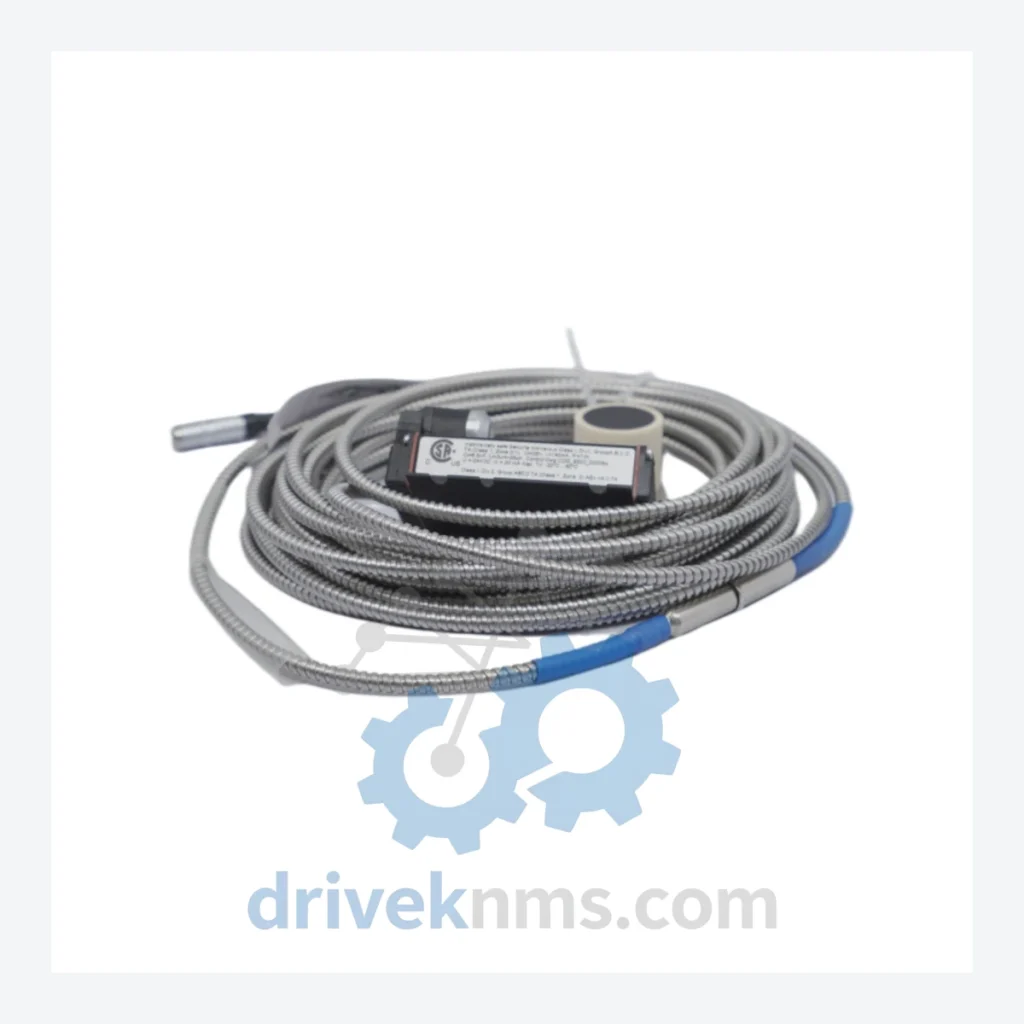
Emerson JYM Series Insulation Monitors
Emerson JYM Series: Comprehensive Module Range and Technical Overview The Emerson JYM Series insulation monitoring devices occupy a critical position…
Model: PR6426/010-040 CON021
Product Overview
Commercial availability is handled through direct RFQ, model verification and export-oriented follow-up rather than public cart checkout.
Datasheet Preview
Use attached product manuals when available. If the manual is not public yet, request the full file directly through RFQ.
Commercial Path
Product pages on DRIVEKNMS are designed to verify model, brand and series first, then move the buyer into one clean quotation path.
Technical Dossier
When a PR6426/010-040 CON021 signal converter fails in a running process plant, the immediate question is not where to find a replacement — it is whether the entire measurement loop, and the control system it feeds, must be decommissioned. For facilities still operating on legacy DCS platforms such as Emerson DeltaV legacy nodes, Honeywell TDC 3000, or ABB MasterPiece 200/1, this single module sits at the boundary between a field transmitter and the control room. Its failure does not stay local. Loop integrity collapses, process variables go blind, and the engineering team faces a choice between an emergency shutdown or an unplanned system upgrade that can run into the millions of dollars in hardware, re-engineering, and lost production time.
DriveKNMS holds verified physical stock of the PR6426/010-040 CON021. This is not a catalogue listing. Availability is finite and is not replenished from the manufacturer.
| Parameter | Detail |
|---|---|
| Manufacturer | Emerson (PR electronics, Denmark) |
| Part Number | PR6426/010-040 CON021 |
| Series | PR 6400 Signal Conditioner Series |
| Function | Current signal converter / loop-powered isolator |
| Signal Type | 4–20 mA (input and output, isolated) |
| Mounting | DIN rail |
| Country of Origin | Denmark |
| Manufacturer Status | Discontinued / Obsolete |
| Replacement Availability | No direct OEM equivalent; field replacement requires loop recalibration |
Note: Electrical parameters listed above are based on the PR 6400 series product family. Specific variant parameters should be verified against the original installation documentation. DriveKNMS does not fabricate specifications.
The PR6426/010-040 CON021 was designed for one purpose: to provide galvanic isolation and signal conditioning between field-level 4–20 mA transmitters and control system input cards. In a legacy DCS environment, this function is not optional. Without a functioning isolator, ground loops corrupt measurement signals, input cards are exposed to transient damage, and the entire loop becomes unreliable.
The problem facing plant engineers today is that the PR 6400 series has been discontinued, and the installed base across refineries, chemical plants, and power generation facilities remains substantial. A single failed unit in a critical measurement loop — flow, pressure, temperature — can trigger a process deviation that forces a manual override or a controlled shutdown. The cost of that event, measured in lost throughput and emergency labour, routinely exceeds the annual maintenance budget for an entire instrument loop.
There is no firmware patch for a failed hardware module. There is no software workaround when the physical signal path is broken. The only operationally safe resolution is a like-for-like hardware replacement — and that requires sourcing from the secondary market before the unit fails, not after.
Facilities that have adopted a proactive critical-spare strategy for obsolete signal conditioners report measurably longer intervals between forced outages. The logic is straightforward: the cost of holding two or three spare units is a fraction of the cost of a single unplanned shutdown. For plant managers operating under asset-life-extension mandates, this is not a procurement decision — it is a risk management decision.
Legacy control systems — particularly those built on platforms from the 1990s and early 2000s — were engineered for 20-year service lives. Many are now operating well beyond that horizon, and the economics of full system replacement are prohibitive. A DCS migration project for a mid-sized process plant typically requires 18–36 months of engineering, $2–8 million in hardware and software, and a planned production outage. For most facilities, that investment cannot be justified until the existing system becomes operationally untenable.
The practical alternative is a structured spare parts programme targeting the modules most likely to fail due to age-related degradation. Signal converters and isolators in the PR 6400 class are high-priority candidates because they contain electrolytic capacitors with finite service lives, operate continuously under load, and are exposed to ambient temperature cycling that accelerates component fatigue.
A defensible asset-life-extension strategy for facilities running legacy instrumentation infrastructure includes the following elements: First, conduct a criticality audit of all installed signal conditioners and isolators, ranking each by the consequence of failure on process continuity. Second, identify which models are discontinued and have no current OEM source. Third, establish a minimum stock level — typically two to four units per critical loop — sourced from verified secondary market suppliers. Fourth, implement a scheduled inspection cycle for installed units, checking for signs of capacitor bulging, terminal corrosion, and output signal drift. Fifth, document the firmware or hardware revision of each installed unit so that replacement units can be matched precisely.
This approach has been demonstrated to extend the operational life of legacy automation assets by five to ten years without requiring a system architecture change. The capital outlay is modest. The operational risk reduction is material.
Sourcing obsolete hardware from the secondary market carries inherent risk. DriveKNMS applies a five-step quality process to every unit before it is offered for sale.
Step 1 – Visual and Physical Inspection: Each unit is examined for case damage, label integrity, and evidence of prior field installation. Units showing signs of thermal stress, mechanical impact, or unauthorised modification are rejected.
Step 2 – Electrolytic Capacitor Assessment: Capacitor condition is the primary age-related failure mode in signal conditioning hardware. Each unit is inspected for capacitor bulging, electrolyte leakage, and ESR deviation. Units with degraded capacitors are either reconditioned by qualified technicians or removed from saleable stock.
Step 3 – Terminal and Pin Inspection: All input and output terminals are inspected for oxidation, corrosion, and mechanical deformation. Contact surfaces are cleaned and verified for continuity.
Step 4 – Firmware and Hardware Revision Verification: Where applicable, the hardware revision marking is recorded and matched against the customer's installed revision to confirm compatibility before shipment.
Step 5 – Functional Output Verification: Units are bench-tested for signal pass-through accuracy and isolation integrity prior to packaging.
Units that pass all five stages are classified as Tested Surplus. Units that pass visual and terminal inspection but are not bench-tested are classified as Surplus As-Removed and are clearly identified as such. DriveKNMS does not represent untested units as tested.
The PR6426/010-040 CON021 is a direct drop-in replacement for the same part number in any existing installation. No loop reconfiguration is required beyond standard commissioning checks. No control system reprogramming is involved. The DIN rail form factor and terminal assignment are unchanged from the original production specification.
This matters operationally because the alternative — adapting a non-equivalent module to perform the same function — requires engineering time, loop documentation updates, and in many jurisdictions, a formal management-of-change process. The cost of that process, in engineering hours alone, typically exceeds the cost of sourcing the correct obsolete part by a factor of ten or more. A like-for-like replacement eliminates that overhead entirely and returns the loop to its validated operating state without introducing new variables into the control system.
What warranty applies to obsolete parts?
DriveKNMS provides a 90-day warranty against defects in material and workmanship on all Tested Surplus units. Surplus As-Removed units are sold with a 30-day inspection warranty. Warranty claims are handled by direct replacement where stock permits, or by credit note.
How do I confirm the unit is genuine and not counterfeit?
All units sourced by DriveKNMS are traceable to documented surplus channels. Label authenticity, date codes, and hardware revision markings are verified during intake inspection. We do not source from unverified brokers or grey-market channels with no provenance documentation.
Should I buy more than one unit?
For any loop classified as critical to process continuity, holding a minimum of two spare units is the standard recommendation. The PR6426/010-040 CON021 is no longer manufactured. Once current secondary market stock is exhausted globally, no further supply will be available. The cost of a second spare unit is negligible relative to the cost of a single unplanned shutdown caused by the absence of a replacement.
Can you source additional quantity if I need more than you have in stock?
DriveKNMS maintains active sourcing relationships across the global surplus market. Contact us with your quantity requirement and we will advise on availability and lead time.
© 2026 DriveKNMS. Status: DRAFT