
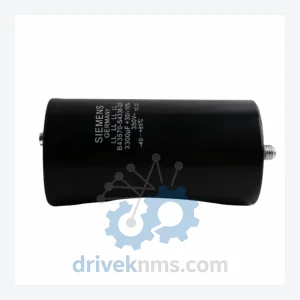
EPCOS TDK B43570 Series Aluminum Electrolytic Capacitors — B43570-S4338-Q3
EPCOS TDK B43570 Series: Comprehensive Module Range and Technical Overview The EPCOS TDK B43570 series represents a family of screw-terminal…
Model: B43458-S0408-M1
Product Overview
Commercial availability is handled through direct RFQ, model verification and export-oriented follow-up rather than public cart checkout.
Datasheet Preview
Use attached product manuals when available. If the manual is not public yet, request the full file directly through RFQ.
Commercial Path
Product pages on DRIVEKNMS are designed to verify model, brand and series first, then move the buyer into one clean quotation path.
Technical Dossier
When a DC link capacitor fails in a legacy industrial drive or inverter system, the production line does not pause politely. It stops. For plant managers operating equipment built around the EPCOS B43458 series, sourcing a direct replacement is no longer a matter of placing a standard purchase order — this component is out of active production. The alternative most procurement teams face is a full drive replacement or system retrofit, a project that routinely runs into six or seven figures when engineering hours, downtime, and recommissioning costs are factored in. DriveKNMS holds verified stock of the B43458-S0408-M1. This is not a catalog listing — it is a working inventory position on a component that the open market has largely exhausted.
| Parameter | Value |
|---|---|
| Manufacturer | EPCOS (TDK Electronics) |
| Part Number | B43458-S0408-M1 |
| Series | B43458 |
| Component Type | Snap-In Aluminum Electrolytic Capacitor |
| Rated Voltage (DC) | 415 V |
| Mounting Style | Snap-In (PCB / chassis mount) |
| Temperature Range | –40°C to +85°C (verify against original datasheet) |
| Application Class | DC Link / Filter |
| Country of Origin | Germany |
| Lifecycle Status | Discontinued / Allocation-Restricted |
| Datasheet Reference | EPCOS B43458 Series – confirm exact capacitance and ESR with DriveKNMS before ordering |
Note: Exact capacitance value and ESR figures are confirmed at order stage against physical unit markings and available datasheet revisions. No parameters are assumed.
The B43458-S0408-M1 is a DC link capacitor — the component that smooths rectified mains voltage before it reaches the inverter bridge in a variable frequency drive (VFD) or servo amplifier. In older drive platforms such as Siemens SIMOVERT Masterdrives, ABB ACS 600/800 series (earlier production runs), Danfoss VLT 5000/6000 series, and Schneider Altivar 58/66 series, this capacitor bank is a known wear item with a finite service life, typically 10–15 years under rated conditions.
When EPCOS consolidated its capacitor portfolio under TDK Electronics, a number of B43458 sub-variants were removed from active production. The S0408-M1 configuration — with its specific voltage rating and case dimensions — does not have a pin-compatible successor in the current TDK catalog. Substituting an alternative capacitor requires electrical validation, mechanical fitment checks, and in some cases firmware recalibration of the drive's DC bus monitoring thresholds. For a plant running 24/7 production, that engineering exercise is not a weekend project.
The practical consequence: a single failed capacitor in an unreplaced drive can trigger a capital expenditure discussion that the maintenance budget was never designed to absorb. Keeping one or two verified spare units on the shelf eliminates that conversation entirely.
DriveKNMS applies a five-stage inspection protocol to all obsolete capacitor stock before it is offered for sale.
1. Visual and Physical Inspection: Each unit is examined for case deformation, vent disc condition, terminal corrosion, and label integrity. Units with any sign of electrolyte leakage are rejected without exception.
2. Electrolytic Capacitor Aging Assessment: Aluminum electrolytic capacitors stored beyond two years require reformation — a controlled voltage ramp-up procedure that restores the oxide layer. Units that have been in storage are reformation-tested before dispatch.
3. Terminal and Pin Integrity Check: Snap-in terminals are inspected under magnification for oxidation, micro-fractures, and plating condition. Corroded terminals are a primary cause of intermittent contact failure in drive capacitor banks.
4. Capacitance and Leakage Current Measurement: Where test equipment is applicable to the voltage and capacitance range, units are measured for capacitance drift and DC leakage current against the original specification window.
5. Firmware and Marking Verification: Date codes and batch markings are cross-referenced against known production records to confirm the unit is not a counterfeit or remarked part.
The B43458-S0408-M1 is a direct mechanical and electrical replacement for the original component position in compatible drive platforms. No PCB modification is required. No firmware parameter changes are triggered by a like-for-like capacitor swap. The drive's DC bus voltage sensing and protection circuits remain calibrated to the same reference points.
This matters operationally. A drop-in replacement means a trained maintenance technician can complete the repair during a scheduled maintenance window without involving a drive commissioning engineer. The difference in labor cost between a capacitor swap and a full drive recommissioning exercise is substantial — typically several thousand dollars in engineering time alone, before any consideration of extended downtime.
For plant managers evaluating the cost of maintaining aging automation assets versus committing to a system upgrade, the arithmetic is straightforward: a verified spare capacitor at a fraction of the cost of a new drive extends the productive life of that asset by years, not months.
Industrial drives and inverters built in the 1990s and 2000s were engineered to last. The mechanical and electrical architecture of platforms like the Siemens SIMOVERT, ABB ACS 600, or Danfoss VLT 5000 is not obsolete in any functional sense — these systems continue to perform their control functions reliably when wear components are replaced on schedule. The obstacle to continued operation is not engineering capability; it is parts availability.
A structured approach to extending asset life by 5–10 years rests on three pillars:
Identify the wear components specific to your drive platform. DC link capacitors, gate drive boards, power supply modules, and IGBT driver cards are the components most likely to reach end-of-life before the drive's mechanical structure. Each of these has a known mean time between failures under rated operating conditions. Mapping these against your maintenance schedule creates a predictive replacement calendar rather than a reactive breakdown response.
Secure critical spares before the market exhausts them. Obsolete component availability follows a predictable curve: initial surplus stock from OEM overruns, followed by a tightening market as integrators and end-users draw down inventory, followed by scarcity. The B43458-S0408-M1 is in the tightening phase. Plants that secure a two-to-three unit buffer now avoid the scarcity phase entirely.
Document your installed base against current parts availability. A simple audit — drive model, serial number, known wear components, current spare stock — gives maintenance management a clear picture of which assets carry the highest replacement risk. That information supports a rational capital planning conversation: targeted spare parts investment versus unplanned drive replacement at full market cost.
The cost differential between these two paths is not marginal. A replacement drive for a legacy platform, where a modern equivalent exists, typically costs between USD 15,000 and USD 80,000 installed, depending on power rating and application complexity. A verified spare capacitor costs a fraction of that. The maintenance strategy that keeps the existing asset running is not a compromise — it is the financially defensible position.
What warranty applies to obsolete parts?
DriveKNMS provides a 90-day warranty against defects in material and workmanship on all inspected spare parts. Warranty claims require the unit to be returned in its original packaging with the original documentation. Warranty does not cover damage resulting from incorrect installation or operation outside rated parameters.
How do I confirm the unit is genuine and not a counterfeit?
All units supplied by DriveKNMS are sourced through documented supply channels. Date codes, batch markings, and physical construction are verified against known EPCOS production standards as part of our five-stage inspection process. We do not source from unverified brokers. If you require additional traceability documentation, contact us before placing your order.
Should I buy more than one unit?
For any drive platform where this capacitor is a known wear item, holding a minimum of two spare units is the standard recommendation. If your facility operates multiple drives of the same model, scale your spare stock proportionally. The cost of a second unit is negligible relative to the cost of an unplanned production stoppage while sourcing a replacement under time pressure.
Can you supply other components for the same drive platform?
Yes. DriveKNMS specializes in obsolete and hard-to-find components across multiple drive and automation platforms. Contact us with your full bill of materials and we will advise on availability.
© 2026 DriveKNMS. All trademarks belong to their respective owners. Specifications are for reference only and subject to change without notice. Verify all parameters against official documentation before installation.
Related Paths
EPCOS TDK B43570 Series: Comprehensive Module Range and Technical Overview The EPCOS TDK B43570 series represents a family of screw-terminal…
ALSTOM MVAJ105RA0802A Protection Relay: Supply Continuity Strategy for a Discontinued Critical Component The ALSTOM MVAJ105RA0802A is a numerical protection relay…
MOORE 16137 Series: Comprehensive Module Range and Technical Overview The MOORE 16137 Series represents a core component family within Moore…