Technical Dossier
Product Details And Specifications
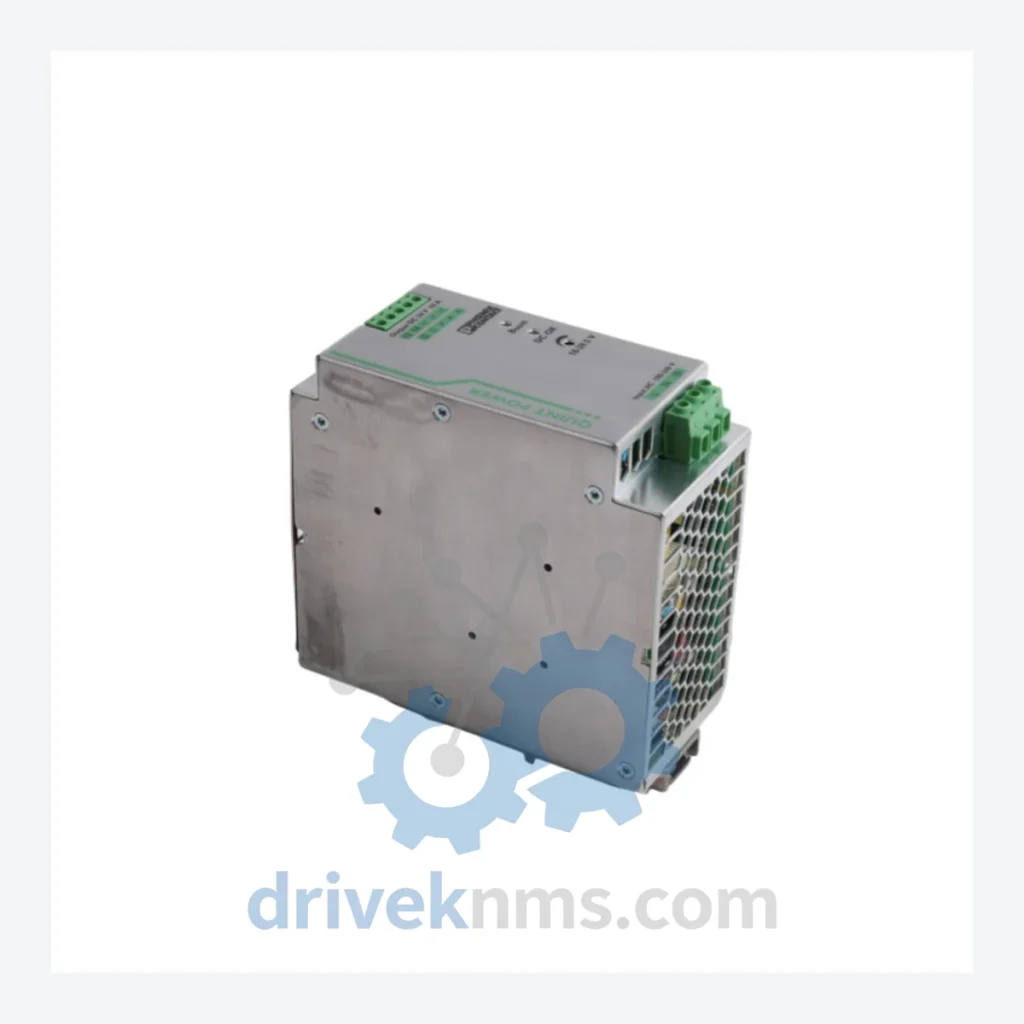
Phoenix Contact 2866763 QUINT-PS/1AC/24DC/10 Rail Power Supply – Obsolete QUINT Series Spare Part
DriveKNMS reviews sourcing status and documentation for this model during RFQ handling before quotation.
RFQ support for obsolete parts: Send the model number, required quantity and destination so DriveKNMS can confirm sourcing options before quotation.
Technical Specifications
| Parameter | Value |
| Manufacturer Part Number | 2866763 |
| Model | QUINT-PS/1AC/24DC/10 |
| Brand | Phoenix Contact |
| Series | QUINT (1st Generation) |
| Product Status | Discontinued / Obsolete – superseded by QUINT4 series |
| Input Voltage | 85–264 VAC (1-phase), 90–350 VDC |
| Output Voltage | 24 VDC (adjustable 18–29.5 VDC) |
| Output Current | 10 A |
| Output Power | 240 W |
| Mounting | DIN rail (EN 60715 TH 35) |
| Protection Class | IP20 |
| Country of Origin | Germany |
| Compatible Systems | Siemens S7-300/400, Allen-Bradley SLC 500/MicroLogix, Modicon Quantum, legacy 24VDC control panels |
Solving the Discontinued Hardware Crisis
The QUINT-PS/1AC/24DC/10 was engineered for industrial environments where power quality directly determines process stability. Its SFB (Static Boost) technology delivers up to 200% rated current for 12 ms to trip upstream circuit breakers reliably — a behavior that many modern replacement PSUs do not replicate without additional configuration. Control systems designed around this characteristic cannot simply accept a generic substitute without re-validating the entire protection coordination scheme.
Phoenix Contact officially discontinued the original QUINT series in favor of the QUINT4 platform. While QUINT4 units offer improved diagnostics and IO-Link capability, they are not form-factor or firmware-transparent replacements in all installations. Panel builders who integrated the original QUINT-PS into certified machine designs face a re-certification burden if they substitute a different model — a process that can take 3 to 6 months and cost tens of thousands of dollars in engineering and compliance fees alone.
For plant managers operating facilities with 10 to 25-year asset lifecycles, the rational strategy is not immediate system replacement. It is structured spare parts procurement. A single unit held in climate-controlled storage eliminates the single point of failure that could otherwise force a premature capital expenditure cycle.
Extending the operational life of an automation asset by 5 to 10 years through targeted spare parts management is a documented practice in process industries. The calculation is straightforward: if a control system replacement project costs USD 2 million and can be deferred 7 years through a USD 3,000–8,000 spare parts investment, the return on that procurement decision requires no further justification to a CFO or plant director.
Condition & Reliability Assurance
Obsolete industrial components sourced outside the original manufacturer's supply chain carry inherent risk. DriveKNMS applies a 5-step inspection protocol before any unit is offered for sale:
- Step 1 – Visual and Mechanical Inspection: Housing integrity, label legibility, connector pin condition, and DIN rail clip function are verified. Units with physical damage are rejected at intake.
- Step 2 – Electrolytic Capacitor Assessment: Capacitor aging is the primary failure mode in stored PSUs. Each unit undergoes ESR (Equivalent Series Resistance) measurement on primary and secondary bulk capacitors. Units showing degradation beyond manufacturer tolerance are quarantined.
- Step 3 – Powered Functional Test: Output voltage regulation, ripple, and SFB response are tested under load. Results are logged against the original Phoenix Contact datasheet specifications.
- Step 4 – Firmware and Label Verification: Hardware revision markings are cross-referenced against Phoenix Contact's known production batches to confirm authenticity and identify any field-modified units.
- Step 5 – Pin and Terminal Corrosion Check: Input/output screw terminals and signal contacts are inspected under magnification. Oxidized contacts are cleaned and re-tested; units with pitting or structural corrosion are rejected.
Units that pass all five stages are classified as Tested Surplus or New Surplus depending on their condition grade, and are documented accordingly in the shipment record.
Key Features for System Maintenance
Q: How do I know the unit is genuine and not counterfeit?
A: Each unit is inspected against known Phoenix Contact production markings, PCB layout references, and label formats. We provide a condition report and, where available, original packaging documentation. We do not sell units that fail authenticity verification.
Q: Should I buy one unit or build a strategic reserve?
A: For any system where this PSU is the sole power source for a critical control loop, a minimum of two units in reserve is the standard recommendation in industrial maintenance practice. For multi-panel facilities running the same hardware, a reserve of 3–5 units amortized across the asset base represents a low-cost insurance position. Given that this part is discontinued and secondary market availability will only decrease over time, procurement decisions made today carry significantly lower cost and risk than those made under emergency conditions.