Technical Dossier
Product Details And Specifications
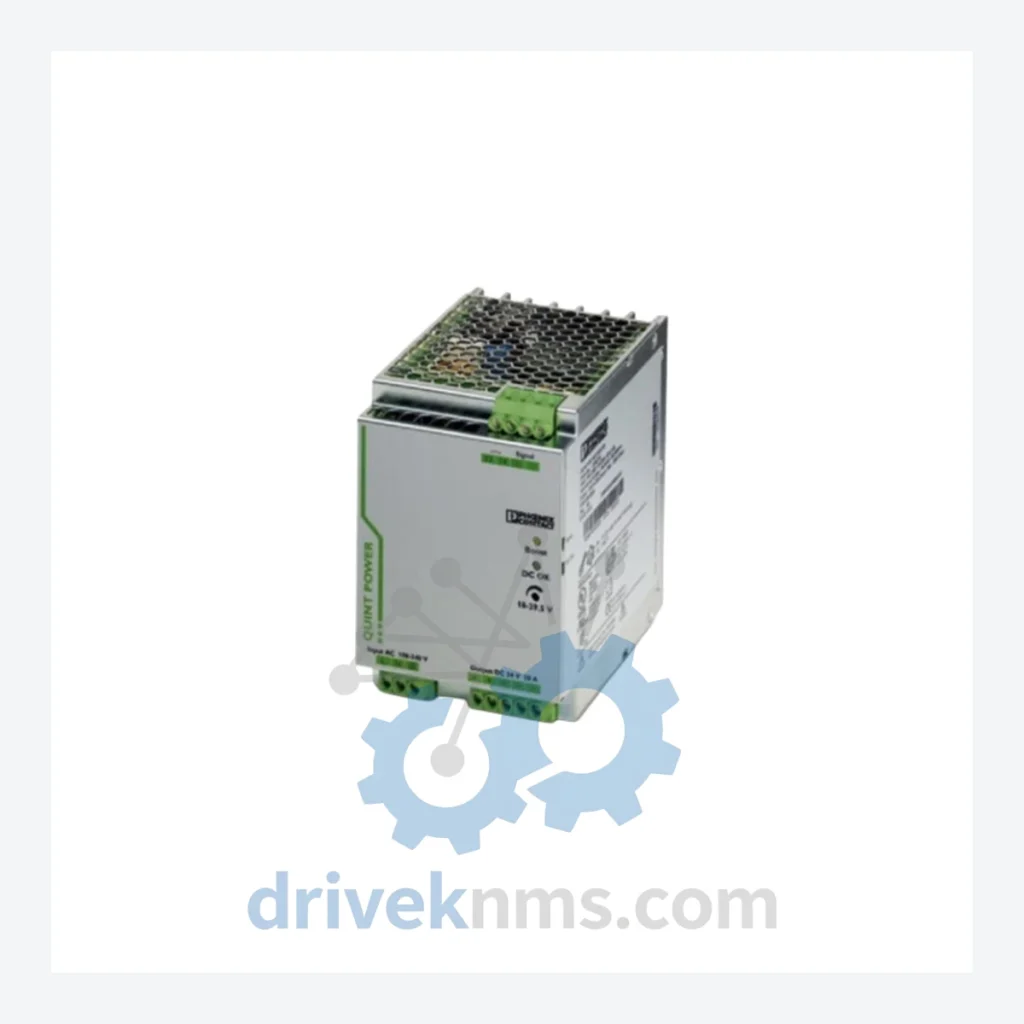
Phoenix Contact QUINT-PS/1AC/24DC/20 2866776 Power Supply – Obsolete QUINT Series Spare Part
RFQ support for obsolete parts: Send the model number, required quantity and destination so DriveKNMS can confirm sourcing options before quotation.
Technical Specifications
| Parameter | Value |
| Manufacturer | Phoenix Contact |
| Part Number / Order Code | 2866776 |
| Model | QUINT-PS/1AC/24DC/20 |
| Series | QUINT Power |
| Input Voltage | 1-phase AC, 100–240 V AC (wide-range) |
| Output Voltage | 24 V DC |
| Output Current | 20 A |
| Output Power | 480 W |
| Mounting | DIN rail (35 mm) |
| Country of Origin | Germany |
| Discontinuation Status | Superseded / End-of-Life (EOL); replaced by QUINT4 series in current Phoenix Contact catalog |
| Typical Legacy System Compatibility | Control cabinets built on Phoenix Contact QUINT-series infrastructure; commonly paired with Siemens S7-300/400 PLCs, Rockwell ControlLogix, and Schneider Modicon M340 architectures |
Solving the Discontinued Hardware Crisis
The QUINT-PS/1AC/24DC/20 (2866776) was a workhorse in industrial control panels throughout the 2000s and 2010s. Its SFB (Selective Fuse Breaking) technology and active power boost capability made it the preferred choice for demanding 24 V DC bus applications where standard power supplies would trip under inrush conditions. Facilities that standardized on this module built their cabinet layouts, cable sizing, and load calculations around its specific output characteristics.
Phoenix Contact has since transitioned its product line to the QUINT4 platform. While the QUINT4 offers improved diagnostics and IoT connectivity, it is not a direct mechanical or electrical drop-in for all existing installations. Retrofitting requires re-evaluation of mounting depth, connector positions, and in some cases, firmware-level changes to connected devices that monitor PSU status signals. For a plant running 40–60 such cabinets, that engineering effort is not a maintenance task — it is a capital project.
How Critical Spare Parts Extend Automation Asset Life by 5–10 Years
2. Calculate the true cost of a stockout. Lost production per hour, emergency engineering labor, expedited freight for alternatives, and potential scrap from process interruption. For most continuous-process industries, this figure exceeds the cost of 10–20 spare units. The business case for strategic stocking writes itself.
Q: How are RFQ terms confirmed?
A: Quantity, required condition, documentation needs, destination and sourcing route are confirmed during RFQ review before quotation.
4. Document the installed base. Knowing exactly how many QUINT-PS/1AC/24DC/20 units are installed across all facilities, their installation dates, and their operating hours allows maintenance teams to predict failure windows and procure replacements before the market dries up entirely. Availability of EOL components decreases non-linearly as time passes.
Condition & Reliability Assurance
Every QUINT-PS/1AC/24DC/20 unit that leaves DriveKNMS passes a structured 5-step quality process designed specifically for end-of-life industrial components:
Step 1 – Electrolytic Capacitor Assessment: Capacitor ESR (Equivalent Series Resistance) is measured on all primary and secondary stage capacitors. Units showing elevated ESR indicative of electrolyte degradation are quarantined. This is the leading failure mode in aged power supplies and the most commonly overlooked in superficial inspections.
Step 2 – Full Load Output Test: Each unit is tested at 100% rated load (20 A / 24 V DC) for a minimum burn-in period. Output voltage regulation, ripple, and efficiency are recorded against original Phoenix Contact factory specifications.
Step 3 – Firmware and Label Verification: Order code, revision level, and production date codes are cross-referenced against Phoenix Contact documentation to confirm the unit matches the 2866776 specification exactly. No substitutions or relabeled units are accepted.
Step 5 – Packaging and ESD Protection: Units are repackaged in anti-static materials with desiccant packs. Each unit ships with a condition report and, where available, original documentation.
Key Features for System Maintenance
The QUINT-PS/1AC/24DC/20 2866776 is a direct mechanical and electrical replacement for existing installations using the same order code. No PLC reprogramming is required. No changes to field wiring or cabinet layout are necessary. The unit occupies the same DIN-rail footprint and uses identical terminal assignments as the original factory installation.
This drop-in replacement capability eliminates the engineering hours associated with alternative sourcing. There is no need to re-evaluate cable sizing, recalculate load budgets, or modify safety relay wiring. Maintenance personnel familiar with the original installation can complete the swap without specialist support. For facilities where engineering resources are constrained, this is a material operational advantage.
Avoiding a forced migration to the QUINT4 platform also means avoiding the associated costs: new mounting hardware, updated documentation, revalidation of safety functions, and potential changes to SCADA monitoring configurations that read PSU status via digital I/O signals.
Q: How is condition confirmed before quotation?
A: Available condition, photos, test records and documentation are checked according to the requested model and sourcing channel before a formal RFQ response.
Q: How do I know the unit is genuine and not a counterfeit?
A: All units are verified against Phoenix Contact documentation including order code, revision markings, and internal construction. We do not source from unverified channels. Traceability documentation is available on request.
Q: Should I buy more than one unit?
A: For any facility with this model installed in a production-critical application, holding a minimum of one cold spare per installed unit is standard practice. Given the declining availability of EOL components, purchasing 2–3 units now is a lower-risk position than relying on spot market availability in 12–24 months.