Technical Dossier
Product Details And Specifications
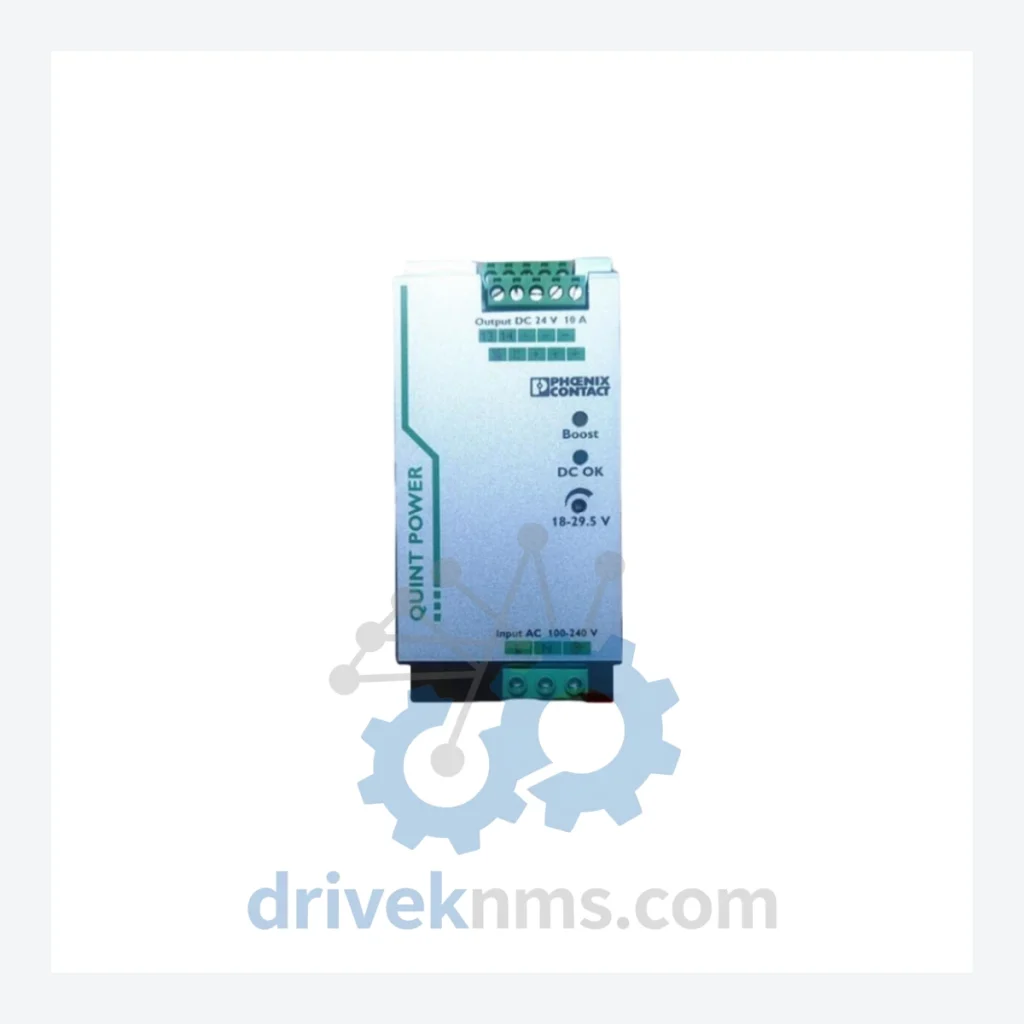
Phoenix Contact QUINT-PS/1AC/24DC/10 DIN Rail Power Supply – Obsolete QUINT POWER Spare Part
RFQ support for obsolete parts: Send the model number, required quantity and destination so DriveKNMS can confirm sourcing options before quotation.
Technical Specifications
| Parameter | Value |
| Part Number | QUINT-PS/1AC/24DC/10 |
| Brand | Phoenix Contact |
| Series | QUINT POWER (1st/2nd Generation) |
| Product Status | Discontinued – superseded by QUINT4 series |
| Input Voltage | 85–264 V AC (1-phase) |
| Output Voltage | 24 V DC |
| Output Current | 10 A |
| Output Power | 240 W |
| Mounting | DIN rail (EN 60715 TH 35) |
| Country of Origin | Germany |
| Typical Compatible Systems | Siemens S7-300/400 cabinets, Rockwell Allen-Bradley legacy panels, Honeywell TDC 3000 auxiliary power rails, ABB MasterPiece 200/1 control stations |
Solving the Discontinued Hardware Crisis
The QUINT POWER series was the backbone of 24 V DC distribution in industrial control panels throughout the 1990s and 2000s. Its SFB (Selective Fuse Breaking) technology and static boost function were engineered to handle the inrush demands of capacitive loads — a characteristic that made it the default choice for system integrators building panels around Siemens S7-300, Allen-Bradley SLC 500, and Honeywell TDC 3000 architectures.
How to Extend Automation Asset Life by 5–10 Years Through Strategic Spare Parts Management
Facilities facing pressure to retire legacy control systems often underestimate the viable service life remaining in their installed base. A structured spare parts strategy can defer a multi-million dollar system migration by a decade or more — without compromising reliability. The following principles apply directly to systems dependent on the QUINT-PS/1AC/24DC/10:
1. Identify single points of failure first. The 24 V DC power supply rail is the most common single point of failure in legacy control cabinets. A failed QUINT-PS/1AC/24DC/10 with no replacement on hand takes the entire panel offline. Prioritize stocking this component above most other spares.
2. Calculate your true replacement cost before dismissing spare parts budgets. The cost of sourcing one QUINT-PS/1AC/24DC/10 from a specialist distributor is measured in hundreds of dollars. The cost of an unplanned line stoppage — including lost production, emergency labor, and expedited engineering — is measured in tens of thousands. The math is not complicated.
5. Document your installed base now. Before the next failure event, catalog every QUINT-PS/1AC/24DC/10 in your facility, its installation date, and its panel assignment. This data drives rational procurement decisions and supports the business case for continued maintenance over premature system retirement.
Condition & Reliability Assurance
Sourcing a discontinued power supply from the secondary market carries inherent risk. DriveKNMS applies a 5-step quality process to every QUINT-PS/1AC/24DC/10 unit before it is offered for sale:
Step 1 – Visual and mechanical inspection. Housing integrity, terminal condition, and label legibility are verified. Units with cracked housings, corroded terminals, or missing identification are rejected at intake.
Step 2 – Electrolytic capacitor assessment. Capacitor aging is the primary failure mechanism in power supplies of this generation. Units are assessed for capacitor bulging, leakage, and ESR deviation. Units with compromised capacitors are either reconditioned with OEM-equivalent components or removed from inventory.
Step 3 – Firmware and hardware revision verification. The hardware revision is documented and disclosed. Buyers receive accurate revision information to confirm compatibility with their installed system.
Step 4 – Pin and connector corrosion inspection. All output terminals and signal contacts are inspected under magnification. Oxidation is treated; units with structural corrosion are not offered for sale.
Step 5 – Functional load test. Each unit is powered under load and output voltage stability, ripple, and SFB response are verified before packaging.
Units are shipped in anti-static packaging with full documentation of inspection results.
Key Features for System Maintenance
The QUINT-PS/1AC/24DC/10 is a direct, drop-in replacement for any panel position currently occupied by the same part number. No firmware changes, no wiring modifications, no re-engineering. The unit mounts on the existing DIN rail, connects to the existing terminal block, and restores the panel to its original certified configuration.
This matters because the alternative — retrofitting a QUINT4 or a third-party equivalent — introduces a change to the panel's documented design. In regulated industries (pharmaceutical, oil and gas, food processing), that change triggers a formal validation or change control process. The QUINT-PS/1AC/24DC/10 avoids that process entirely. It is the same part, in the same position, performing the same function. Maintenance is closed out in hours, not weeks.
Q: Can you source multiple units for a long-term spares program?
A: Yes. Contact us with your quantity requirement and timeline. DriveKNMS can structure staged delivery to support multi-year maintenance programs.