Technical Dossier
Product Details And Specifications
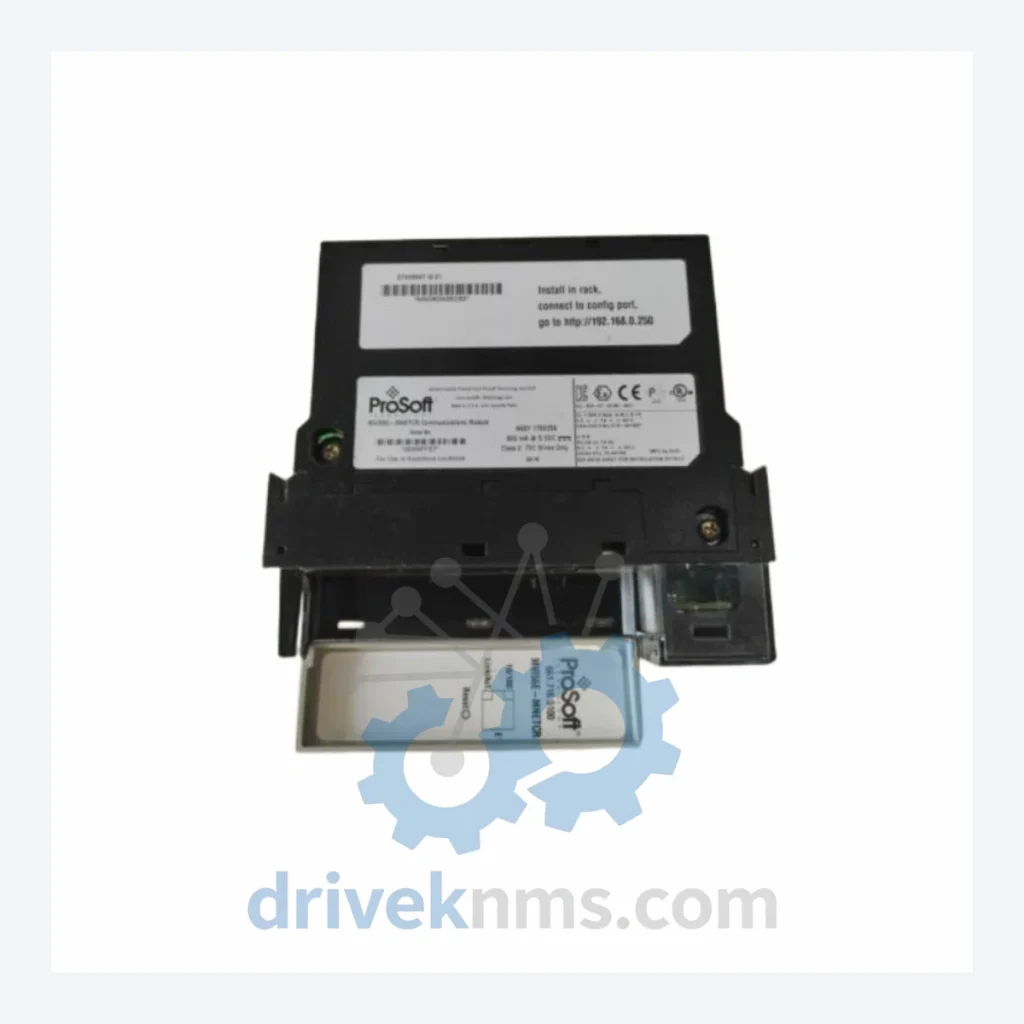
ProSoft MVI56E-MNETCR Communication Module – Obsolete MVI56E Series Spare Part
RFQ support for obsolete parts: Send the model number, required quantity and destination so DriveKNMS can confirm sourcing options before quotation.
Technical Specifications
| Manufacturer | ProSoft Technology |
| Part Number | MVI56E-MNETCR |
| Series | MVI56E |
| Function | Modbus TCP/IP Client/Server Communication Module |
| Platform Compatibility | Allen-Bradley ControlLogix (1756 chassis) |
| Protocol | Modbus TCP/IP (Client and Server) |
| Backplane Interface | ControlLogix 1756 backplane |
| Country of Origin | United States |
| Product Status | Obsolete / Discontinued – Legacy inventory available |
| Inventory Status | RFQ availability review – subject to prior sale |
| RFQ terms review | Commercial terms are confirmed during RFQ review based on model, condition, documentation, quantity and destination. |
Note: Electrical parameters not listed above are not independently verified by DriveKNMS. Buyers are advised to cross-reference the original ProSoft MVI56E-MNETCR datasheet for full electrical specifications. We do not fabricate parameters.
Solving the Discontinued Hardware Crisis
The MVI56E-MNETCR was designed for ControlLogix systems that needed to communicate with Modbus TCP/IP-based field devices — flow computers, drives, meters, and remote I/O — without replacing the entire PLC platform. Plants that built their automation architecture around this module in the 2000s and early 2010s now face a hard reality: ProSoft has discontinued the MVI56E series, and no direct drop-in replacement exists that preserves the original ladder logic, register mapping, and configuration file structure without engineering rework.
The practical consequence is that a single spare MVI56E-MNETCR on the shelf is worth far more than its purchase price. It is the difference between a 4-hour swap and a 6-month re-engineering project. Industries most exposed to this risk include oil and gas processing, water treatment, chemical manufacturing, and discrete manufacturing plants with long equipment lifecycles. If your facility runs a ControlLogix system with Modbus TCP/IP integration and has no spare MVI56E-MNETCR in inventory, that is an unmanaged single point of failure.
Extending the life of an existing ControlLogix system by 5 to 10 years through strategic spare parts procurement is a well-established asset protection strategy. The capital cost of maintaining a legacy system with verified spare modules is typically 3–8% of the cost of a full platform migration. For plant managers facing budget constraints or mid-cycle capital plans, this is not a compromise — it is sound financial engineering.
Condition & Reliability Assurance
Obsolete parts sourced from the secondary market carry inherent risk. DriveKNMS applies a 5-step QA process to every MVI56E-MNETCR unit before dispatch review:
- Step 1 – Visual Inspection: Full board-level inspection for physical damage, corrosion on connector pins, and signs of prior repair or rework.
- Step 2 – Electrolytic Capacitor Assessment: Aging electrolytic capacitors are a primary failure mode in legacy communication modules. Each unit is assessed for capacitor bulging, leakage, or ESR deviation.
- Step 3 – Firmware Version Verification: The firmware version is documented and disclosed to the buyer prior to shipment. Compatibility with the target ControlLogix firmware revision is confirmed where possible.
- Step 4 – Functional Power-On Test: Units are powered and tested for backplane communication and Ethernet port activity.
- Step 5 – Packaging & ESD Protection: All units are shipped in anti-static packaging with moisture barrier protection, suitable for long-term storage if required.
Condition grades (New, Refurbished-Grade A, Tested-Used) are disclosed transparently in the quotation. We do not mix grades without explicit buyer acknowledgment.
Key Features for System Maintenance
Q: How are RFQ terms confirmed?
A: Quantity, required condition, documentation needs, destination and sourcing route are confirmed during RFQ review before quotation.
Q: How do I know the unit is genuine and not counterfeit?
A: All units are sourced from traceable channels. We provide full sourcing disclosure on request. Units are inspected for counterfeit indicators including label quality, board markings, and component date codes.
Q: How are commercial terms confirmed?
A: Commercial terms are confirmed during RFQ review based on model, quantity, destination, documentation and sourcing route.