Technical Dossier
Product Details And Specifications
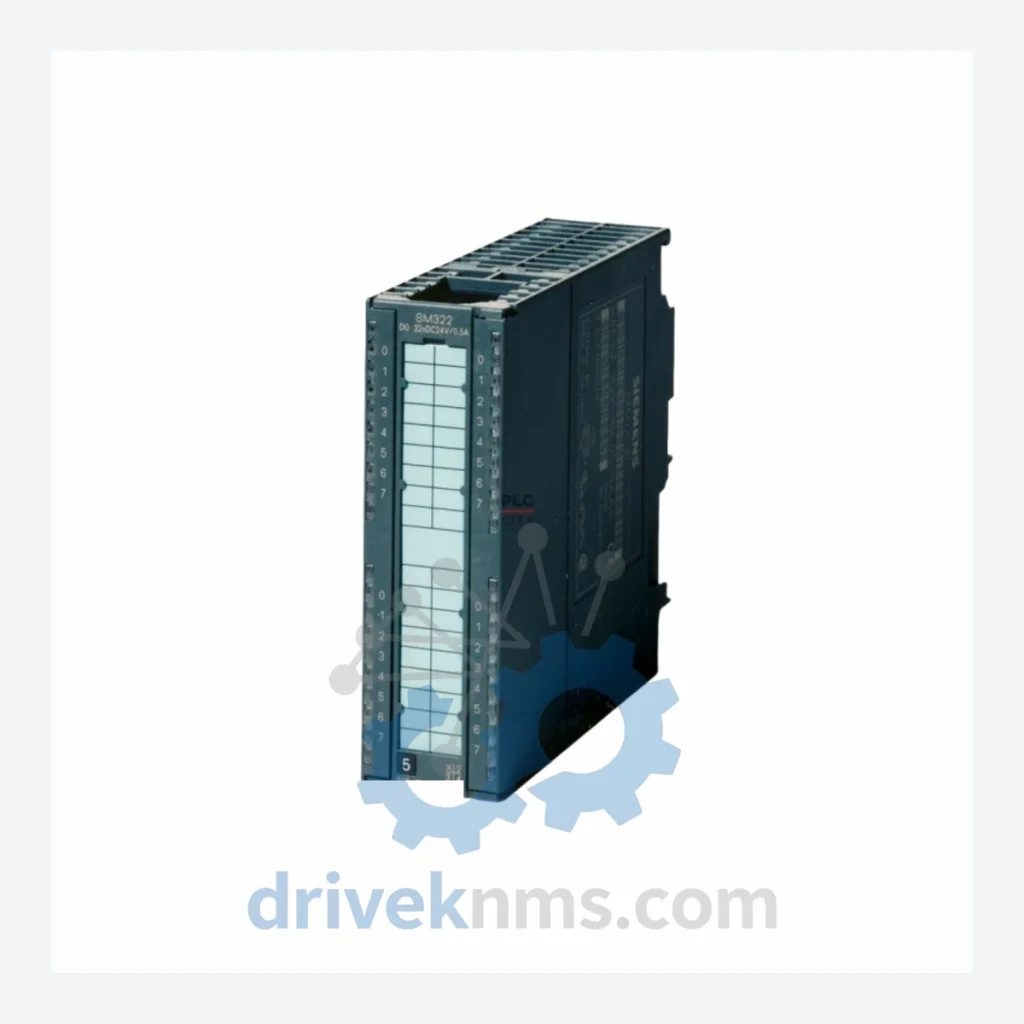
Siemens 6ES7322-8BH10-0AB0 Digital Output Module – Obsolete S7-300 Spare Part
RFQ support for obsolete parts: Send the model number, required quantity and destination so DriveKNMS can confirm sourcing options before quotation.
Technical Specifications
| Parameter | Value |
| Part Number | 6ES7322-8BH10-0AB0 |
| Series | Siemens SIMATIC S7-300 |
| Module Type | Digital Output (DO) |
| Number of Outputs | 16 DO |
| Output Voltage | 24 V DC |
| Output Current per Channel | 0.5 A |
| Total Current per Module | 4 A |
| Output Type | Transistor (sourcing) |
| Backplane Bus | S7-300 standard backplane |
| Discontinuation Status | Officially discontinued by Siemens. No longer available through standard distribution. |
| Compatible Systems | Siemens SIMATIC S7-300 (CPU 312–319 series), ET 200M distributed I/O |
| Country of Origin | Germany |
Solving the Discontinued Hardware Crisis
The Siemens S7-300 platform has been the backbone of discrete and process manufacturing automation for over two decades. Facilities running S7-300 CPUs — particularly those integrated with Profibus DP networks, WinCC SCADA systems, or legacy Step 7 programming environments — face a structural problem: the control architecture is deeply embedded in the production process, and the cost of replacing it is not a maintenance decision but a capital expenditure decision that requires board-level approval.
The 6ES7322-8BH10-0AB0 sits at a critical node in these systems. As a 16-channel transistor output module, it drives actuators, solenoid valves, motor starters, and indicator systems. A single failed module can halt an entire production cell. With Siemens having officially ended production and support for this module, procurement teams face a narrowing window to secure replacement units before the secondary market dries up entirely.
Facilities that have not yet established a strategic spare parts buffer for their S7-300 infrastructure are operating with unquantified risk. The question is not whether a module will fail — it is whether a replacement will be available when it does.
How to Extend Your S7-300 Asset Life by 5–10 Years Without a Full Migration
For plant managers and maintenance engineers facing pressure to retire aging S7-300 systems, a structured spare parts strategy is the most cost-effective path to deferring a multi-million dollar capital project. The following approach has been applied successfully across automotive, chemical, and food processing facilities:
4. Maintain firmware and configuration backups. Ensure all S7-300 CPU program backups are current and stored off-site. In the event of a module swap, a verified backup eliminates re-programming time entirely.
5. Source from verified secondary market suppliers now. Secondary market availability for discontinued S7-300 modules is declining year over year. Procurement decisions deferred by 12–18 months frequently result in either unavailability or significantly higher unit costs. DriveKNMS maintains active sourcing relationships specifically for this category of obsolete Siemens hardware.
Condition & Reliability Assurance
Sourcing discontinued industrial hardware from the secondary market carries inherent risk. DriveKNMS applies a five-step quality assurance process to every unit before it is offered for sale:
Step 1 – Electrolytic Capacitor Inspection. Capacitor aging is the primary failure mode in modules that have been in storage or light service for extended periods. Each unit is inspected for capacitor bulging, electrolyte leakage, and ESR deviation from specification.
Step 2 – Firmware Version Verification. The firmware version is confirmed and documented. Units with corrupted or unverifiable firmware are rejected. Firmware version is disclosed to the buyer prior to shipment.
Step 3 – Connector Pin and Backplane Interface Inspection. All I/O connector pins and backplane edge connectors are inspected under magnification for corrosion, mechanical deformation, and contact resistance. Corroded pins are a common failure point in modules recovered from humid or coastal industrial environments.
Step 4 – Functional Output Channel Test. Each of the 16 output channels is tested under load to verify switching function, current capacity, and absence of cross-channel leakage.
Step 5 – Packaging and ESD Protection. Units that pass all four prior steps are cleaned, photographed, and packaged in anti-static bags with desiccant. Shipment is via tracked courier with full insurance coverage.
Key Features for System Maintenance
The 6ES7322-8BH10-0AB0 is a direct drop-in replacement for any S7-300 rack slot previously occupied by the same module. No hardware modification, no software re-configuration, and no engineering intervention is required beyond the physical swap and a standard CPU restart. This characteristic is the core economic argument for maintaining a spare parts buffer rather than pursuing system migration:
- Drop-in replacement: compatible with all S7-300 backplane configurations without rack modification
- No re-programming required: the CPU recognizes the module automatically upon restart
- No engineering re-validation: the I/O address mapping is preserved, eliminating the need for software testing cycles
- Avoids capital expenditure: a single spare module at a fraction of the cost of a migration project restores full production capability within the time required for a physical swap
- Maintains existing safety certifications: no change to the control system architecture means existing CE, UL, or functional safety certifications remain valid
How do I know the unit is genuine and not counterfeit?
All units sourced by DriveKNMS are inspected for authenticity markers including Siemens holographic labels, mold markings, and PCB layer consistency. Units with any indication of non-genuine manufacture are rejected and destroyed. We provide photographic documentation of the specific unit shipped upon request.
Should I buy more than one unit?
For facilities with active S7-300 systems, yes. Secondary market availability for this specific module is declining. Purchasing a buffer of two to three units now is a lower-cost decision than sourcing under emergency conditions 18 months from now, when availability may be further reduced and unit costs higher.
Can you source other discontinued S7-300 modules?
Yes. DriveKNMS specializes in obsolete Siemens SIMATIC hardware across the S7-300, S7-400, and ET 200 product families. Contact us with your full bill of materials for a sourcing assessment.