Technical Dossier
Product Details And Specifications
Siemens SINUMERIK Operator Panel Series Technical Notes
The Siemens SINUMERIK operator panel family — anchored by part numbers in the 6FC5203-0AFxx and 6FC5210-0DAxx ranges — represents one of the most widely deployed human-machine interface (HMI) platforms in global heavy industry CNC environments. Installed across chemical processing plants, nuclear facility auxiliary systems, petroleum refinery machine lines, and large-scale metal fabrication shops, these panels serve as the primary operator interface for SINUMERIK 840D sl, 840Di sl, and 828D CNC controllers. Their ruggedized construction, standardized PROFIBUS/Ethernet connectivity, and long production lifecycles have made them a default specification in OEM machine tool builds from the 1990s through the present decade.
The Evolution of SINUMERIK Operator Panel Architecture
The SINUMERIK operator panel platform has undergone three distinct architectural generations since its commercial introduction. The first generation (circa 1994–2002) centered on the OP 031 and OP 032 panels, which used proprietary MPI (Multi-Point Interface) bus communication and monochrome CRT displays. These units were tightly coupled to SINUMERIK 840C and early 840D hardware stacks and are now fully obsolete with no OEM replacement path.
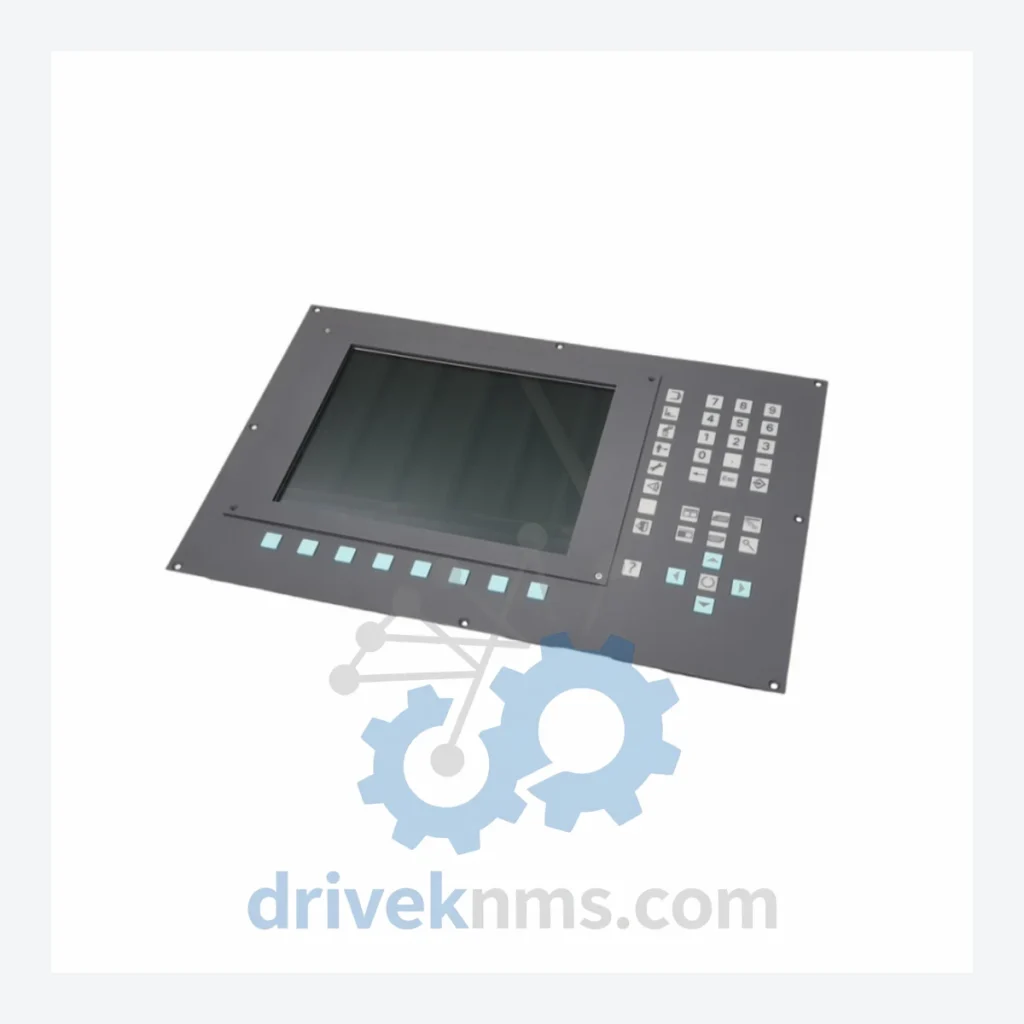
The second generation (2002–2012) introduced the OP 010, OP 010C, OP 010S, OP 012, and OP 015 panel families. These units transitioned to TFT flat-panel displays, retained MPI/PROFIBUS compatibility, and added Ethernet ports for network-based data transfer. The 6FC5203-0AF52-0AA0 belongs to this generation as an OP 012 variant — a 12.1-inch TFT color panel with integrated keyboard unit (IKB) interface, designed for front-panel mounting in SINUMERIK 840D sl systems. Compatibility issues in this generation primarily arise from firmware version mismatches between the PCU (PC Unit) and the panel's embedded communication firmware; cross-version upgrades require explicit Siemens compatibility matrices.
The third generation (2012–present) is represented by the OP 019 and TCU (Thin Client Unit) architecture, where display intelligence is offloaded to a centralized PCU 50.5 or PCU 50.3, and the panel itself becomes a thin client terminal. This shift introduced significant cabling and mounting incompatibilities with second-generation installations, making direct panel-for-panel substitution impossible without PCU hardware changes.
SINUMERIK Operator Panel Full Catalog & Functionalities (SKU List)
Operator Panels (OP Series)
- 6FC5203-0AF52-0AA0: OP 012, 12.1-inch TFT color panel, IKB interface, SINUMERIK 840D sl front-panel mount
- 6FC5203-0AF02-0AA0: OP 010, 10.4-inch TFT color panel, standard keyboard unit, 840D/840Di compatible
- 6FC5203-0AF02-2AA0: OP 010C, compact 10.4-inch variant, reduced-depth housing for space-constrained cabinets
- 6FC5203-0AF02-1AA0: OP 010S, slim-line 10.4-inch panel, side-mount keyboard bracket configuration
- 6FC5203-0AF62-0AA0: OP 015, 15-inch TFT color panel, extended display area for multi-axis visualization
- 6FC5203-0AF92-0AA0: OP 019, 19-inch widescreen TFT, TCU-compatible thin client panel, third-generation architecture
- 6FC5210-0DA00-0AA0: PCU 50.3, PC Unit for OP 010/012/015 panels, Windows XP Embedded, SINUMERIK 840D sl host
- 6FC5210-0DA01-0AA0: PCU 50.5, PC Unit, Windows 7 Embedded, dual-Ethernet, supports OP 019 and TCU topology
- 6FC5211-0AA00-0AA0: TCU (Thin Client Unit), panel-side terminal for PCU 50.5 distributed HMI architecture
- 6FC5203-0AB10-0AA0: OP 031, legacy MPI-bus monochrome panel, SINUMERIK 840C era, fully obsolete
- 6FC5203-0AB20-0AA0: OP 032, legacy MPI-bus color panel, 840C/early 840D, no current OEM support
- 6FC5247-0AA18-0AA0: Machine Control Panel (MCP) 483, 19-inch rack-mount operator station with axis selection keys
- 6FC5247-0AA38-0AA0: MCP 483C IE, Ethernet-connected machine control panel, 840D sl / 828D compatible
- 6FC5303-0AF10-0AA0: Handheld Unit (HHU), portable operator terminal with E-stop, 840D sl auxiliary interface
- 6FC5348-0AA08-0AA0: Operator Panel Front (OPF) 012, replacement front assembly for OP 012 housing, display and keypad only
- 6FC5500-0AA10-1AA0: SINUMERIK 828D PPU 240.2, integrated panel processing unit, 8.4-inch display, turning/milling
- 6FC5500-0AA11-1AA0: SINUMERIK 828D PPU 260.2, 10.4-inch integrated panel, extended axis count support
Quality Control for the SINUMERIK Operator Panel Range
SINUMERIK operator panels present specific quality verification challenges due to their integrated backplane communication architecture. Each panel contains an embedded communication module that negotiates protocol handshake with the connected PCU over a proprietary high-speed serial link. A panel that passes basic power-on and display tests may still fail in-system if this communication firmware is corrupted or version-mismatched.
DriveKNMS applies a four-stage verification protocol to all SINUMERIK operator panel units: (1) Visual and mechanical inspection — housing integrity, connector pin condition, display surface assessment, keyboard membrane continuity; (2) Standalone power-on test — verification of backlight operation, display initialization sequence, and absence of pixel defects across the full TFT matrix; (3) PCU communication test — each panel is connected to a reference PCU 50.3 running a validated SINUMERIK 840D sl software image; successful HMI boot and operator interface rendering confirms communication firmware integrity; (4) Keyboard and MCP interface test — all operator keys, axis selection switches, and override potentiometers are individually actuated and verified against expected signal outputs. Units that fail any stage are either routed to component-level repair or quarantined from inventory.