
SMC VCZ Series Circulating Fluid Valves: VCZW31-5G-15-04-J-X21 0190-11558
SMC VCZ Series: Comprehensive Circulating Fluid Valve Range and Technical Overview The SMC VCZ series is a dedicated line of…
Model: 0190-39554 W/ EX160-SDN2 VV5Q11-08-X1619 0063453490018 TLC534 F SAM E5AR E5AR-Q4B-323
Product Overview
Commercial availability is handled through direct RFQ, model verification and export-oriented follow-up rather than public cart checkout.
Datasheet Preview
Use attached product manuals when available. If the manual is not public yet, request the full file directly through RFQ.
Commercial Path
Product pages on DRIVEKNMS are designed to verify model, brand and series first, then move the buyer into one clean quotation path.
Technical Dossier
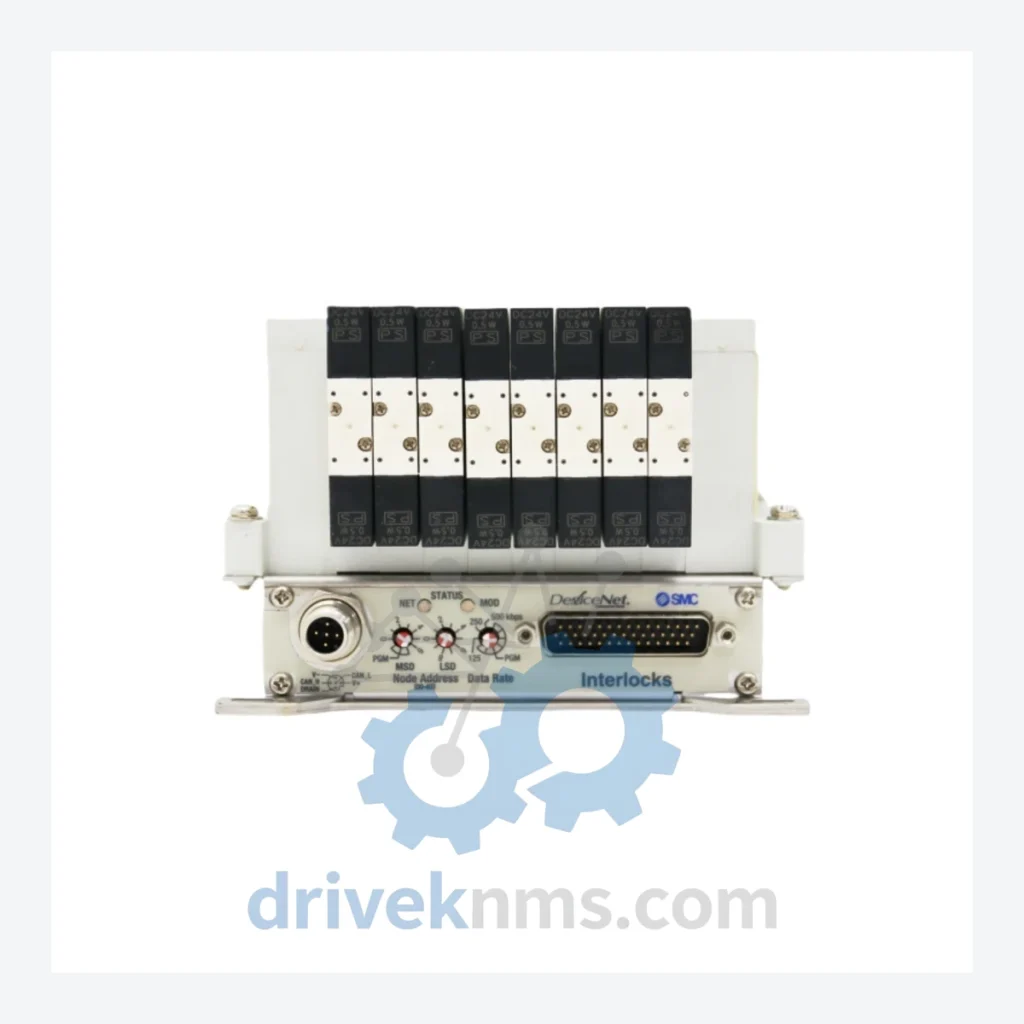
When a DeviceNet-based pneumatic manifold assembly fails on a production line built around SMC's EX160 fieldbus architecture, the replacement path is not straightforward. The EX160-SDN2 communication unit was designed for DeviceNet — a fieldbus protocol that reached end-of-active-development over a decade ago. New automation projects no longer specify it. Integrators who once stocked these assemblies have long since cleared their shelves.
What remains is a hard arithmetic problem for plant engineering teams: a single failed manifold assembly of this type can halt a multi-station pneumatic circuit. Replacing the entire control architecture — migrating from DeviceNet to EtherNet/IP or PROFINET, re-engineering the PLC logic, requalifying the line — carries a project cost that routinely exceeds six figures, plus weeks of lost production. Against that exposure, a verified spare assembly represents a fraction of the risk.
DriveKNMS maintains sourced inventory of legacy SMC assemblies including the 0190-39554 configuration. Stock is finite and not replenishable from standard distribution channels.
| Parameter | Detail |
|---|---|
| Assembly Part Number | 0190-39554 |
| Valve Manifold Series | SMC VV5Q11 |
| Manifold Stations | 8-slot |
| Fieldbus Communication Unit | SMC EX160-SDN2 |
| Communication Protocol | DeviceNet |
| Valve Series (Station) | VQ11 Series (per VV5Q11-08-X1619 configuration) |
| Included Sub-components | EX160-SDN2, VV5Q11-08-X1619, TLC534, E5AR, E5AR-Q4B-323 |
| Country of Origin | Japan |
| Fieldbus Status | DeviceNet – Legacy protocol, no new SMC product development |
| Availability Status | Hard-to-find / Legacy spare – not available through standard SMC distribution |
Note: Electrical parameters specific to this assembly configuration are verified against unit documentation at time of inspection. Parameters are not published here to prevent misapplication. Contact us for full datasheet confirmation prior to ordering.
The SMC EX160-SDN2 was the fieldbus gateway of choice for DeviceNet-integrated pneumatic systems throughout the 2000s and early 2010s. It allowed a single DeviceNet node to control up to 32 solenoid outputs across a VV5Q11 manifold bank — a compact, cost-effective architecture for automotive assembly, food processing, and semiconductor handling lines.
The problem facing maintenance engineers today is structural. DeviceNet scanners in the PLC rack — Allen-Bradley 1756-DNB, for example — are themselves aging hardware. The entire communication layer was designed as an integrated system. Replacing one node without disrupting the rest of the network requires an exact protocol match. A manifold assembly retrofitted with an EtherNet/IP gateway cannot simply substitute for an EX160-SDN2 node without PLC program modifications, network reconfiguration, and in many cases, a full revalidation cycle.
For a production environment where the line qualification documentation runs to hundreds of pages, that revalidation is not a maintenance task — it is a capital project. Procurement of a verified legacy spare is the only path that keeps the existing validation intact.
The strategy for extending the service life of DeviceNet-based pneumatic systems by 5 to 10 years rests on three pillars. First, maintain a minimum of one verified spare assembly per critical manifold station — not per line, per station. A single-point failure in an 8-slot manifold can idle the entire pneumatic circuit. Second, audit the DeviceNet scanner cards in the PLC rack on the same cycle as the manifold inspection. The communication layer and the field device must be treated as a matched set. Third, document the current firmware version of the EX160-SDN2 unit in service. SMC issued multiple firmware revisions for the EX160 series; a replacement unit with a mismatched firmware version can produce inconsistent node behavior on the DeviceNet network. DriveKNMS verifies firmware revision on all EX160-SDN2 units prior to shipment.
Plant managers facing pressure to retire legacy DeviceNet lines should weigh the full cost of migration against the cost of a structured spare parts program. A three-year spare parts reserve for a critical manifold station — covering the manifold assembly, the fieldbus unit, and the solenoid valve cartridges — typically costs less than 2% of the engineering budget required for a full fieldbus migration. The maintenance strategy does not require a capital appropriation. The migration does.
Legacy pneumatic manifold assemblies sourced outside of active distribution channels carry age-related failure risks that differ from standard spare parts. DriveKNMS applies a 5-step inspection protocol to all EX160-SDN2 and VV5Q11 assemblies before they are offered for sale.
Step 1 – Electrolytic Capacitor Assessment: The EX160-SDN2 power supply and communication circuitry contains electrolytic capacitors with a finite service life. Each unit is inspected for capacitor bulging, electrolyte leakage, and ESR deviation. Units with capacitor degradation are either reconditioned by qualified technicians or removed from inventory.
Step 2 – Firmware Version Verification: The firmware version of the EX160-SDN2 communication unit is read and recorded. This information is provided to the customer at time of shipment to confirm compatibility with the existing DeviceNet network configuration.
Step 3 – Pin and Connector Corrosion Inspection: All DeviceNet connector pins, solenoid valve connectors, and manifold sub-base contacts are inspected under magnification for oxidation, corrosion, and mechanical deformation. Affected contacts are cleaned or the unit is rejected.
Step 4 – Pneumatic Integrity Check: Manifold sub-base ports and internal galleries are checked for seal integrity. Valve cartridge seats are inspected for wear consistent with extended service.
Step 5 – Functional Communication Test: Where test equipment permits, the EX160-SDN2 unit is powered and its DeviceNet node address and communication parameters are verified to be configurable and stable.
Units that pass all five steps are classified as verified serviceable. Units that pass steps 1–3 and 5 but show cosmetic wear are classified as verified refurbished. Both classifications are disclosed at time of quotation.
The 0190-39554 assembly is a direct replacement for the same assembly in service. It requires no PLC program changes, no DeviceNet network reconfiguration, and no requalification of the pneumatic circuit — provided the replacement unit carries the same firmware revision as the unit being replaced (confirmed by DriveKNMS prior to shipment).
This drop-in replacement capability is the defining operational advantage of sourcing an exact spare over pursuing a cross-reference or protocol migration. Engineering time to commission a verified like-for-like replacement is measured in hours. Engineering time to commission a protocol migration is measured in months. The cost differential is not marginal.
For maintenance teams operating under a planned downtime window, DriveKNMS can provide pre-shipment documentation — including firmware version, inspection report, and sub-component serial numbers — to allow pre-staging of the replacement unit before the maintenance window opens.
What warranty applies to legacy spare parts?
DriveKNMS provides a 90-day warranty against defects in the supplied unit under normal operating conditions. Warranty terms are confirmed in writing at time of order. Extended warranty arrangements are available for volume orders — contact us to discuss.
How do I confirm the unit is new or quality-refurbished?
Every unit is accompanied by an inspection report generated during our 5-step QA process. The report identifies the unit's condition classification (verified serviceable or verified refurbished), firmware version, and any remediation steps performed. We do not sell units without a completed inspection record.
Should I stock more than one spare?
For any production line where this manifold assembly is a single point of failure, yes. The sourcing window for EX160-SDN2 assemblies in verified condition is narrowing as installed base units age out of service. Units available today may not be available in 18 months. A two-unit reserve — one active spare, one long-term reserve — is the minimum we recommend for critical applications.
Can you source specific sub-components separately?
In some cases, yes. The EX160-SDN2 fieldbus unit, VV5Q11 manifold sub-base, and valve cartridges can sometimes be sourced individually. Contact us with your specific requirement and we will advise on availability.
© 2026 DriveKNMS. All trademarks belong to their respective owners. Specifications are for reference only and subject to change without notice. Verify all parameters against official documentation before installation.
Related Paths
SMC VCZ Series: Comprehensive Circulating Fluid Valve Range and Technical Overview The SMC VCZ series is a dedicated line of…
SMC SQ2431N-5-C6-Q Solenoid Valve: Global Sourcing Strategy & Asset Return Value The SMC SQ2431N-5-C6-Q is a 4/2-way single-solenoid valve from…
SMC VV5Q11-10-X3105V Pneumatic Manifold – Obsolete Series Spare Part When a pneumatic manifold fails on a production line built around…