Technical Dossier
Product Details And Specifications
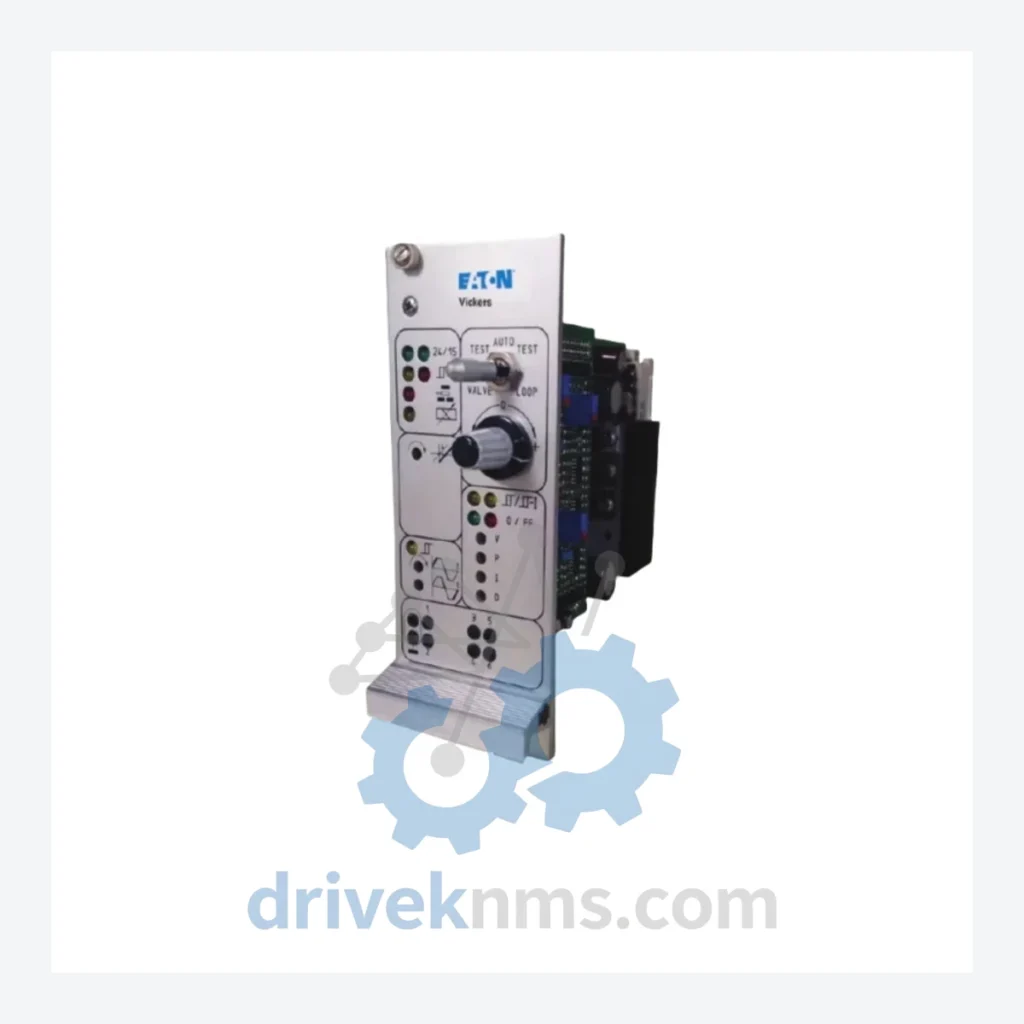
Vickers EEA-PAM513A32-EN53 6025852-001 Proportional Amplifier Card – Obsolete Vickers Spare Part
RFQ support for obsolete parts: Send the model number, required quantity and destination so DriveKNMS can confirm sourcing options before quotation.
Technical Specifications
| Manufacturer | Vickers (now Eaton Hydraulics) |
| Part Number | EEA-PAM513A32-EN53 |
| Reference Number | 6025852-001 |
| Component Type | Proportional Valve Amplifier Card |
| Product Series | EEA-PAM Series |
| Discontinuation Status | Discontinued / Obsolete – No longer in production |
| Country of Origin | United States |
| Typical Application | Proportional directional control valves in industrial hydraulic systems |
| Compatible Systems | Vickers legacy hydraulic control systems; older PLC-integrated hydraulic axes |
Note: Electrical parameters such as supply voltage, input signal range, and output current specifications are not published here to avoid inaccuracy. Please contact us with your system documentation for confirmation before ordering.
Solving the Discontinued Hardware Crisis
The EEA-PAM513A32-EN53 belongs to Vickers' EEA-PAM proportional amplifier series — a product line that was central to industrial hydraulic motion control throughout the 1990s and 2000s. These cards were embedded into presses, injection molding machines, die casting equipment, and heavy-duty test rigs that remain in active production today. Vickers, now operating under the Eaton Hydraulics brand, discontinued this series as the industry transitioned toward integrated digital valve electronics. No direct OEM replacement exists that is pin-compatible and functionally equivalent without system-level re-engineering.
For plant managers facing this situation, the decision tree is stark: source the original card, or commit to a capital project. The capital project path involves not just hardware costs but engineering hours, new software integration, safety re-certification, and weeks of production loss. The original card path — when a verified unit can be located — costs a fraction of that and restores the line within days. This is the operational reality that defines the value of maintaining access to obsolete industrial components.
Condition & Reliability Assurance
Sourcing a discontinued amplifier card from the secondary market carries legitimate risk. DriveKNMS applies a structured 5-step inspection protocol before any unit is offered for sale:
Step 1 – Electrolytic Capacitor Assessment: Amplifier cards of this era rely on electrolytic capacitors that degrade over time regardless of usage. Each unit is inspected for capacitor bulging, leakage, and ESR deviation. Units with compromised capacitors are either reconditioned by qualified technicians or removed from inventory.
Step 2 – Firmware Version Verification: Where version markings are present on the PCB or EPROM, the firmware revision is documented and disclosed. This allows the end user to confirm compatibility with their existing system configuration before installation.
Step 3 – Pin and Connector Inspection: All edge connectors and terminal pins are examined under magnification for oxidation, corrosion, and mechanical deformation. Corroded contacts are the leading cause of intermittent faults in legacy amplifier cards and are treated as a disqualifying defect.
Step 4 – Board-Level Visual Inspection: The PCB is inspected for cracked solder joints, burnt components, and trace damage — failure modes common in cards that have experienced power surges or thermal stress in service.
Key Features for System Maintenance
The primary operational advantage of sourcing the original EEA-PAM513A32-EN53 is that it is a direct drop-in replacement for the failed unit. The card slots into the existing mounting position, connects to the existing wiring harness, and — provided the replacement unit carries the same firmware revision — requires no reprogramming of the upstream PLC or motion controller. This eliminates the engineering cost associated with any alternative approach.
Q: How do I know the unit is genuine and not a counterfeit?
A: All units are sourced through documented supply channels. Markings, board revisions, and component dates are cross-referenced against known genuine units. Where provenance documentation is available, it is provided to the buyer. We do not sell units where authenticity cannot be reasonably established.