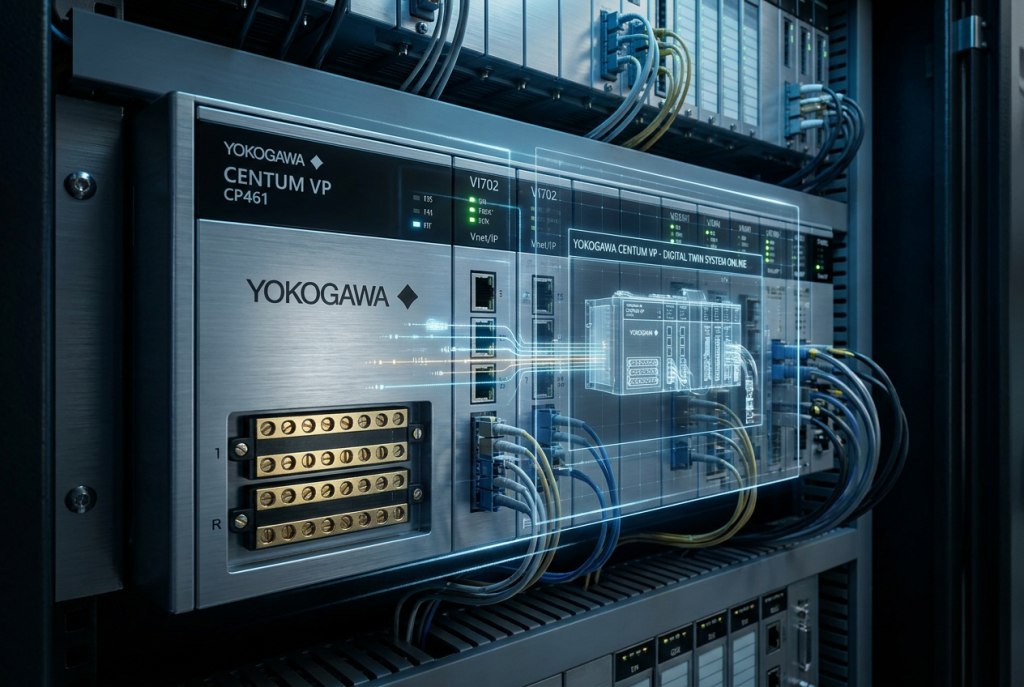
As we cross the halfway mark of 2026, the global process automation community is marking a milestone that few platforms ever reach: the 50th Anniversary of Yokogawa’s CENTUM series. Since its debut in 1975, CENTUM has defined the gold standard for high-availability Distributed Control Systems (DCS). However, as Yokogawa celebrates this half-century of innovation with the aggressive rollout of CENTUM VP Release 7 (R7), a different reality is unfolding in the maintenance shops and procurement offices of the world’s chemical plants and refineries. We are entering what I call the “Transition Scarcity” phase, where the push for autonomous operations is colliding with the physical reality of legacy hardware fatigue.
As an engineer who has commissioned CENTUM systems ranging from the classic XL to the current R6, I’ve observed that 2026 has become a year of “forced decisions.” The OEM’s vision for R7 is centered on cloud-native integration and AI-driven orchestration. It is a magnificent vision, but for the reliability engineer responsible for a R5 or R6 node that has been running flawlessly for a decade, the “R7 Promise” comes with a hidden cost: the accelerated sunset of the very hardware modules that keep those legacy nodes alive. Today, we audit the state of Yokogawa hardware sovereignty and how to navigate the R5/R6 supply chain void in 2026.
The Vnet/IP Bottleneck: The 2026 Scarcity Audit
The core of the CENTUM VP architecture is the Vnet/IP network—a dual-redundant, high-speed control communication bus. In 2026, the primary point of failure for legacy systems isn’t the software; it’s the VI702 Vnet/IP Interface Cards and the CP461/CP471 Field Control Unit (FCU) Processors. As Yokogawa optimizes its manufacturing lines for the newer, high-density R7 components, the availability of these specific R5/R6-era cards has hit a critical low.
I recently spoke with a procurement manager for a major LNG facility who was told that the lead time for a verified CP461 processor was stretching into 30 weeks. This is the “Scarcity Spike” of 2026. For a system that promises 99.99999% availability, a 30-week wait for a critical spare is effectively a 30-week risk of a total plant trip. Maintaining hardware sovereignty means securing a stable inventory of PLC and DCS control modules before the OEM’s “Limited Support” phase turns into a total supply vacuum. In the current market, an audited, technically verified spare card is worth its weight in gold.
CENTUM VP R5 vs. R7: The Lifecycle Gap
The gap between the “legacy” R5/R6 systems and the “modern” R7 is widening. Yokogawa’s newest branding focuses heavily on “Integrity” and “Autonomy.” While these features are essential for the next generation of smart factories, they often require a total backplane and network overhaul. For many plants, the “Migration Fatigue” is real. The engineering hours required to port a complex R5 configuration into an R7 environment can be staggering, often leading to commissioning bugs that threaten the very stability the system is supposed to provide.
The expert’s choice in 2026 is often “Continuity over Complexity.” If your CENTUM VP R5 or R6 system is meeting your production needs, the most pragmatic move is to double down on your existing architecture by securing brand and model specific spares. This allows you to manage your migration roadmap on your own schedule, not the OEM’s manufacturing cycle. At DriveKNMS, we have seen a 45% increase in requests for audited **VI701/VI702** cards and **AIP series** communication modules as plants choose to extend their R5/R6 lifecycles into the 2030s.
Auditing the ‘Air-Gapped’ Security of 2026
The June 2, 2026 CISA advisories highlighted a growing trend: vulnerabilities in legacy communication protocols that were never designed for a connected world. For CENTUM users, this creates a dilemma. The R7 platform offers “Security by Design,” but it also requires more connectivity to the corporate cloud. For those committed to “Hardware Sovereignty,” the solution is a “Hardened Legacy” approach. This involves keeping the legacy hardware in place but isolating it with robust, unidirectional gateways while maintaining a “Deep Reserve” of spares to ensure that physical component failure doesn’t compromise the air-gap.
Resilience in 2026 is about having a redundant supply of monitoring and control system hardware that has been audited for both physical integrity and firmware consistency. We’ve found that many legacy CENTUM modules fail not because of chip wear, but because of capacitor aging in the internal power supply circuits of the cards. A proper technical audit of your spares can identify these “Hidden Failures” before the card is ever called into emergency service.
The 2026 Yokogawa CENTUM Resilience Checklist:
- Vnet/IP Health Check: Have you audited the error logs on your VI702 cards recently? Intermittent “Bus Faults” are often the first sign of a card nearing its end-of-life.
- Processor Redundancy Audit: Do you have at least one verified CP461 or CP471 card in reserve for every redundant pair in your plant?
- Capacitor Aging Audit: For modules installed before 2015, have you performed a thermal imaging or ESR (Equivalent Series Resistance) check on the power supply capacitors?
- Strategic Sourcing: Have you identified a partner for emergency Yokogawa DCS hardware that provides full technical verification reports?
Conclusion: The Future is Your Decision
The 50th Anniversary of Yokogawa CENTUM is a testament to the platform’s enduring quality. But the transition to Release 7 is a reminder that in the world of industrial automation, “Newer” isn’t always “Better” if it comes at the expense of your immediate reliability. By securing your inventory of audited R5/R6 spares today, you reclaim your hardware sovereignty and ensure that your plant’s future is determined by your expertise, not an OEM’s phase-out schedule.
Frequently Asked Questions (FAQ)
1. Can I use VI702 cards in a system originally commissioned with VI701 cards?
Yes, the VI702 is generally backward compatible with VI701 systems, but you must ensure that your Vnet/IP driver and CENTUM VP software version (R5.03 or higher) can recognize the newer hardware. Always perform a firmware audit before replacing a critical communication card.
2. Is it possible to migrate from CENTUM VP R5 to R7 without replacing my Field Control Units (FCUs)?
While some “software-only” upgrades are possible, the full benefits of R7—especially the AI-driven autonomous features—often require the newer, more powerful FCU processors. For many, a “Hybrid Migration” is the best path, keeping old I/O while upgrading the processors and network cards.
3. Why are lead times for Yokogawa AIP modules so high in 2026?
The AIP series communication modules (like the AIP827) use specialized communication chips that have seen reduced production runs as foundries prioritize newer-generation automotive and AI silicon. This “Silicon Scarcity” is the primary driver of lead times for legacy Yokogawa parts in 2026.
4. What is the biggest risk of buying Yokogawa spares from unverified surplus dealers?
The biggest risk is “Firmware Inconsistency.” A card might “power up” but have a firmware version that is incompatible with your rack, leading to a redundant-sync failure that could trip your entire controller. At DriveKNMS, every Yokogawa card undergoes a full firmware and functional audit.
Running low on Yokogawa CENTUM VP or Vnet/IP spares?
Don’t wait for a plant trip to reveal a gap in your supply chain. Contact DriveKNMS for a technical consultation and an immediate quote on audited Yokogawa CP461, VI702, and AIP series hardware.
Email: sale@driveknms.com | WhatsApp: +86 18359293191
Direct Inquiry: Request a Quote Directly
© 2026 DriveKNMS. All rights reserved. Official Website: https://driveknms.com Inquiry: sale@driveknms.com | WhatsApp/Tel: +86 18359293191