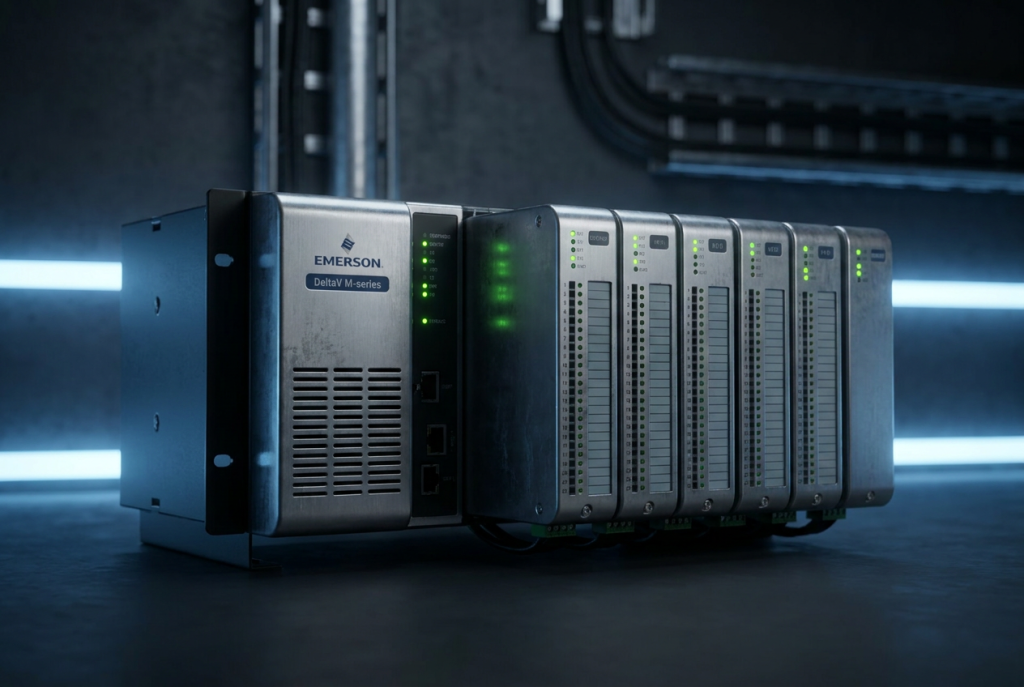
In the world of distributed control systems (DCS), the start of 2026 was marked by a major milestone: the release of Emerson DeltaV Version 16.LTS. This latest iteration is more than just a software patch; it represents a fundamental pivot toward “Software-Defined Automation.” For the modern plant, v16 offers boundless integration and enhanced cybersecurity. But for the thousands of facilities still running on legacy DeltaV M-series hardware, this announcement serves as a sobering reminder of the ticking clock on physical hardware support.
As an expert who has watched the DeltaV platform evolve from its inception, I’ve seen the industry cycle through many “next big things.” However, the 2026 shift feels different. The push toward the S-series and the universal I/O of CHARMs (Characterization Modules) is accelerating, leaving the venerable M-series controllers and traditional I/O cards in a “scarcity spike.” If your facility is among those whose core logic still resides on an MD or MX controller, the mid-2026 landscape requires a strategic reassessment of your hardware resilience.
The M-Series Scarcity: Why 2026 is the Year of the Hardware Squeeze
The Emerson DeltaV M-series was built for a different era of manufacturing—one where durability outweighed data velocity. While these controllers are famously robust, the specialized semiconductors required to maintain and repair them are being phased out of global silicon foundries. With the launch of v16.LTS, the OEM’s attention has shifted almost entirely to the software-defined capabilities of the next generation.
In May 2026, we are seeing lead times for critical M-series components, such as the VE3008 and VE3007 processors, stretch beyond 26 weeks in some regions. This isn’t just a supply chain hiccup; it’s a symptom of a legacy portfolio reaching its true end-of-life. For a facility manager, a single card failure without an on-site spare isn’t just an inconvenience—it’s a multi-month threat to production. This is why “Hardware Sovereignty”—the physical possession of audited, tested spares—is the only way to retain control over your migration schedule.
Migration Pressure: The Reality of ‘Software-Defined’ Constraints
Emerson’s vision for “Boundless Automation” is built on a software-defined architecture. While this reduces total cost of ownership in the long run, the immediate hurdle for M-series users is the migration gap. Upgrading from v14 or v15 to v16.LTS often highlights the incompatibility of older hardware revisions. You might find that your legacy controllers lack the processing overhead required to handle the enhanced security protocols and data throughput of the new release.
Many plants are being “forced” into migrations they aren’t budgetarily ready for. My advice to reliability engineers is this: Use inventory as a bridge. By securing a robust stock of PLC and DCS modules, you can maintain your existing M-series environment for another 5-7 years, allowing for a planned, rather than reactive, transition to the S-series or PK controllers on your terms.
The 2026 Security Mandate: Legacy Firmware and CISA Advisories
Cybersecurity is the silent driver of hardware obsolescence. The latest CISA advisories from May 2026 (including the broader ICS security mandates) emphasize the vulnerability of legacy communication stacks. Older M-series hardware often lacks the hardware-based encryption and secure boot capabilities that are standard in the S-series. If you are running an M-series system in a connected environment, you are essentially managing a “Resilience Gap.”
The OEM solution is usually a full hardware refresh. However, if a refresh isn’t in this year’s Capex, you must focus on the “Hard-Layer Defense.” This involves maintaining the physical integrity of your system with identical hardware replacements that are known-good and audited. In 2026, the reliability of your brand and model specific spare parts is your primary insurance policy against downtime caused by failed, un-patchable legacy boards.
Building a Strategic Spare Parts Reserve
Navigating the 2026 scarcity requires a granular audit of your racks. Don’t just look at what’s in use; look at what’s in the bin. Are your spare M5 or MX controllers truly tested, or are they “best-guess” pulls from a decommissioned unit? As lead times increase, the “Expert-to-Expert” supply chain becomes critical. You need a partner who understands the firmware compatibility between an older VE3006 and a newer v16 environment.
The 2026 DeltaV Resilience Checklist:
- Controller Audit: Do you have 2:1 redundancy for your critical MD and MX controllers on-site?
- I/O Card Scarcity: Have you mapped the lead times for your most common AI and DI cards?
- Firmware Mapping: Are your legacy spares compatible with your current DeltaV software release?
- Supply Chain Diversity: Have you established a relationship with a non-OEM source for emergency DCS spare parts?
Conclusion: Resilience is a Choice, Not a Product
The release of DeltaV v16.LTS is a sign of progress, but for the maintenance professional, progress must be balanced with stability. The Emerson M-series remains a masterpiece of industrial engineering, and with the right hardware strategy, it can continue to serve your facility long after the OEM has moved on. By securing your supply of audited spares today, you protect your plant against the “forced” upgrades of tomorrow.
Frequently Asked Questions (FAQ)
1. Can I run DeltaV v16.LTS on my existing M-series controllers?
While some late-revision M-series controllers are supported, many older MD and MX units lack the memory and processing power to handle the v16 security features. You must check the specific hardware revision numbers against the v16 compatibility matrix.
2. Is it safe to buy “refurbished” DeltaV M-series cards for safety-critical loops?
Reliability depends entirely on the auditing process. A “refurbished” card should undergo full-load testing, NVRAM battery replacement, and thermal stress testing. At DriveKNMS, we treat every legacy card with the same scrutiny as a new unit to ensure mission-critical performance.
3. What is the most common failure point in legacy DeltaV controllers?
Thermal degradation of electrolytic capacitors and the failure of NVRAM batteries are the most common issues in cards that have been in service for 10+ years. Proactive replacement of these components in your spare stock is essential.
4. How does ‘Software-Defined Automation’ affect my spare parts strategy?
As automation becomes more software-defined, the physical hardware becomes more commoditized but also more specialized. This means that while new systems are flexible, legacy systems like the M-series require exact, part-number-specific hardware that is becoming harder to find.
Running low on Emerson DeltaV spares?
Don’t wait for a controller fault to reveal a gap in your supply chain. Contact DriveKNMS for a technical consultation and immediate quote on audited M-series and S-series hardware.
Email: [email protected] | WhatsApp: +86 18359293191
Request a Quote: Direct Inquiry Form
© 2026 DriveKNMS. All rights reserved. Official Website: https://driveknms.com Inquiry: [email protected] | WhatsApp/Tel: +86 18359293191