Technical Dossier
Product Details And Specifications
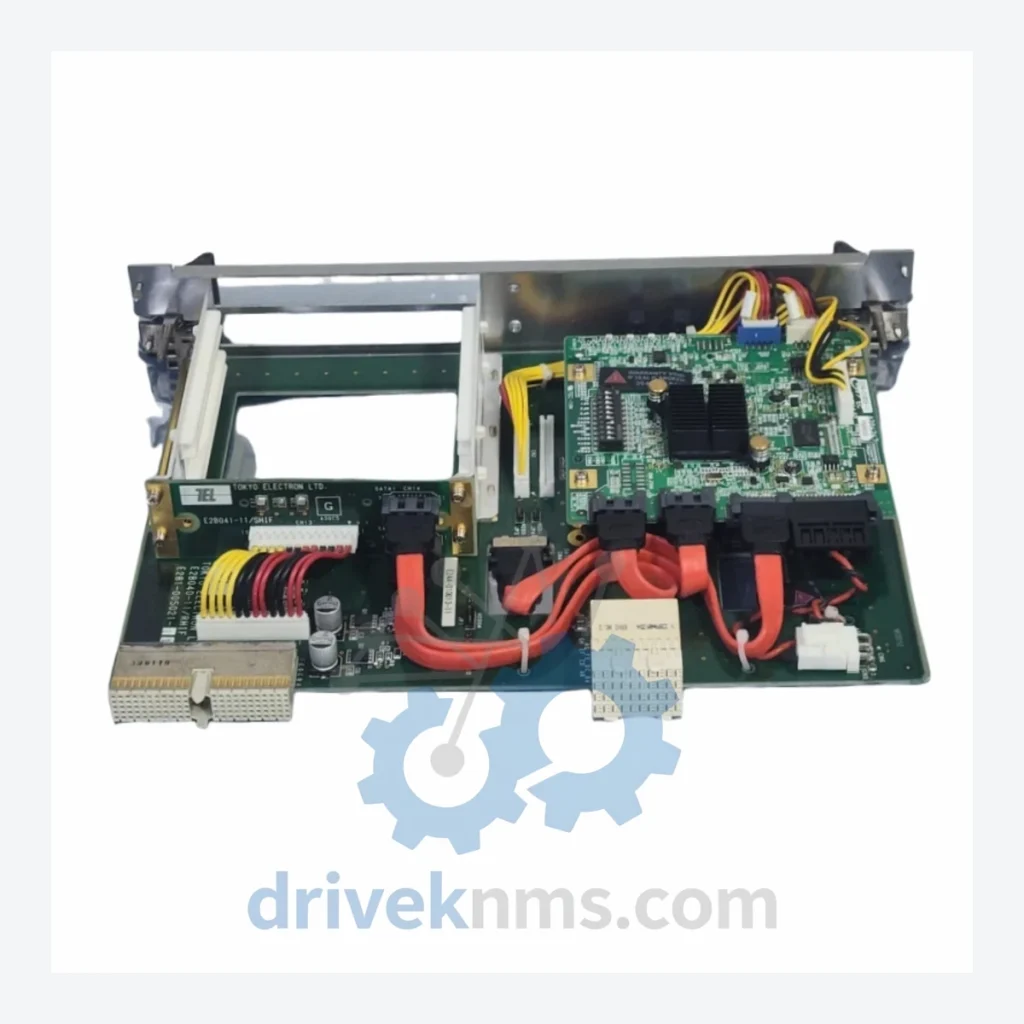
TOKYO E2B040-11/RHIF E281-005021-11 E244-010035-11 Circuit Board – Obsolete Drive Control Spare Part
When a control circuit board fails in a legacy drive system, the consequences extend far beyond a single component. For facilities still operating TOKYO-branded drive controllers — common in elevator traction systems, industrial hoists, and variable-speed motor control applications — the discontinuation of boards such as the E2B040-11/RHIF E281-005021-11 E244-010035-11 creates a procurement crisis that standard channels cannot resolve. A full system replacement, including engineering assessment, new drive installation, rewiring, commissioning, and production downtime, routinely runs into the hundreds of thousands of dollars. In contrast, a verified replacement board from existing stock eliminates that cost entirely. DriveKNMS maintains sourced inventory of discontinued industrial control components specifically to protect facilities from this scenario.
Technical Specifications
| Parameter | Detail |
| Part Number | E2B040-11 / RHIF E281-005021-11 / E244-010035-11 |
| Manufacturer | TOKYO (Toyo Denki Seizo K.K.) |
| Component Type | Drive Control Circuit Board |
| Country of Origin | Japan |
| Discontinuation Status | Obsolete – No longer in OEM production |
| Typical Application | Elevator traction drive control, industrial variable-speed drive systems |
| Compatible Systems | TOKYO VF-series and legacy drive controller platforms |
Note: Electrical parameters such as voltage ratings and signal specifications are not published here to prevent misapplication. Verified compatibility data is provided upon request based on your system configuration.
Solving the Discontinued Hardware Crisis
The TOKYO E2B040-11 board series served as the core control interface in drive systems deployed across elevator installations and industrial motor control panels throughout the 1990s and 2000s. These systems were engineered for 20–30 year service lives, and many remain in active operation today. The problem is straightforward: TOKYO ceased production of this board series years ago, and authorized distributors exhausted their stock long before most facilities recognized the exposure.
When this board fails — whether from capacitor degradation, power surge damage, or firmware corruption — the drive system goes offline. For elevator applications, this means immediate loss of vertical transport. For industrial lines, it means unplanned production stoppage. The OEM replacement path no longer exists. The only viable options are: locate a verified spare from the secondary market, or commit to a full system overhaul.
Facilities that have already secured one or more spare boards of this type have effectively insured their drive system against the most disruptive failure mode possible. Those that have not are operating under unquantified risk. DriveKNMS sources, inspects, and holds inventory of boards in this category specifically to serve facilities in this position.
Extending Automation Asset Life by 5–10 Years: A Practical Strategy for Plant Management
The decision to replace a functioning drive system is rarely made on technical grounds alone. It is made when the cost and risk of maintaining the existing system exceeds the cost of replacement — and that calculation changes dramatically when critical spare parts are available.
For plant managers and maintenance engineers operating legacy TOKYO drive systems, the following approach has proven effective in extending asset service life without major capital expenditure:
1. Identify single-point-of-failure boards. The E2B040-11 control board is the most failure-prone component in this drive platform due to electrolytic capacitor aging. A single spare board on the shelf eliminates the primary failure risk.
2. Establish a condition-monitoring baseline. Document current drive performance parameters — output frequency stability, response time, fault log history — so that early degradation is detectable before failure occurs.
3. Negotiate a phased replacement timeline. With a spare board secured, facilities gain the negotiating position to plan system upgrades on their own schedule rather than under emergency conditions. This alone typically reduces total replacement cost by 30–50% compared to emergency procurement.
4. Maintain firmware version records. Legacy TOKYO drives are sensitive to firmware version mismatches. Retaining documentation of the installed firmware version ensures that any replacement board can be configured correctly without trial-and-error commissioning.
5. Treat spare boards as capital assets. A verified spare board for a discontinued drive system has a defined and increasing value over time as remaining inventory in the market contracts. It is not a consumable — it is an insurance asset.
Condition & Reliability Assurance
All boards supplied by DriveKNMS for discontinued part numbers undergo a structured 5-step inspection process before shipment:
Step 1 – Visual and Physical Inspection: Full board surface examination for mechanical damage, burn marks, cracked solder joints, and component displacement.
Step 2 – Electrolytic Capacitor Assessment: Capacitors are the primary failure point in boards of this age. Each capacitor is checked for bulging, leakage, and ESR deviation. Boards with degraded capacitors are either recapped or removed from serviceable inventory.
Step 3 – Pin and Connector Integrity Check: All edge connectors and pin headers are inspected for corrosion, oxidation, and mechanical deformation. Affected contacts are cleaned or the board is downgraded.
Step 4 – Firmware Version Verification: Where applicable, onboard firmware or EPROM version is documented and disclosed to the buyer prior to shipment.
Step 5 – Functional Classification: Each board is classified as New (sealed OEM stock), Tested Serviceable (pulled from operational equipment, tested), or Refurbished (repaired and retested). Classification is stated explicitly on the invoice.
Key Features for System Maintenance
Drop-in replacement: The E2B040-11 board installs directly into the existing drive chassis using the original mounting points and connectors. No mechanical modification is required.
No reprogramming required: Drive parameter sets stored in the main controller are retained during board replacement. Standard commissioning procedures apply — there is no requirement for full system re-engineering.
Avoids engineering reconstruction costs: Replacing this board preserves the existing drive architecture, eliminating the need for new cable runs, updated safety certifications, or retraining of maintenance personnel — costs that accompany any full system replacement.
Immediate availability: Unlike OEM lead times that no longer exist for this part, DriveKNMS ships from existing physical inventory. Lead time is determined by logistics, not production.
FAQ
Q: What warranty applies to obsolete parts?
A: DriveKNMS provides a 90-day warranty on all tested serviceable and refurbished boards, covering functional failure under normal operating conditions. New sealed stock carries a 12-month warranty. Warranty terms are confirmed in writing at the time of order.
Q: How do I confirm this is a genuine board and not a counterfeit?
A: All boards are sourced through documented supply chains. Upon request, we provide sourcing documentation, inspection records, and high-resolution photographs of the specific unit prior to shipment. We do not ship boards that cannot be traced to a verifiable source.
Q: Should I purchase more than one unit?
A: For facilities with multiple drive systems using this board, holding two or more spares is the standard recommendation. As remaining market inventory contracts, procurement becomes progressively more difficult and expensive. Purchasing additional units now locks in current pricing and eliminates future sourcing risk.
Q: Can you source this board if it is not currently in stock?
A: Yes. DriveKNMS maintains an active sourcing network for discontinued industrial components. If current stock is depleted, contact us with your requirement and timeline — we will initiate a sourcing search at no obligation.