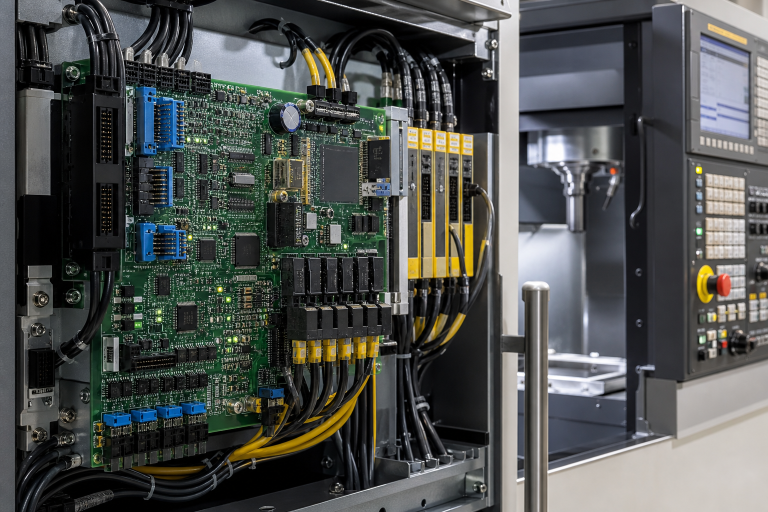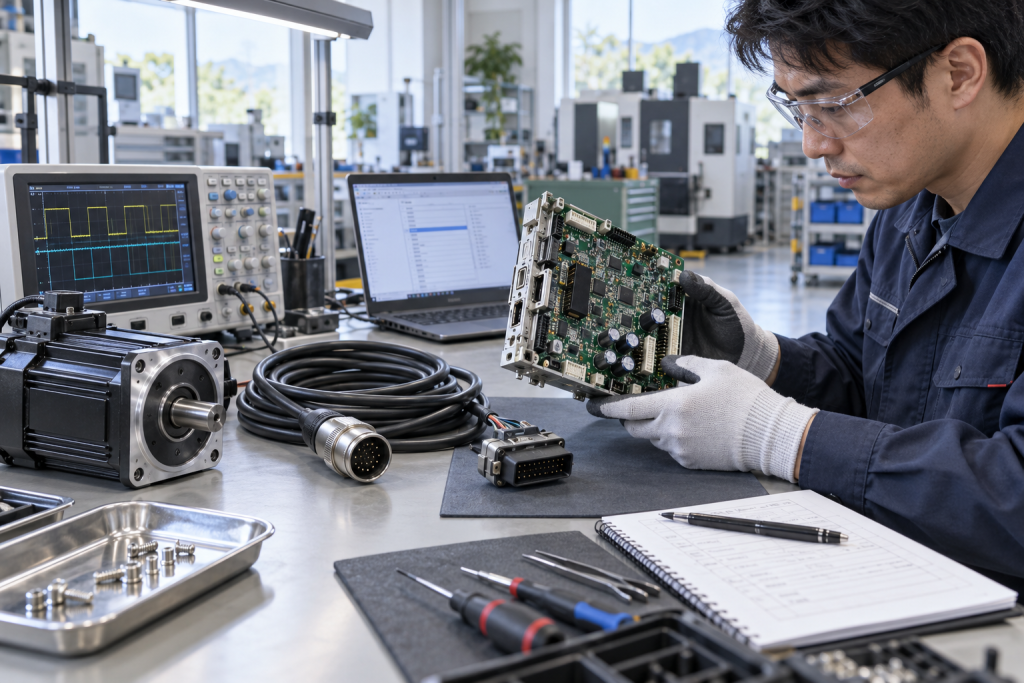
An older servo axis can stop production with an alarm that appears to blame the amplifier or its control board. The board is an understandable procurement target, especially when the manufacturer has moved the family into legacy status. But a servo system is a chain of motor, encoder, cable, amplifier power stage, control board, parameters, braking circuit and mechanical load. Replacing the board without separating those paths can produce a second failure at commissioning and leave the original defect unexplained.
Panasonic MINAS equipment is often embedded in machines where the original program, tuning values and encoder wiring are more important than the name on the front panel. A disciplined diagnosis protects the machine data and gives procurement enough evidence to find a usable obsolete spare.
Capture the axis before opening the cabinet
Record machine, axis, amplifier model, complete board designation, motor, encoder type, feedback cable, brake, firmware or parameter revision, alarm history and the last-known-good cycle. Photograph the board label, connectors, cable routing, grounding, cooling path and terminal positions. Save the servo parameters, electronic gearing, limits, homing data and tuning values through the approved engineering toolchain.
Describe the symptom in motion terms: no enable, overcurrent at acceleration, encoder alarm, position error, vibration, thermal trip, intermittent reset or loss of homing. Note whether the symptom follows speed, load, direction, temperature or cable movement. A board that faults only during acceleration may be reacting to a motor, power stage or mechanical load rather than failing at idle.
Check feedback and power separately
Inspect the encoder connector, shield, strain relief and cable for crushed sections, oil, flex fatigue or loose pins. Check supply and grounding under the site’s electrical safety procedure. Confirm brake release, motor insulation, phase wiring and mechanical freedom. Do not disconnect a feedback cable on an energized axis, and do not force motion merely to reproduce a fault.
Review amplifier diagnostics and compare them with a known-good axis if the machine permits. A feedback fault that moves with the cable points in a different direction from one that stays with the amplifier input. An overcurrent alarm requires attention to motor phase, insulation, acceleration profile, mechanical binding and power electronics. Preserve the original board and its connectors before swapping.
Define an obsolete-board spare correctly
For a legacy servo board, specify the exact board number, compatible amplifier family, revision, connector arrangement, motor and encoder system, parameter backup, condition expectation, quantity and required date. Ask whether the board is new old stock, repaired or tested used. Require a clear test scope: inspection, power-up, communication, parameter handling, encoder interface, alarm behavior and what could not be simulated.
The Panasonic 581B740C MINAS circuit board is a published product example for an obsolete servo spare. Confirm the installed amplifier, revision and machine application before treating it as a match. A connector that fits does not prove that the control board has the same feedback interface, firmware expectation or tuning behavior.
Prepare the replacement test
Before the outage, back up the complete axis configuration and agree who can load parameters and release the machine. At replacement, verify board identity, connector seating, cable shield, cooling, power, motor phase and brake wiring. Load the approved parameters through the controlled procedure and compare the read-back with the saved file. Do not use an unverified laptop copy simply because it is newer.
Test enable, jog, homing, direction, speed, position error, brake behavior, limits and the machine handshake at a safe state. Compare current, following error, cycle time and repeatability with the baseline. Test the axis through representative load if the procedure allows. Remove temporary overrides and confirm that the machine returns to its approved mode.
Keep the removed board tagged until the failure review closes. If the replacement does not fix the alarm, return to feedback, motor, mechanical load and parameters rather than consuming another board. Record serial numbers and test results so a repaired spare does not re-enter inventory without a known disposition.
When the axis is safety or quality critical, include the servo recovery record in the machine’s standard maintenance package. Note the last verified homing position, the mechanical reference, the safe speed used during testing, and the person who accepted the first production cycle. If the machine has multiple identical axes, compare their parameter structures without copying values blindly. Small differences in motor inertia, encoder resolution, gearing, or load can make a seemingly identical parameter file unsuitable. Keeping this evidence with the board number also helps the sourcing team decide whether a board-only spare is enough or whether an amplifier, cable, or complete tested assembly should be held as the recovery unit.
Questions motion teams ask
Does an encoder alarm prove the servo board is bad?
No. Inspect the encoder, cable, connector, grounding, motor and input configuration before condemning the board.
Is a repaired MINAS board safe for production?
It can be considered only with disclosed condition, compatible identity and a test scope that covers the installed application and its limits.
What data must be backed up before a board swap?
Save parameters, homing, limits, gearing, tuning, motor and encoder identity, machine program context and the last-known-good baseline.
What should an urgent servo RFQ contain?
Include full board and amplifier numbers, revision, motor and encoder details, symptoms, photos, condition expectation, quantity and required date.
Protect the axis data with the spare
Legacy servo recovery is faster when the board, feedback path and parameters are treated as one controlled system. Send labels, alarm history and the parameter context to DriveKNMS. We can help verify the published MINAS item and quote its condition without replacing the site’s engineering acceptance process.
© 2026 DriveKNMS. All rights reserved. Official Website: https://driveknms.com Inquiry: sale@driveknms.com | WhatsApp/Tel: +86 18359293191