Technical Dossier
Product Details And Specifications
AMAT JAGUAR-II Series Technical Notes
The Evolution of JAGUAR-II Architecture
The JAGUAR-II platform succeeded the original JAGUAR-I controller architecture, which was introduced in the early 1990s as AMAT transitioned from discrete relay-based equipment control to integrated VME-bus and proprietary backplane designs. JAGUAR-II introduced a higher-density interconnect layer, improved EMI shielding on signal lines, and a revised power distribution topology compatible with 48V DC subsystem rails. The architecture supports both legacy RS-422 serial communication stacks and later-generation Ethernet-based equipment interfaces, making it a transitional platform that bridges two generations of fab automation standards. Compatibility with AMAT's Equipment Front End Module (EFEM) and SECS/GEM communication layers is maintained through dedicated interface cards within the JAGUAR-II chassis. As AMAT has progressively migrated newer tool platforms to the CENTURA and PRODUCER series controllers, JAGUAR-II has entered a mature/end-of-life support phase. Field-installed units remain in active production at fabs operating legacy tool sets, creating sustained demand for OEM-equivalent spare parts and refurbished assemblies.
JAGUAR-II Full Catalog & Functionalities (SKU List)
The following SKUs represent verified components within the AMAT JAGUAR-II ecosystem, organized by functional category:
Interconnect & Backplane Assemblies
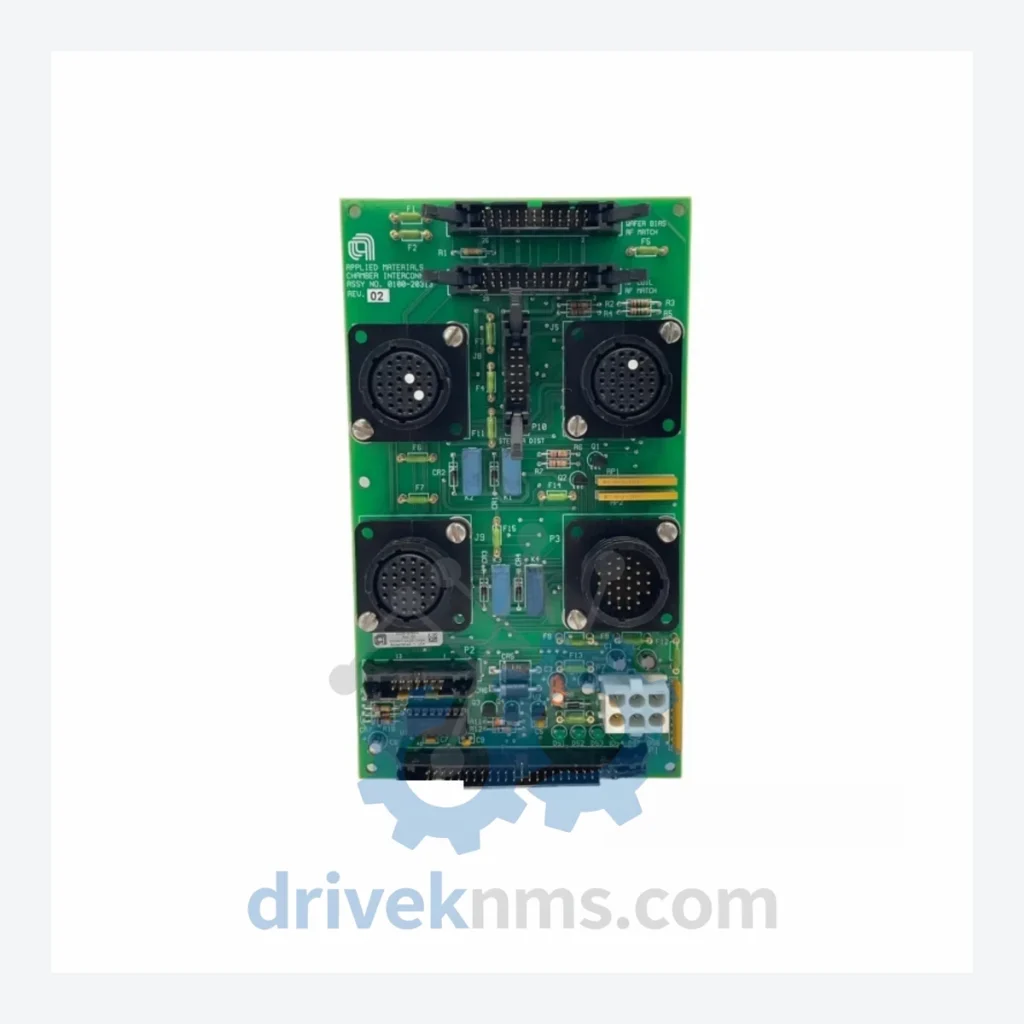
- 0100-20313 / 2305618-A: JAGUAR-II internal signal interconnect board, routes control signals between subsystem I/O layers and the main controller backplane.
- 0100-20314: JAGUAR-II secondary interconnect assembly, used in dual-chamber tool configurations for cross-chamber signal isolation.
- 0100-20315: Backplane extension board for JAGUAR-II expanded I/O chassis configurations.
Controller & CPU Modules
- 0100-09042: JAGUAR-II main CPU board, VME-bus architecture, 68040 processor, primary process sequencer.
- 0100-09043: JAGUAR-II co-processor module, handles real-time motion and endpoint detection algorithms.
- 0100-09044: JAGUAR-II system controller card, manages SECS/GEM host communication and recipe management.
Digital I/O (DI/DO) Modules
- 0100-35001: 32-channel digital input module, 24VDC logic, optically isolated, used for sensor and interlock monitoring.
- 0100-35002: 32-channel digital output module, relay-driven, rated for solenoid valve and actuator control.
- 0100-35003: 16-channel bidirectional DIO module, configurable per-channel direction, used in mixed signal environments.
Analog I/O (AI/AO) Modules
- 0100-36001: 8-channel analog input module, 4–20mA / 0–10V selectable, 12-bit resolution, for MFC and pressure transducer feedback.
- 0100-36002: 4-channel analog output module, 0–10V, used for MFC setpoint control and throttle valve positioning.
Power Supply & Distribution
- 0100-76001: JAGUAR-II chassis power supply, 48VDC main rail, 300W, with over-current and over-temperature protection.
- 0100-76002: Auxiliary 24VDC power distribution board for I/O subsystem rails within the JAGUAR-II enclosure.
Communication & Interface Adapters
- 0100-40001: RS-422 serial communication adapter, supports SECS-I protocol for host-to-tool messaging.
- 0100-40002: Ethernet interface card for JAGUAR-II, enables HSMS/SECS-II over TCP/IP for GEM-compliant host integration.
- 0100-40003: PROFIBUS DP adapter module for JAGUAR-II, used in European fab installations with Siemens DCS integration.
Quality Control for the JAGUAR-II Range
JAGUAR-II modules present specific test challenges due to their proprietary VME-bus backplane architecture and multi-layer signal routing on interconnect assemblies such as the 0100-20313. DriveKNMS applies the following verification protocol to all JAGUAR-II units processed through its facility:
- Visual inspection per IPC-A-610 Class 2 criteria, with specific attention to BGA solder joint integrity on CPU modules and connector pin condition on backplane-facing edge connectors.
- Powered functional test using a JAGUAR-II chassis test fixture, verifying bus arbitration, I/O channel response, and communication protocol handshake sequences.
- Isolation resistance testing on all signal lines of interconnect boards to detect latent dielectric breakdown from electrostatic discharge (ESD) events.
- Burn-in cycle (minimum 48 hours at elevated ambient temperature) for CPU and power supply modules prior to shipment.
- Revision-level verification: all boards are confirmed against AMAT engineering change order (ECO) records to ensure revision compatibility with the target tool configuration.