Technical Dossier
Product Details And Specifications
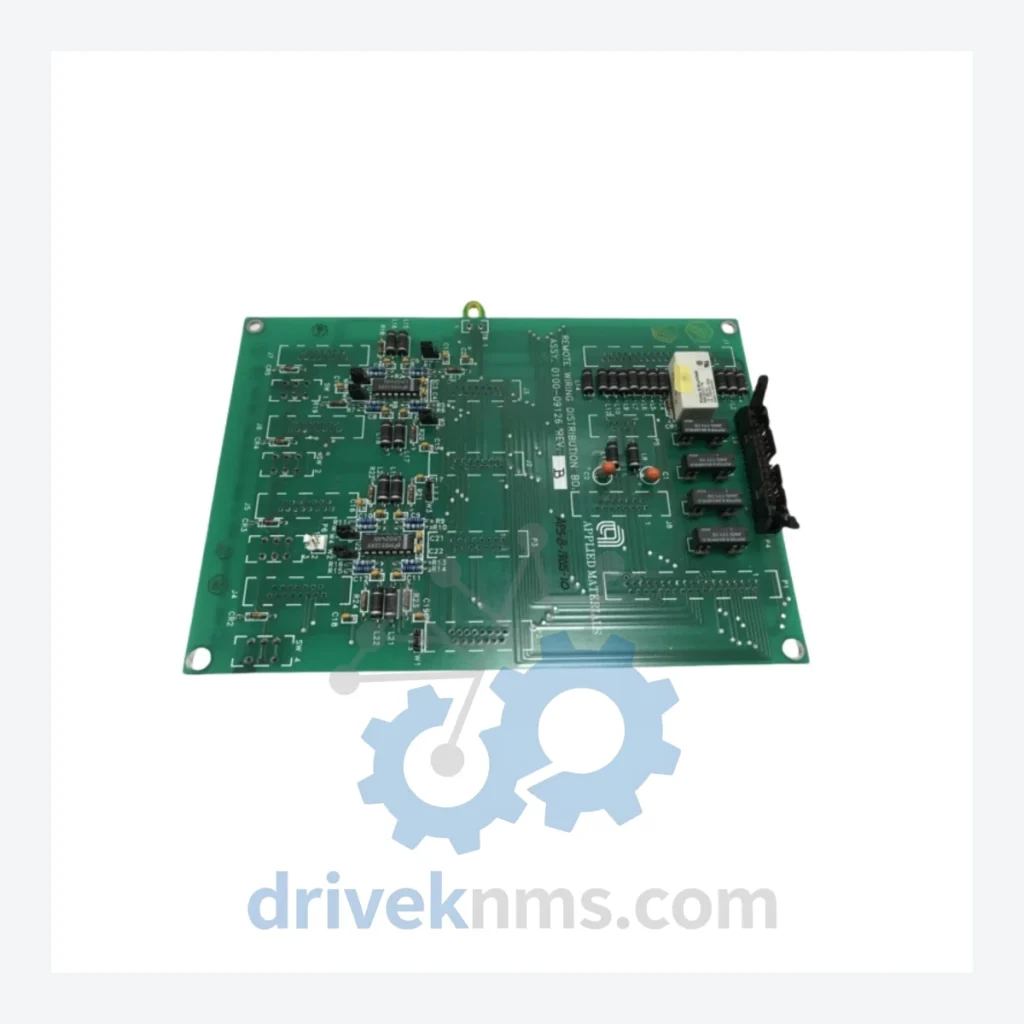
Applied Materials 0100-09126 Remote Wiring Distribution Board Panel – Obsolete AMAT Spare Part
When a Remote Wiring Distribution Board Panel fails inside an Applied Materials (AMAT) semiconductor processing system, the consequences extend far beyond a single module replacement. A forced platform migration — driven solely by the unavailability of one discontinued board — can cost a fab operation anywhere from several hundred thousand to several million dollars in equipment write-offs, requalification cycles, process re-certification, and lost wafer throughput. The 0100-09126 (cross-reference: US17276 / 4060-00633) is no longer in active production. DriveKNMS maintains RFQ-reviewed sourcing status of this board for facilities that cannot afford to let a legacy AMAT system go dark.
RFQ support for obsolete parts: Send the model number, required quantity and destination so DriveKNMS can confirm sourcing options before quotation.
Technical Specifications
Note: Electrical parameters (voltage ratings, signal specifications) are system-dependent and vary by AMAT platform configuration. Confirmed parameters are provided upon request with unit serial number verification. No parameters are assumed or fabricated.
Solving the Discontinued Hardware Crisis
Applied Materials platforms — including legacy CVD, PVD, and etch systems — rely on distributed wiring and signal routing architectures where the Remote Wiring Distribution Board Panel serves as a critical interconnect node. In these systems, the board manages signal distribution between the main controller and remote I/O assemblies. Its failure does not produce a graceful degradation; it produces a hard system fault.
AMAT ceased active support for this component class years ago. OEM replacement channels are closed. The engineering documentation required to substitute a modern equivalent without full system requalification is rarely available to end users. For a fab running 24/7 production schedules, this creates a binary situation: source the original part, or face a system retirement decision that the capital budget was not prepared for.
Facilities that have extended the operational life of their AMAT equipment by 5 to 10 years beyond the OEM end-of-support date consistently report the same strategy: they built a controlled spare parts inventory for exactly these high-risk, low-availability components. The 0100-09126 belongs in that inventory. A single unit held in climate-controlled storage represents a fraction of one day's wafer production value — and eliminates the risk of an unplanned multi-week outage while a replacement is sourced on the open market under emergency conditions.
Condition & Reliability Assurance
Discontinued boards sourced from the secondary market carry age-related failure risks that differ from those of new production components. DriveKNMS applies a 5-step QA protocol to all obsolete PCB assemblies before dispatch review:
Step 1 – Electrolytic Capacitor Inspection: All electrolytic capacitors are inspected for physical signs of aging — bulging, electrolyte leakage, and ESR deviation. Capacitors outside acceptable tolerance are replaced with specification-matched components before the board is offered for sale.
Step 2 – Firmware & Label Version Verification: Where firmware revision markings or label revision codes are present, these are cross-checked against known compatible revision levels for the target AMAT platform. Incompatible revisions are flagged and disclosed prior to sale.
Step 3 – Pin and Connector Corrosion Audit: All edge connectors, header pins, and terminal blocks are inspected under magnification for oxidation, corrosion, and mechanical deformation. Affected contacts are cleaned or the unit is downgraded accordingly.
Step 4 – Functional Continuity Test: Signal path continuity is verified across all documented connector positions. Open circuits and shorts are identified and documented.
Step 5 – Packaging for Long-Term Storage: Units are packaged in anti-static shielding bags with desiccant, sealed, and stored in a temperature-controlled environment. Units shipped for immediate installation are packaged to IPC/JEDEC J-STD-033 handling standards.
Key Features for System Maintenance
The 0100-09126 is a direct hardware replacement for the original installed unit. It requires no firmware reprogramming, no I/O remapping, and no modification to the host system's control software. Installation follows the original AMAT field service procedure for this board class.
This drop-in replacement characteristic is the defining advantage of sourcing the original part number versus attempting a functional substitute. Engineering substitution projects for wiring distribution boards in legacy AMAT systems have historically required 3 to 6 months of validation time and carry process qualification risk. The original part eliminates that cost entirely.
Should I purchase more than one unit?
For any AMAT system where this board is a single point of failure, holding a minimum of one cold spare is a standard risk management practice. For multi-system facilities or systems with no near-term retirement plan, two units is the recommended minimum. Current market availability of the 0100-09126 is limited; restocking after depletion of current inventory cannot be guaranteed on any timeline.
Can you source other AMAT obsolete parts?
Yes. DriveKNMS specializes in hard-to-find and discontinued components across major automation and semiconductor equipment manufacturers. Submit your full part number list for a sourcing assessment.