Technical Dossier
Product Details And Specifications
Bently Nevada 21000 Series Technical Notes
The Bently Nevada 21000 Series represents one of the most widely deployed proximity probe systems in global heavy industry. Installed across petrochemical refineries, nuclear power stations, offshore platforms, and rotating machinery facilities, the 21000 Series established the foundational architecture for eddy-current-based shaft displacement monitoring. Its 3300 XL predecessor compatibility and long field service life — frequently exceeding 20 years in continuous operation — have made it a critical spare parts category for plant maintenance engineers worldwide. The system operates on the principle of eddy-current proximity sensing, providing non-contact measurement of radial shaft vibration, axial position, and differential expansion in turbines, compressors, pumps, and generators. Facilities running legacy Bently Nevada monitoring systems continue to depend on 21000 Series components for scheduled turnaround maintenance, emergency replacement, and long-term asset integrity programs.
The Evolution of 21000 Series Architecture
The 21000 Series was introduced as part of Bently Nevada's second-generation proximity transducer platform, designed to replace earlier 7200 Series probes in applications requiring higher temperature tolerance and improved signal linearity. The system is built around a three-component architecture: the proximity probe (sensing element), the extension cable, and the proximitor (signal conditioning driver). Each component carries its own part number and must be matched within the same calibrated system to maintain measurement accuracy per API 670 standards.
Early 21000 Series probes used a 5-meter standard cable configuration with a 5 mm tip diameter, targeting general-purpose turbomachinery. Subsequent revisions introduced 8 mm and 11 mm tip variants for longer measurement ranges, high-temperature probe assemblies rated to 177°C (350°F) for steam turbine applications, and armored cable configurations for environments with mechanical abrasion risk. The proximitor drivers evolved from discrete analog circuitry to integrated signal conditioning modules, with output standardized at -24 VDC supply and a -18 VDC nominal output at the calibrated gap. Compatibility with the Bently Nevada 3300 Series monitoring system made the 21000 Series the de facto standard probe for installations using 3300 XL rack-based vibration monitors. As the 3500 Series monitoring platform gained adoption through the 2000s, the 21000 Series probes retained backward compatibility through matched extension cables and proximitor drivers, extending the operational life of existing probe installations without requiring full system replacement.
21000 Series Full Catalog & Functionalities (SKU List)
The following SKUs represent verified, commonly stocked components within the Bently Nevada 21000 Series. Each entry reflects a distinct part number with a defined functional role within the proximity transducer system.
Proximity Probe Assemblies
- 21000-00-05-10-02-00: 5 mm probe, 5 m cable, standard temperature, general-purpose radial vibration
- 21000-00-08-10-02-00: 8 mm probe, 5 m cable, extended range, radial vibration and position
- 21000-00-11-10-02-00: 11 mm probe, 5 m cable, long-range axial position measurement
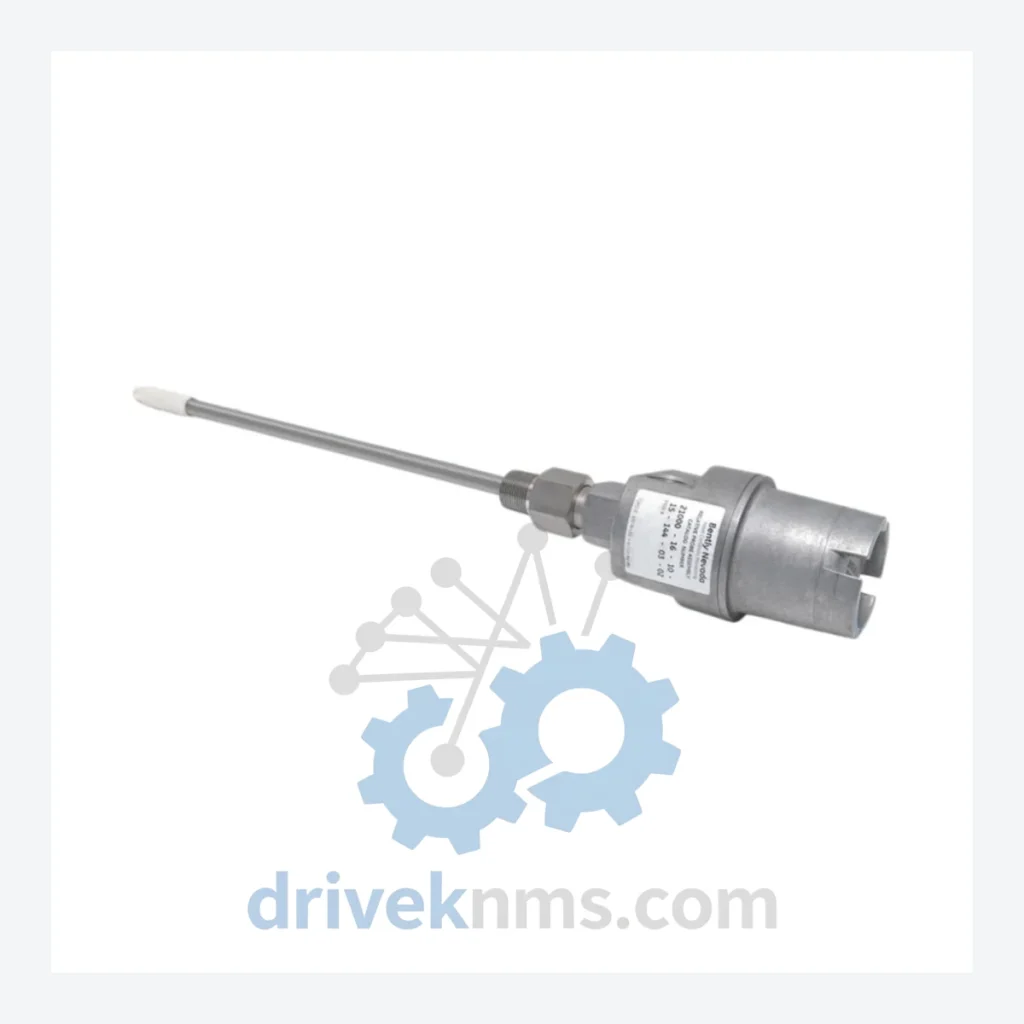
- 21000-16-10-00-030-00-02: Housing assembly variant, 16 mm body, 30 cm cable, specialized mounting configuration
- 21000-00-05-10-05-00: 5 mm probe, 5 m cable, high-temperature rating to 177°C, steam turbine service
- 21000-00-08-10-05-00: 8 mm probe, 5 m cable, high-temperature, compressor and hot gas expander service
- 21000-00-05-10-02-05: 5 mm probe, armored cable, abrasion-resistant jacket, harsh environment
- 21000-00-08-10-02-05: 8 mm probe, armored cable, mechanical protection, offshore and refinery service
Extension Cables
- 21000-00-01-05-00: 1 m extension cable, standard, system interconnect for short-run installations
- 21000-00-05-05-00: 5 m extension cable, standard, primary field-to-proximitor interconnect
- 21000-00-09-05-00: 9 m extension cable, extended run, large machinery housings
- 21000-00-14-05-00: 14 m extension cable, long-run, turbine pedestal to remote proximitor panel
Proximitor Drivers (Signal Conditioners)
- 21000-00-00-05-00-00: Standard proximitor, -24 VDC supply, -18 VDC output, 5 mm/8 mm probe compatible
- 21000-00-00-05-02-00: Proximitor with integral barrier, intrinsically safe, ATEX/IECEx rated, hazardous area
- 21000-00-00-05-05-00: High-temperature proximitor, extended ambient rating, hot utility room installation
- 21000-00-00-11-00-00: 11 mm system proximitor, matched calibration for long-range axial position systems
Sourcing Hard-to-Find & Obsolete 21000 Series Parts
The Bently Nevada 21000 Series has entered the mature-to-end-of-life phase of its product lifecycle. Baker Hughes (the current owner of the Bently Nevada brand) has progressively discontinued 21000 Series components in favor of the 3300 XL and 3500 Series transducer platforms. However, the installed base of 21000 Series systems in operating plants remains substantial, particularly in facilities that have not undergone full monitoring system upgrades.