Technical Dossier
Product Details And Specifications
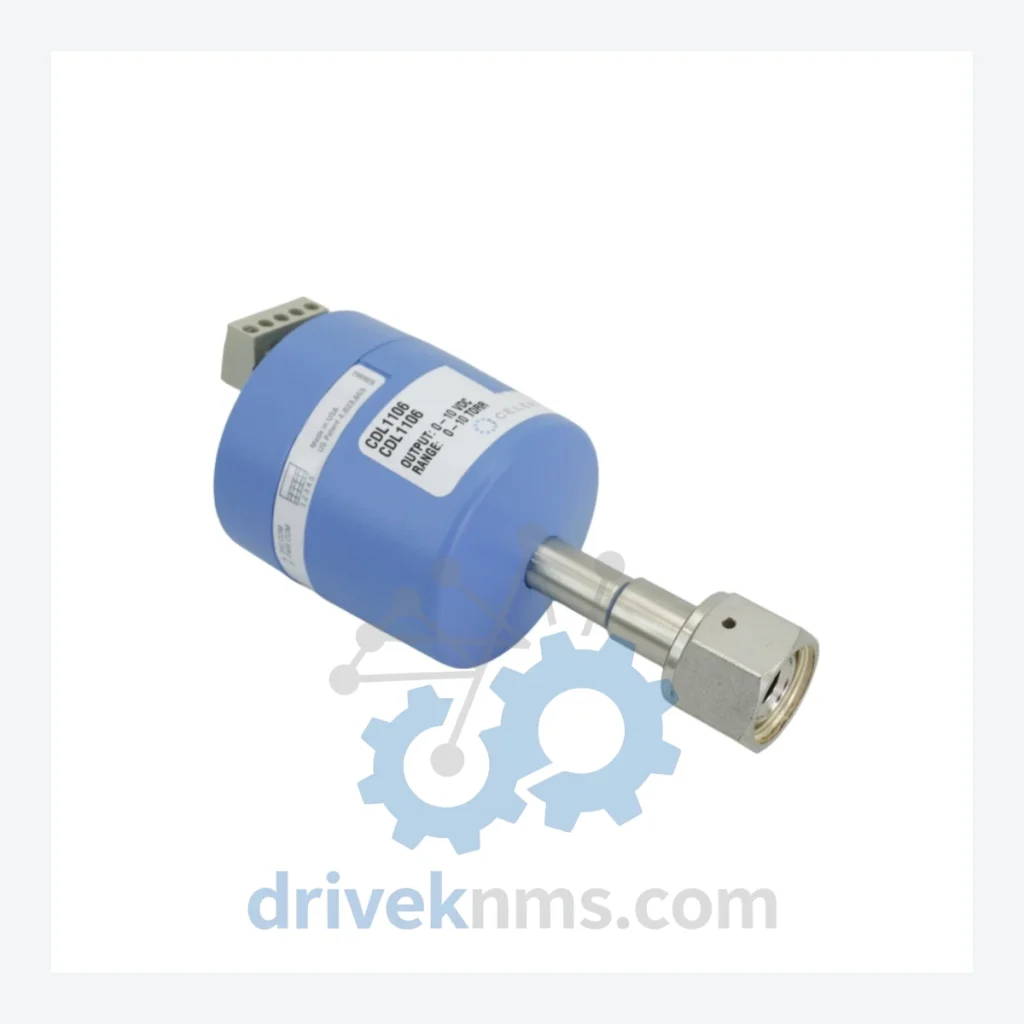
Celerity A330344001 CDL1106 4S007-667-A Pressure Transducer – Obsolete Baratron Spare Part
When a Baratron pressure transducer fails in a legacy semiconductor or chemical process line, the consequences extend far beyond a single component. The CDL1106 series — manufactured under the Celerity brand and closely associated with MKS Instruments' Baratron technology — was a cornerstone of process pressure measurement in CVD, PVD, etch, and gas delivery systems built throughout the 1990s and 2000s. These systems were engineered for 20-year service lives, and many remain in production today. A single failed transducer on an unspared system can force a facility into an unplanned shutdown, triggering a cascade: emergency engineering assessments, OEM end-of-life notices, and capital expenditure proposals for full system replacement that can run into the millions of dollars.
DriveKNMS reviews sourcing status and documentation for this model during RFQ handling before quotation.
RFQ support for obsolete parts: Send the model number, required quantity and destination so DriveKNMS can confirm sourcing options before quotation.
Technical Specifications
| Parameter | Detail |
| Manufacturer | Celerity (MKS Instruments Baratron platform) |
| Part Numbers | A330344001 / CDL1106 / 4S007-667-A / 710-404556-00 / 073-404555-00 |
| Product Series | CDL1106 / Baratron |
| Device Type | Capacitance Manometer Pressure Transducer |
| Discontinuation Status | Obsolete – No longer manufactured or supported by OEM |
| Country of Origin | United States |
| Typical Application | Semiconductor process chambers, CVD/PVD reactors, gas delivery panels, industrial vacuum systems |
| Compatible Legacy Systems | Applied Materials, Lam Research, Novellus, and similar OEM process tools using Celerity/MKS gas control modules |
Note: Specific electrical parameters (full-scale range, output signal, connector type) vary by sub-configuration. Confirm your exact sub-model requirements before ordering. DriveKNMS will cross-reference your system documentation upon inquiry.
Solving the Discontinued Hardware Crisis
The CDL1106 Baratron transducer is not a commodity item that can be substituted with a modern equivalent without engineering intervention. Its signal conditioning, connector pinout, and calibration protocol are matched to the specific process controller and recipe management software of the host system. Replacing it with a current-generation MKS or Pfeiffer unit requires recalibration, potential firmware updates to the process controller, and re-qualification of the process recipe — a project that typically consumes 4 to 12 weeks of engineering time and carries full process re-validation costs.
For facilities operating legacy semiconductor or industrial process equipment, the calculus is straightforward: a verified spare of the original part eliminates all of that risk. The cost of a single CDL1106 transducer is orders of magnitude lower than the cost of a process re-qualification, let alone a capital equipment replacement cycle.
Facilities that have extended the service life of their process tools by 5 to 10 years beyond OEM support windows consistently cite one strategy above all others: maintaining a curated inventory of high-failure-rate consumable and semi-consumable components. Pressure transducers, particularly capacitance manometers operating in corrosive or high-cycle environments, are among the first components to degrade. A proactive spare parts strategy — holding one to two units of each critical transducer model — converts what would be a catastrophic unplanned outage into a scheduled 30-minute swap.
Condition & Reliability Assurance
Sourcing obsolete instrumentation from the secondary market carries legitimate risk. DriveKNMS applies a structured 5-step qualification process to every Baratron transducer unit before it is offered for sale:
Step 1 – Physical Inspection: Full external inspection for mechanical damage, corrosion on process fittings, and connector pin integrity. Units with compromised wetted surfaces are rejected outright.
Step 2 – Electrolytic Capacitor Assessment: The capacitance sensing element and any associated signal conditioning board are evaluated for electrolytic capacitor aging — the primary failure mode in units that have been stored for extended periods. Capacitors showing ESR drift beyond tolerance are flagged.
Step 3 – Firmware & Calibration Label Verification: Where applicable, firmware revision markings and factory calibration labels are cross-referenced against known production records to confirm the unit has not been modified or re-labeled.
Step 4 – Pin and Connector Corrosion Check: Electrical connectors are inspected under magnification for oxidation, pin recession, and contact resistance anomalies.
Step 5 – Functional Verification: Units are powered and output signal integrity is verified against baseline specifications where test equipment permits.
Units that pass all five steps are classified as Verified Serviceable. Units with minor cosmetic wear but full functional integrity are classified as Refurbished – Functionally Equivalent. No unit is sold without a classification designation.
Key Features for System Maintenance
Drop-in replacement: The CDL1106 / A330344001 is a direct mechanical and electrical replacement for the original installed unit. No wiring modifications, no connector adapters, no process controller reconfiguration.
No re-programming required: The transducer operates on the same signal protocol as the original. Your process recipes, alarm setpoints, and interlock logic remain unchanged.
Avoids engineering re-qualification costs: Substituting a non-equivalent modern transducer triggers a formal process change — with associated validation, documentation, and regulatory review in regulated industries. A like-for-like replacement does not.
Q: How do I know the unit is genuine and not a counterfeit?
A: All units sourced by DriveKNMS are traceable to documented supply chain origins. Physical markings, part number labels, and construction details are cross-referenced against known genuine units. Our 5-step QA process specifically targets the indicators most commonly associated with counterfeit or re-labeled instrumentation.