Technical Dossier
Product Details And Specifications
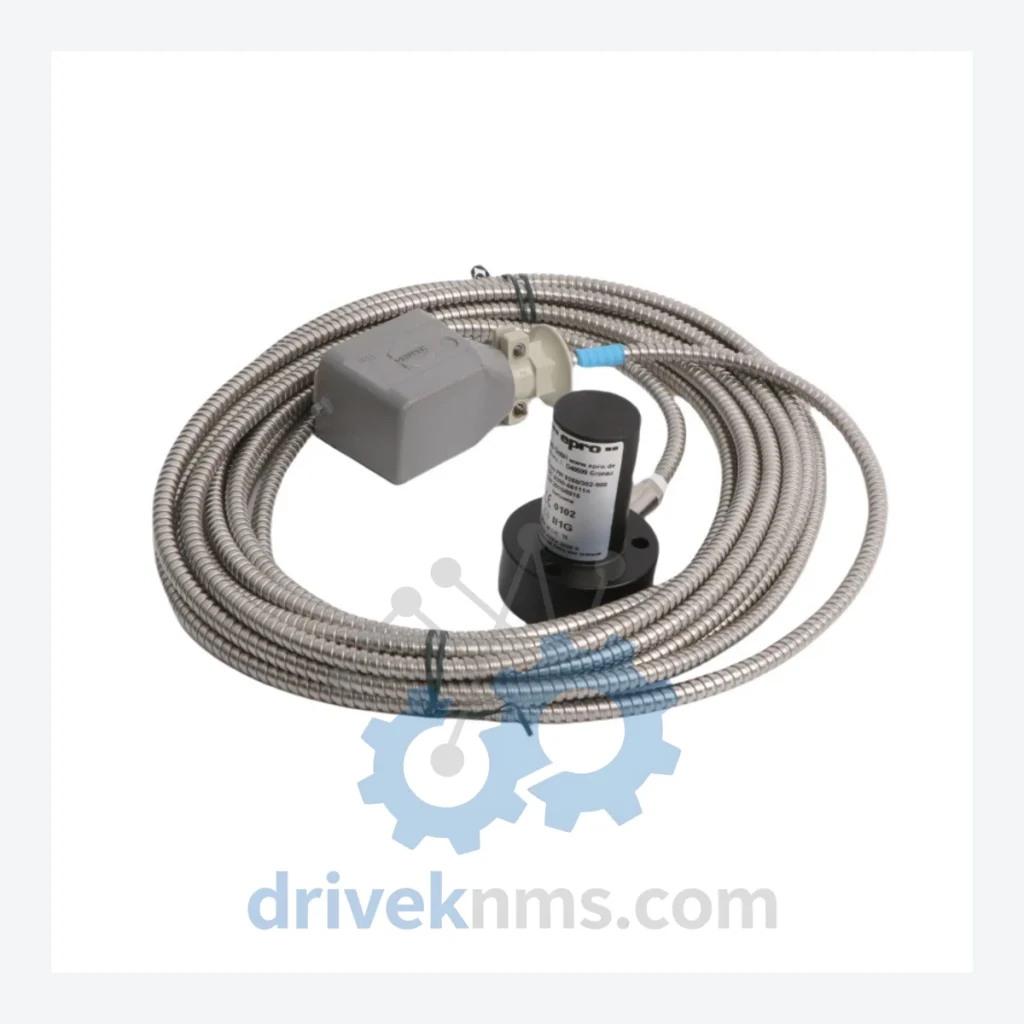
Epro PR9268/300-000 Electrodynamic Sensor – Obsolete Epro Series Spare Part
RFQ support for obsolete parts: Send the model number, required quantity and destination so DriveKNMS can confirm sourcing options before quotation.
Technical Specifications
| Parameter | Detail |
| Manufacturer | Epro (now part of Emerson / Bently Nevada ecosystem) |
| Part Number | PR9268/300-000 |
| Type | Electrodynamic (velocity) vibration sensor |
| Measurement Principle | Electromagnetic induction – moving coil |
| Country of Origin | Germany |
| Product Status | Discontinued / Obsolete – no longer in active production |
| Compatible Systems | Epro protection systems; Bently Nevada 3500 series (with appropriate signal conditioning); legacy turbomachinery monitoring panels |
| Typical Application | Axial and radial vibration measurement on steam turbines, gas turbines, centrifugal compressors, and large rotating machinery |
Note: Electrical parameters such as sensitivity (mV/mm·s⁻¹), frequency range, and coil resistance vary by sub-variant and mounting configuration. Confirmed specifications are provided upon request with unit serial number verification. No parameters are published here that cannot be independently verified.
Solving the Discontinued Hardware Crisis
The PR9268/300-000 was designed for continuous-duty vibration monitoring in environments where sensor reliability directly determines whether a machine trips safely or runs to destruction. Its electrodynamic operating principle — no external power supply required for the sensing element — made it a preferred choice for safety-critical loops in the 1990s and 2000s.
Plants that standardized on Epro sensor architectures during that period now face a specific problem: the monitoring system was engineered around the PR9268's signal characteristics. Substituting a modern IEPE or eddy-current sensor is not a drop-in exercise. It requires signal conditioner replacement, loop recalibration, alarm setpoint re-validation, and in many jurisdictions, re-certification of the safety function. The engineering cost of that substitution frequently exceeds the cost of sourcing an original PR9268/300-000 by a factor of ten or more.
For plant managers under pressure to defer capital expenditure, the arithmetic is straightforward: one verified original spare, correctly installed, extends the operational life of the existing protection system by years — without triggering a change management process or a safety case revision.
How to extend your automation asset life by 5–10 years using critical spare parts:
Condition & Reliability Assurance
Sourcing an obsolete sensor from the secondary market carries legitimate risk. DriveKNMS applies a structured 5-step quality process to every PR9268/300-000 unit before it is offered for sale:
- Visual and mechanical inspection: Connector pins, cable jacket, and housing are examined for corrosion, mechanical damage, and evidence of prior field repair. Units with compromised connectors or cracked housings are rejected.
- Electrolytic capacitor assessment: Where applicable in associated signal conditioning components, capacitor condition is evaluated. Aged electrolytic capacitors are a primary failure mode in electronics stored beyond ten years.
- Coil continuity and insulation resistance check: The sensing coil is verified for continuity and insulation integrity. Open-circuit or shorted coils are non-negotiable rejection criteria.
- Pin and contact integrity: All connector contacts are inspected for oxidation and fretting corrosion. Contact surfaces are cleaned where required; units with structurally compromised contacts are not offered for sale.
- Firmware and labeling verification (where applicable): Part number markings are cross-referenced against known authentic label formats. Units with inconsistent or absent markings are quarantined pending further verification.
Units that pass all five stages are classified as Verified Serviceable and offered with full condition disclosure. Units that do not pass are not sold.
Key Features for System Maintenance
- Drop-in replacement: The PR9268/300-000 installs directly into existing mounting arrangements without mechanical modification. No adapter plates, no re-machining of sensor bosses.
- No reprogramming required: The electrodynamic sensor has no firmware, no configuration parameters, and no calibration data stored in the device. Replacement does not require a programmer, a laptop, or a controls engineer on site.
- Signal compatibility preserved: Output signal characteristics match the original, meaning existing alarm setpoints, trip thresholds, and trend baselines remain valid. No loop recalibration is required in standard replacement scenarios.
- Avoids engineering change order (ECO) process: Because the replacement is identical to the original, most plant change management procedures classify it as a like-for-like replacement — not a modification. This avoids the documentation burden and approval cycle associated with a design change.
- Defers capital expenditure: Every year the existing protection system remains operational is a year the capital budget is not committed to a platform migration. A single spare part, correctly applied, can represent years of deferred expenditure.
Should I buy more than one unit?
For any machine where the PR9268/300-000 is installed in a safety-critical loop, holding a minimum of one spare per train is standard practice. Given that secondary market availability of this part is finite and declining, purchasing two to three units now — while RFQ-reviewed sourcing status exists — is a lower-risk strategy than relying on spot availability at the point of failure.