Technical Dossier
Product Details And Specifications
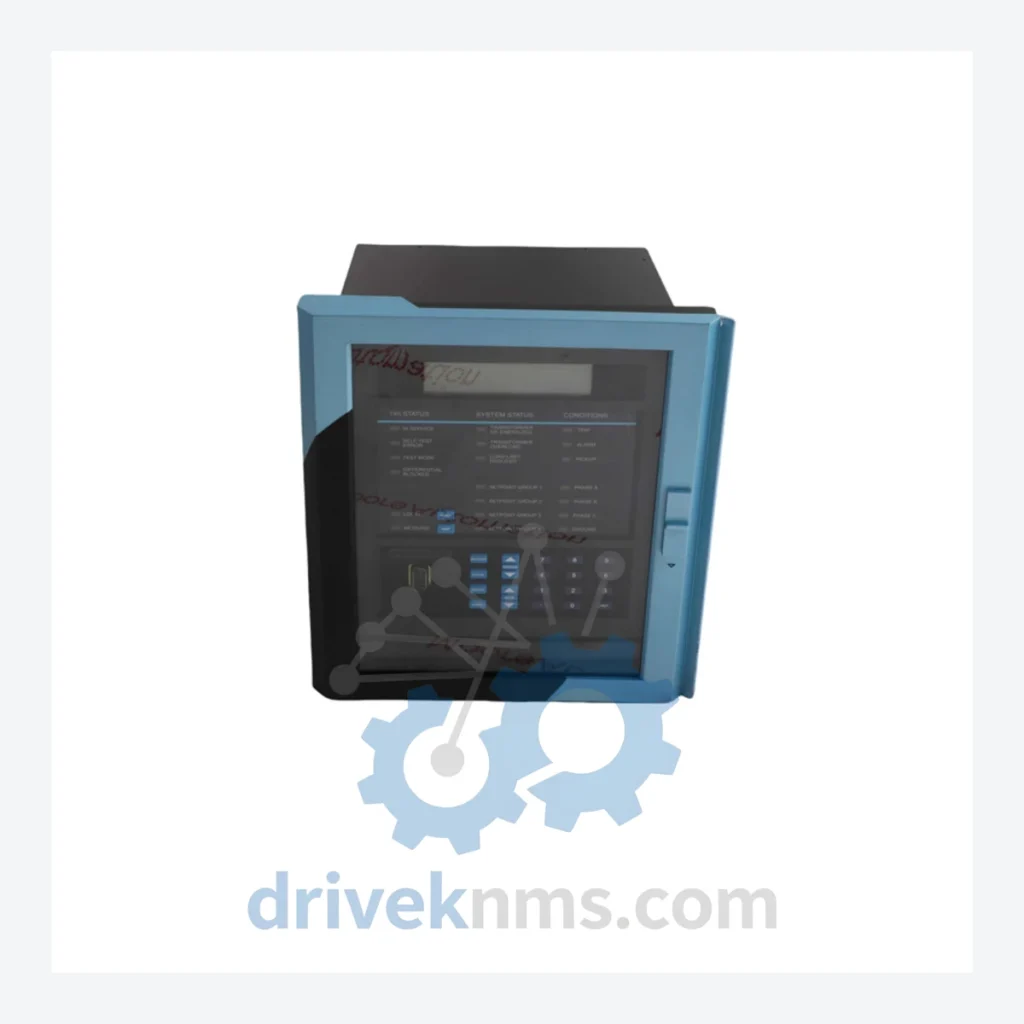
GE 745-W2-P5-G5-HI-R-E-H Transformer Management Relay – Obsolete 745 Series Spare Part
DriveKNMS maintains sourced inventory of discontinued GE protection relays for exactly this scenario. This is not a catalog listing — availability is limited and subject to prior sale.
RFQ support for obsolete parts: Send the model number, required quantity and destination so DriveKNMS can confirm sourcing options before quotation.
Technical Specifications
| Parameter | Detail |
| Manufacturer | GE Grid Solutions (formerly GE Multilin) |
| Model Number | 745-W2-P5-G5-HI-R-E-H |
| Series | GE 745 Transformer Management Relay |
| Product Category | Transformer Protection & Management Relay |
| Discontinuation Status | Discontinued / Obsolete – No longer manufactured or sold by OEM |
| Form Factor | 19-inch rack-mount, 3U panel |
| Communication | RS-485 (Modbus RTU); optional DNP3 / IEC 60870-5-103 depending on order code |
| Typical Application | Two-winding power transformer differential protection, overexcitation, restricted earth fault, thermal modeling |
| Compatible Systems | GE EnerVista 745 Setup Software; legacy SCADA systems using Modbus RTU polling |
| Country of Origin | United States |
Note: Electrical parameters specific to this order code (W2/P5/G5/HI/R/E/H suffix configuration) are confirmed against original GE documentation. No parameters are assumed or extrapolated. Contact us for the original datasheet.
Solving the Discontinued Hardware Crisis
The GE 745 series was a standard-bearer for transformer differential protection throughout the 1990s and 2000s. Utilities, industrial plants, and mining operations standardized on it precisely because of its reliability and the depth of its protection functions — 87T differential with harmonic restraint, 24 V/Hz overexcitation, 49 thermal model, 50/51 overcurrent, and restricted earth fault, all in a single chassis.
This creates a specific and serious operational risk: a single relay failure in a transformer bay protected by the 745 forces a choice between an unprotected transformer (unacceptable) and an emergency system replacement (extremely costly and time-consuming). Neither option is acceptable for a facility managing critical power infrastructure.
The only rational risk mitigation strategy is pre-positioned spare inventory. One unit of the 745-W2-P5-G5-HI-R-E-H on the shelf converts a potential six-figure emergency into a scheduled maintenance event measured in hours, not weeks.
How to Extend Your GE 745-Based Protection System by 5–10 Years
For plant managers and substation engineers facing pressure to retire legacy protection infrastructure, the following approach has been validated across multiple industrial and utility environments:
1. Conduct a relay census. Identify every GE 745 unit in service, its order code, firmware version, and last test date. Map which transformers are protected by which relay. This is the foundation of any asset extension strategy.
2. Establish a minimum spare ratio. For critical transformer bays (main power transformers, unit transformers), maintain at least one verified spare per three units in service. For non-critical applications, one spare per five units is a defensible minimum.
3. Freeze firmware versions. Do not attempt firmware upgrades on units that are stable. The risk of a failed upgrade on an obsolete platform with no OEM support outweighs any marginal benefit. Document the current firmware version for each unit and treat it as a fixed configuration.
4. Extend calibration and test cycles. Annual functional testing of differential and overcurrent elements, combined with CT secondary injection testing, will identify degrading units before they fail in service. A relay that fails a bench test is a controlled event. A relay that fails during a fault is not.
This strategy does not require capital expenditure on new protection systems. It requires disciplined inventory management and a realistic assessment of the cost of an unplanned failure versus the cost of a verified spare unit.
Condition & Reliability Assurance
All GE 745-W2-P5-G5-HI-R-E-H units sourced by DriveKNMS pass a structured 5-step inspection protocol before any unit is offered for sale. This process is designed specifically for the failure modes common to relay hardware of this age and design generation.
Step 1 – Electrolytic Capacitor Assessment. Capacitors in the power supply and analog input conditioning circuits are the primary age-related failure point in relay hardware from this era. Each unit is inspected for capacitor bulging, electrolyte leakage, and ESR deviation. Units with degraded capacitors are either reconditioned with OEM-equivalent components or rejected.
Step 2 – Firmware Version Verification. The firmware version is read from each unit and documented. This is cross-referenced against known stable versions for the 745 platform. Units with corrupted or unreadable firmware are not offered for sale.
Step 3 – Terminal and Pin Corrosion Inspection. All rear-panel terminal blocks, communication port pins, and internal connector contacts are inspected under magnification for oxidation, corrosion, and mechanical damage. Contact surfaces are cleaned and treated where required.
Step 4 – Functional Power-On Test. Each unit is powered and brought through its self-test sequence. Display, LED indicators, and communication port response are verified. Units that fail self-test are not offered for sale.
Step 5 – Condition Classification and Documentation. Each unit is classified as New Surplus (unused, original packaging), Tested Serviceable (used, passed all inspection steps), or Reconditioned (used, specific components replaced, fully tested). Condition is disclosed at point of sale. No unit is sold without a documented condition classification.
Key Features for System Maintenance
The 745-W2-P5-G5-HI-R-E-H is a direct drop-in replacement for any existing GE 745 unit with the same order code. There is no firmware re-flashing required, no protection setting re-entry required (settings are stored in the relay and can be uploaded from an existing backup via EnerVista 745 Setup), and no wiring modifications required.
This means a trained protection engineer can execute a relay swap in a planned outage window of four to eight hours, including functional testing. Compare this to a full protection system replacement, which requires engineering design, panel fabrication, wiring, commissioning, and protection coordination review — a process that typically spans three to nine months and costs orders of magnitude more.
Q: How do I know the unit is genuine GE and not a counterfeit?
A: All units are inspected for OEM markings, serial number format, PCB construction, and component sourcing consistent with genuine GE Multilin manufacturing. We do not source from unverified brokers. Provenance documentation is provided where available.
Q: What if my unit has a slightly different order code suffix?
A: The 745 order code encodes specific hardware options. We can cross-reference your existing unit's order code against available inventory to confirm compatibility. Do not assume cross-compatibility between different order codes without verification.
Q: How long will spare units remain available on the secondary market?
A: Availability of obsolete GE 745 units is declining. Units removed from service during substation upgrades represent the primary supply source, and that supply is finite. Procurement decisions delayed by 12–24 months frequently result in no available inventory at any price.