
Honeywell XDL505 I/O Module FSC Series
Honeywell XDL505 is listed for Monitoring Systems RFQ review. Confirm quantity, condition and destination before quotation.
RFQ-ready industrial model
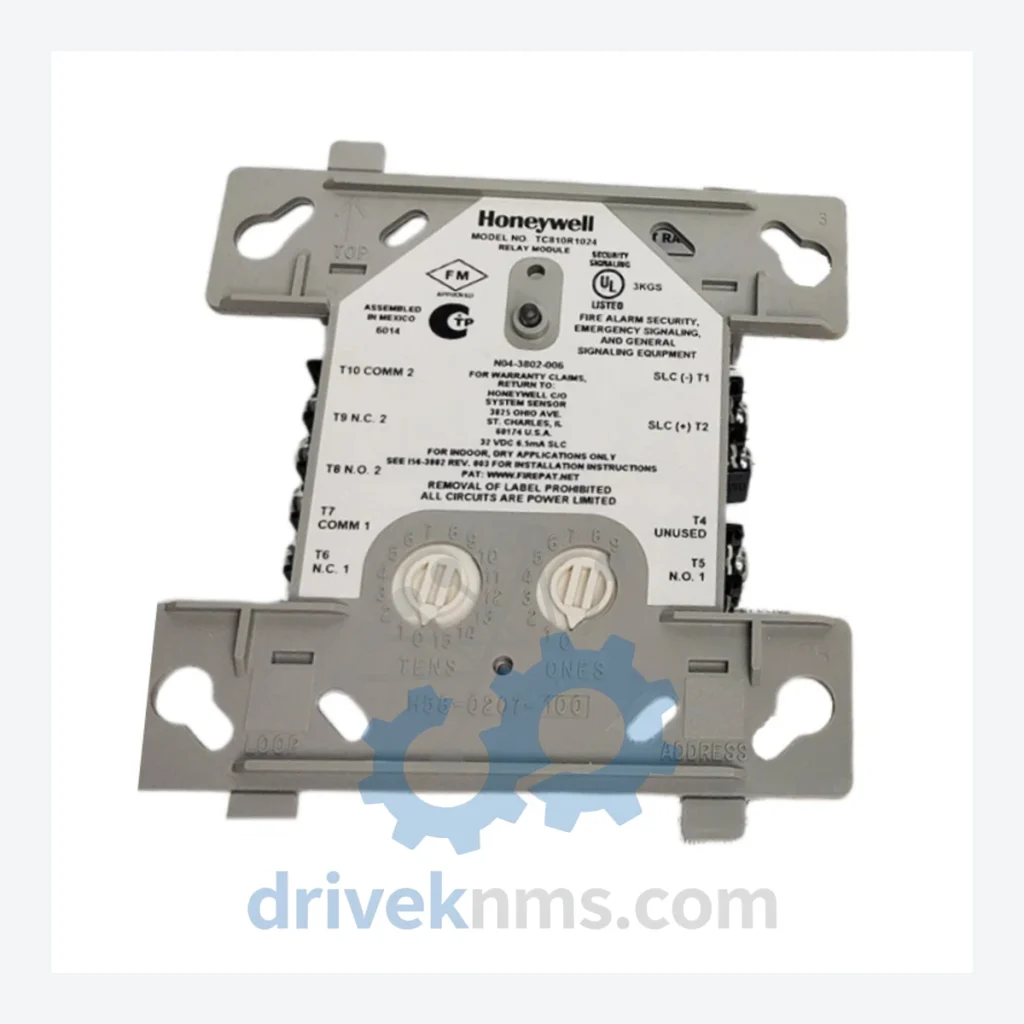
Model: TC810R1024
Product Overview
Commercial availability is handled through direct RFQ, model verification and export-oriented follow-up rather than public cart checkout.
Datasheet Preview
Use attached product manuals when available. If the manual is not public yet, request the full file directly through RFQ.
Commercial Path
Product pages on DRIVEKNMS are designed to verify model, brand and series first, then move the buyer into one clean quotation path.
Technical Dossier
The Honeywell TC810R series represents a core component family within Honeywell's building automation and industrial fire detection control infrastructure. These addressable relay modules are deployed extensively across global heavy industry installations, including petrochemical refineries, nuclear power facilities, offshore platforms, and large-scale chemical processing plants. The TC810R architecture interfaces directly with Honeywell's addressable loop controllers, enabling supervised relay output control at the field device level without requiring dedicated hardwired control panels. Installed base figures across critical infrastructure sectors confirm the TC810R as one of the most widely specified addressable output modules in Honeywell's legacy and transitional product portfolio. Its compatibility with Honeywell's XLS, Excel, and FS90 series control platforms has made it a long-term fixture in facilities where system replacement is cost-prohibitive and lifecycle extension is the operational priority.
The TC810R series was introduced as part of Honeywell's addressable field device ecosystem during the expansion of two-wire loop technology in industrial fire and safety systems. Early iterations of the module operated on single-loop addressable protocols with fixed relay configurations, supporting normally open (NO) and normally closed (NC) contact outputs rated for low-voltage supervisory circuits. As industrial control requirements evolved through the 1990s and 2000s, Honeywell refined the TC810R platform to support higher current relay ratings, improved short-circuit isolation, and compatibility with expanded loop capacities exceeding 250 addressable points per loop.
The transition from analog addressable to digital addressable protocols introduced firmware-level address assignment, replacing the earlier DIP-switch mechanical addressing found in first-generation units. This change significantly reduced commissioning time in large installations. Subsequent hardware revisions introduced conformal coating on PCB assemblies to meet IEC 60068 environmental standards for humidity and corrosive atmosphere resistance — a critical requirement for chemical plant and offshore deployments.
By the mid-2010s, the TC810R series entered a mature phase of its product lifecycle. Honeywell's strategic shift toward the NOTIFIER and Morley-IAS platforms, as well as the introduction of the XLS140 and XLS3000 controller families, positioned newer addressable output modules as the forward-compatible replacement path. However, the installed base of TC810R-dependent systems remains substantial, and direct hardware replacement without full system retrofit is not economically viable for most operators. This has created sustained demand for TC810R spare parts and refurbished units well beyond the official end-of-sale date.
The following SKUs represent the verified TC810R series module range, classified by functional category. Each entry reflects a distinct hardware configuration within the addressable relay output family.
Addressable Relay Output Modules
Addressable Monitor / Input Modules
Loop Isolator & Interface Modules
Power Supply & Ancillary Modules
The TC810R module family presents specific technical challenges during refurbishment and functional testing due to its addressable loop communication architecture and relay output supervision circuitry. Standard bench testing procedures applied to conventional relay modules are insufficient for validating TC810R units intended for safety system deployment.
DriveKNMS applies a multi-stage quality control protocol to all TC810R units processed through its facility. Stage one involves visual inspection and PCB-level assessment for capacitor degradation, relay contact wear, and solder joint integrity — failure modes commonly observed in units recovered from high-cycle industrial environments. Stage two involves loop communication testing using a calibrated Honeywell-compatible addressable loop simulator, verifying correct address response, relay actuation timing, and supervisory fault reporting across the full address range supported by the module.
Stage three applies relay contact load testing at rated current and voltage, confirming contact resistance within manufacturer-specified limits and verifying NO/NC switching under both resistive and inductive load conditions. Units exhibiting contact resistance above 100mΩ or actuation timing deviation exceeding ±15ms from specification are rejected and not returned to serviceable inventory. Final stage involves 48-hour burn-in under simulated loop conditions to identify latent failures prior to shipment. All passed units are issued a DriveKNMS test certificate with recorded test parameters and technician identification.
Continue The Model Path
Move from this exact model into the matching system hub, brand archive, model-family archive or lifecycle sourcing route before sending a final RFQ list.
Related Paths
Honeywell XDL505 is listed for Monitoring Systems RFQ review. Confirm quantity, condition and destination before quotation.
Honeywell U2-1018S-PF is listed for Monitoring Systems RFQ review. Confirm quantity, condition and destination before quotation.
Honeywell MC-GHAO11 51309540-175 is listed for Monitoring Systems RFQ review. Confirm quantity, condition and destination before quotation.