Technical Dossier
Product Details And Specifications
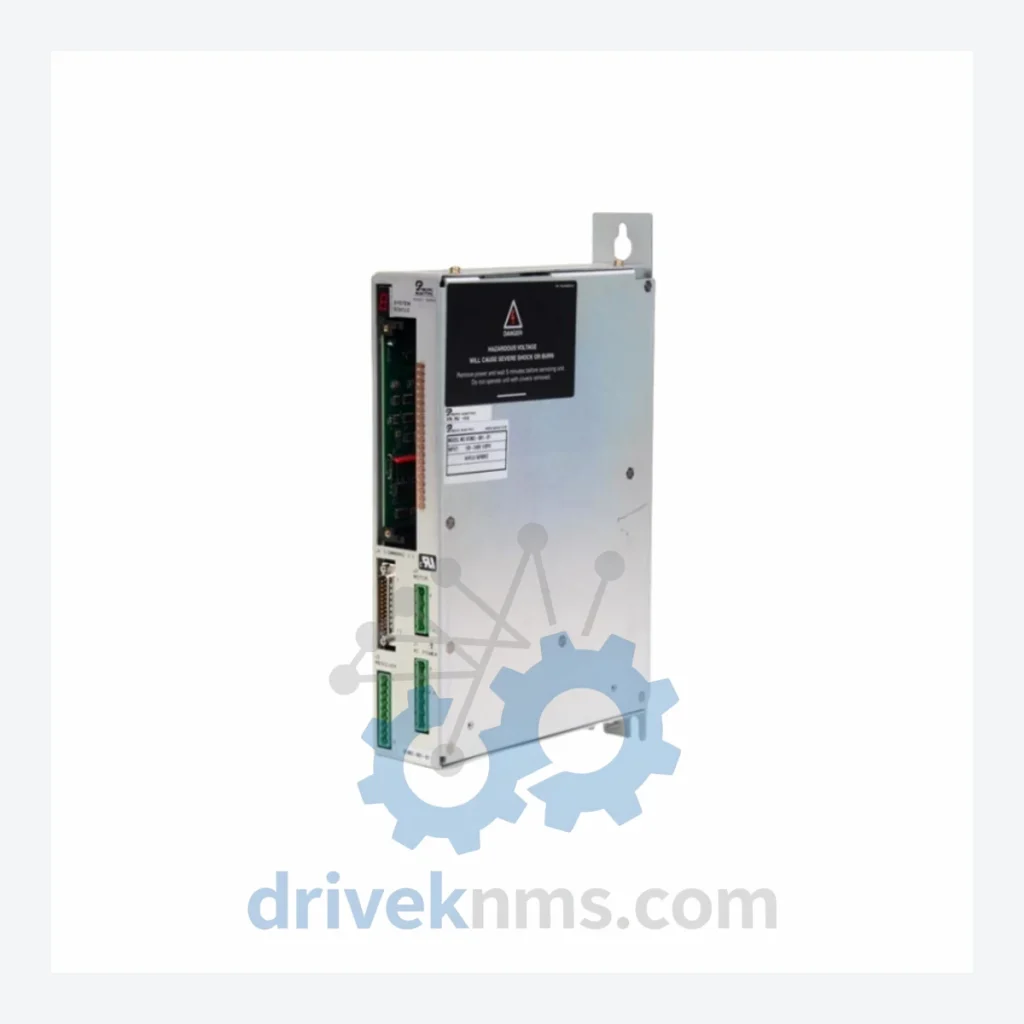
Pacific Scientific SC902-001-01 Servo Drive – Obsolete SC900 Series Spare Part
Pacific Scientific's SC900 series was widely deployed in precision motion control applications throughout the 1990s and 2000s — particularly in semiconductor handling, medical device assembly, packaging automation, and CNC auxiliary axes. The SC902-001-01 variant was a core component in many of these installations, often paired with legacy motion controllers and GD120/SM3430D-DN drive systems. Pacific Scientific (later absorbed into Danaher Motion, now part of Kollmorgen) discontinued the SC900 series, and factory support has long since ended. Replacement units are no longer manufactured.
RFQ support for obsolete parts: Send the model number, required quantity and destination so DriveKNMS can confirm sourcing options before quotation.
Technical Specifications
Note: Specific electrical parameters (input voltage range, continuous/peak current output, bus voltage) vary by sub-revision. DriveKNMS will confirm exact specifications against your unit's nameplate data upon inquiry. No parameters are assumed or fabricated.
Solving the Discontinued Hardware Crisis
The SC900 series occupied a specific performance tier in Pacific Scientific's lineup — compact form factor, analog command interface, and tight integration with the GD120 and SM3430D-DN motor families. These characteristics made it the default choice for machine builders who needed deterministic servo response without the overhead of a full digital fieldbus architecture. That same tight integration is now the source of the replacement problem: the SC902-001-01 does not have a direct modern equivalent that installs without mechanical, electrical, or software modification.
Facilities still operating SC900-based equipment face a binary choice: source the original hardware, or commit to a system-level retrofit. The retrofit path is not simply a matter of swapping a drive. It requires re-matching motor feedback types, reconfiguring motion controller command outputs, validating new tuning parameters against existing mechanical loads, and in many cases, modifying machine guarding and safety relay wiring to meet current standards. None of this is fast, and none of it is cheap.
For plant managers operating under capital expenditure constraints, the arithmetic is straightforward: the cost of one verified SC902-001-01 spare is a fraction of one day of lost production on a line that depends on it.
Extending Automation Asset Life by 5–10 Years: A Maintenance Strategy for Legacy Servo Systems
The SC900 series, like most industrial servo hardware of its generation, was built to last. The limiting factors are not the power electronics — they are the electrolytic capacitors on the DC bus and control boards, the encoder feedback cables, and the firmware revision compatibility between drive and controller. A structured maintenance approach addresses each of these systematically.
Electrolytic Capacitor Management: DC bus capacitors in drives of this era have a rated service life of 10–15 years under nominal thermal conditions. Units that have been in storage or light-duty service may have capacitors that are still within specification. Units pulled from high-cycle applications should be evaluated for capacitance drift and ESR before being placed back into service. Scheduled capacitor reformation (applying rated voltage gradually after extended storage) is standard practice for preserving NOS units.
Feedback Cable and Connector Inspection: Encoder cables on SC900-era systems are a common failure point. The connectors are proprietary and no longer stocked by the OEM. Maintaining a supply of verified cables alongside the drive itself is a necessary part of any long-term sparing strategy.
Firmware Version Control: The SC902-001-01 has known firmware revisions that affect compatibility with specific motion controller versions. Before deploying a replacement unit, confirm that the firmware revision matches the existing installation. DriveKNMS documents firmware versions on all units where this information is recoverable.
Environmental Controls: Servo drives of this generation were not designed for the thermal cycling that comes from intermittent operation in poorly climate-controlled enclosures. If the original installation environment has changed — higher ambient temperatures, increased dust loading — addressing those conditions extends the life of both the spare and the installed unit.
Condition & Reliability Assurance
DriveKNMS applies a structured 5-step qualification process to all discontinued servo drives before they are offered for sale.
Step 1 – Electrolytic Capacitor Assessment: All DC bus and control board capacitors are tested for capacitance value and equivalent series resistance (ESR). Units with capacitors outside of acceptable tolerance are either recapped with equivalent-specification components or flagged accordingly.
Step 2 – Firmware Version Verification: Where accessible, firmware revision is read and documented. This information is provided to the buyer to confirm compatibility with their existing motion controller configuration.
Step 3 – Pin and Connector Inspection: All I/O connectors, power terminals, and feedback ports are inspected under magnification for corrosion, bent pins, and mechanical damage. Corroded contacts are treated; damaged connectors are disclosed.
Step 4 – Functional Bench Test: Units are powered and tested for basic drive enable, fault-free initialization, and command response where test fixtures permit. Results are documented.
Step 5 – Packaging and ESD Protection: Units are packaged in anti-static bags with desiccant and shipped in double-wall corrugated cartons. Handling procedures follow IPC/JEDEC standards for ESD-sensitive assemblies.
Key Features for System Maintenance
Q: Can DriveKNMS source other SC900-series variants?
A: Inquire directly. DriveKNMS maintains sourcing relationships for a range of discontinued Pacific Scientific and related motion control hardware.