Technical Dossier
Product Details And Specifications
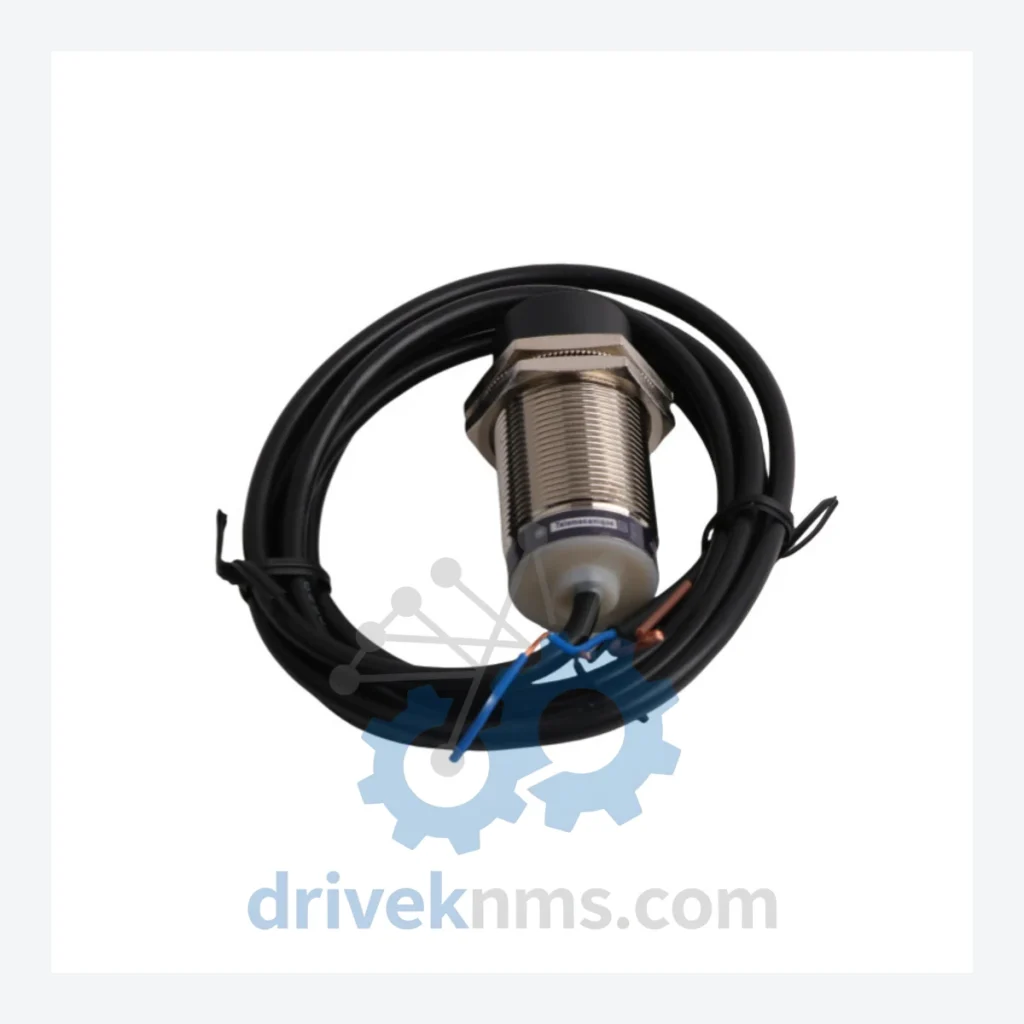
Schneider XS4P30NA340 Inductive Proximity Sensor – Obsolete OsiSense XS Spare Part
RFQ support for obsolete parts: Send the model number, required quantity and destination so DriveKNMS can confirm sourcing options before quotation.
Solving the Discontinued Hardware Crisis
The XS4P30NA340 was designed for deterministic, high-cycle sensing in industrial environments where sensor response time and output signal integrity are critical to PLC scan-cycle accuracy. In legacy Modicon TSX and Telemecanique control architectures, the sensing network was engineered as a matched system: cable lengths, signal thresholds, and I/O card input impedances were specified together. Substituting a modern sensor with different output characteristics — even within the same form factor — introduces signal timing deviations that can cause intermittent faults, nuisance trips, or, in worst cases, undetected position errors.
Condition & Reliability Assurance
Every XS4P30NA340 unit processed by DriveKNMS passes a structured five-stage inspection protocol before it is offered for sale:
- Stage 1 – Electrolytic Capacitor Assessment: Internal capacitors are checked for ESR drift and capacitance loss, both of which accelerate in units that have been stored in non-climate-controlled environments.
- Stage 2 – Firmware & Configuration Verification: Where applicable, output switching characteristics are verified against original factory specifications using calibrated test equipment.
- Stage 3 – Pin and Terminal Inspection: All electrical contacts and cable terminations are examined under magnification for oxidation, corrosion, and mechanical deformation. Affected units are rejected, not reconditioned.
- Stage 4 – Functional Switching Test: Each unit is cycled through its full operating range — supply voltage, target distance, and output load — to confirm switching repeatability and output signal integrity.
- Stage 5 – Packaging and Storage Audit: Units are repackaged in anti-static, moisture-barrier packaging with desiccant. Storage date and inspection batch number are recorded for traceability.
Key Features for System Maintenance
- Drop-in Replacement: The XS4P30NA340 installs directly into existing 30 mm sensor mounts with no mechanical modification. Cable connector and thread pitch are OEM-standard.
- No Reprogramming Required: Output switching characteristics match the original factory specification. PLC I/O configuration, threshold settings, and scan-cycle parameters require no adjustment.
- Avoids Engineering Rework: Using an OEM-equivalent part eliminates the need for I/O card reconfiguration, cable rerouting, or control logic modification — costs that typically range from tens to hundreds of engineering hours on legacy systems.
- Validated Compatibility: Confirmed for use with Modicon TSX and Telemecanique I/O platforms. No compatibility testing burden is transferred to the end user.
- Documented Traceability: Each unit ships with inspection records. Suitable for facilities operating under ISO 9001 maintenance documentation requirements.
Extending Automation Asset Life: A Maintenance Strategy for Plant Management
Industrial automation assets — PLC cabinets, servo drives, sensing networks — are routinely depreciated over 10 to 15 years on capital expenditure schedules. In practice, well-maintained systems frequently operate productively for 20 to 25 years. The gap between the depreciation schedule and the actual useful life represents recoverable value, but only if critical spare parts remain available.
The following approach has been used by maintenance engineering teams to extend legacy system life by five to ten years without capital reinvestment:
The cost of this strategy — spare parts procurement, storage, and documentation — is measurable and bounded. The cost of an unplanned line stoppage caused by an unavailable obsolete component is neither.
Can you source additional quantity if I need more than you have listed?
Contact us directly. DriveKNMS maintains active sourcing relationships across global surplus markets. For volume requirements, we can provide a sourcing timeline and firm quotation.