Technical Dossier
Product Details And Specifications
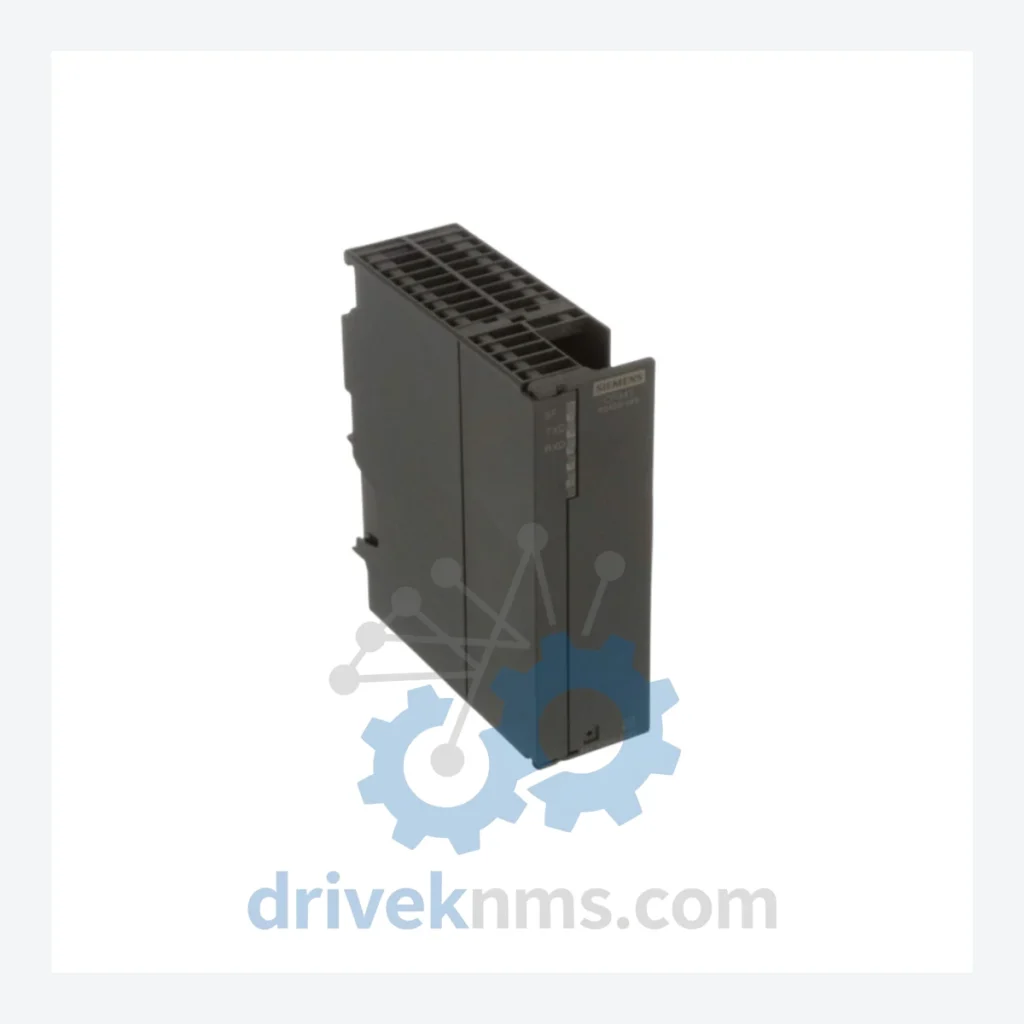
Siemens 6ES7341-1CH01-0AE0 Communications Processor – Obsolete S7-300 Spare Part
RFQ support for obsolete parts: Send the model number, required quantity and destination so DriveKNMS can confirm sourcing options before quotation.
Technical Specifications
| Parameter | Value |
| Part Number | 6ES7341-1CH01-0AE0 |
| Product Family | SIMATIC S7-300 |
| Module Type | CP 341 Communications Processor |
| Interface | RS-422 / RS-485 point-to-point serial |
| Supply Voltage | 24 V DC (via S7-300 backplane) |
| Manufacturer | Siemens AG |
| Country of Origin | Germany |
| Discontinuation Status | Discontinued / Obsolete – no longer in Siemens active production |
| Compatible Systems | SIMATIC S7-300 series (CPU 312 through CPU 319); also deployed in Siemens TI 505 migration environments and legacy SCADA architectures |
Solving the Discontinued Hardware Crisis
The CP 341 with RS-422/RS-485 interface was the standard serial communications bridge in S7-300 installations throughout the 1990s and 2000s. It handled point-to-point data exchange between PLCs and peripheral devices — barcode readers, weighing systems, drives, and third-party controllers — using ASCII, 3964(R), and RK 512 protocols.
Siemens has formally discontinued this module. No direct drop-in replacement exists within the current S7-300 or S7-1500 portfolio that replicates its exact protocol stack without firmware-level reconfiguration. For facilities running continuous processes — chemical, pharmaceutical, food and beverage, automotive stamping — an unplanned CP 341 failure does not produce a maintenance event. It produces a production halt.
Beyond immediate failure risk, facilities that have deferred PLC modernization for budget or operational reasons face a compounding problem: as the installed base of S7-300 hardware ages, the secondary market for CP 341 modules contracts. Units available today will not be available at the same price — or at all — in 24 months. Procurement decisions made now determine whether a 5–10 year asset life extension remains viable or whether an emergency capital project becomes unavoidable.
Condition & Reliability Assurance
Discontinued hardware sourced from the secondary market carries inherent risk. DriveKNMS applies a structured 5-step inspection protocol to every CP 341 unit before it is offered for sale:
Step 1 – Electrolytic Capacitor Assessment: Capacitors on boards manufactured in this era are the primary failure point after extended storage. Each unit is inspected for bulging, electrolyte leakage, and ESR deviation. Units with degraded capacitors are not offered as functional spares.
Step 2 – Firmware Version Verification: The firmware version is read and documented. Compatibility with the target CPU firmware revision is confirmed prior to shipment where the customer's CPU version is known.
Step 3 – Pin and Connector Inspection: All backplane connector pins are examined under magnification for oxidation, corrosion, and mechanical deformation. Affected pins are treated or the unit is rejected.
Step 4 – Functional Power-On Test: Each module is powered through a test rack and communication initialization is verified.
Step 5 – Packaging and ESD Protection: Units are packaged in anti-static bags with desiccant and labeled with inspection date and condition grade prior to shipment.
Key Features for System Maintenance
The 6ES7341-1CH01-0AE0 is a direct hardware replacement for any existing CP 341 RS-422/RS-485 slot in an S7-300 rack. No PLC reprogramming is required. The module reads its configuration from the existing project data on the CPU — the replacement procedure is a physical swap followed by a CPU restart. There is no engineering reconfiguration cost, no revalidation cycle triggered by a hardware change at the module level, and no interruption to the existing communication protocol configuration.
For plant engineering teams, this means a verified spare can be installed by maintenance personnel during a scheduled or emergency window without specialist PLC programming resources on site. The total cost of the spare — purchase, storage, and installation — remains well below the cost of a single unplanned production stoppage, and orders of magnitude below the cost of a forced platform migration.
How do I confirm the unit is genuine and not counterfeit?
All units sourced by DriveKNMS are inspected for label authenticity, PCB markings, and component consistency against known-good reference units. We do not source from unverified liquidation channels. Customers requiring additional documentation may request an inspection report prior to purchase.
Should I purchase more than one unit?
For any facility operating more than one S7-300 rack with CP 341 modules, holding a minimum of two spares is the standard recommendation. As secondary market availability continues to decline, the cost of a second unit today is significantly lower than the cost of emergency sourcing under production pressure. Long-term spare holding — 3 to 5 units for multi-line facilities — is a recognized asset protection strategy for legacy automation infrastructure.