
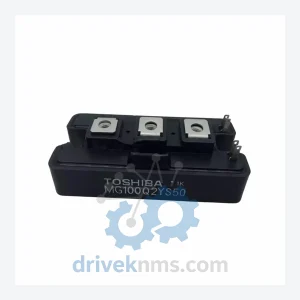
Toshiba MG Series IGBT Power Modules MG100Q2YS50
Toshiba MG100Q2YS50 is listed for MG Series IGBT Power RFQ review. Confirm quantity, condition and destination before quotation.
RFQ-ready industrial model
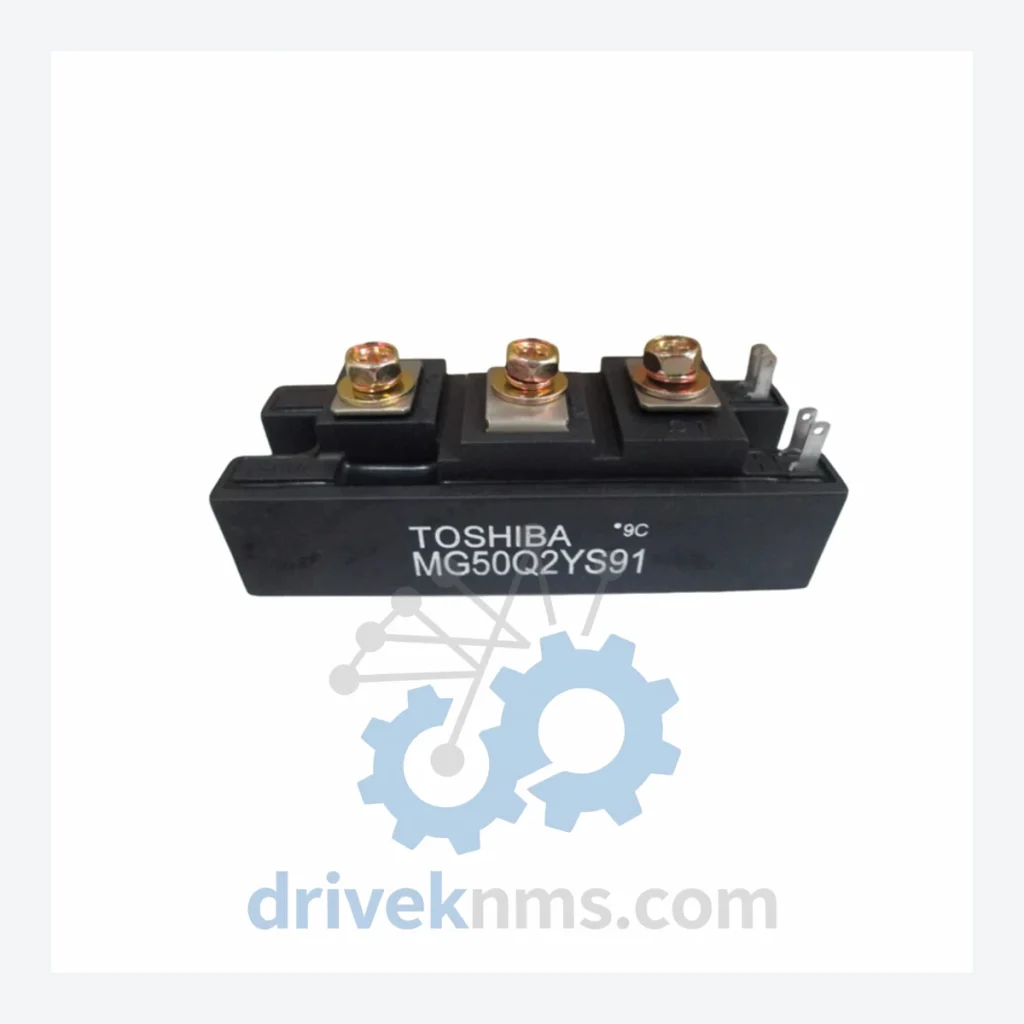
Model: MG50Q2YS91
Product Overview
Commercial availability is handled through direct RFQ, model verification and export-oriented follow-up rather than public cart checkout.
Datasheet Preview
Use attached product manuals when available. If the manual is not public yet, request the full file directly through RFQ.
Commercial Path
Product pages on DRIVEKNMS are designed to verify model, brand and series first, then move the buyer into one clean quotation path.
Technical Dossier
The TOSHIBA MG Series represents one of the most widely deployed families of IGBT (Insulated Gate Bipolar Transistor) power modules in global heavy industry. Installed across chemical processing plants, nuclear power auxiliary systems, petroleum refinery drive systems, steel mill variable frequency drives, and large-scale UPS infrastructure, the MG Series established TOSHIBA as a tier-one supplier of discrete power semiconductor modules throughout the 1990s and 2000s. These modules are characterized by their dual, single, and six-pack IGBT configurations, rated from 25A to 600A collector current and blocking voltages from 600V to 1200V (VCES). The MG50Q2YS91 is a representative dual IGBT module rated at 50A / 1200V, widely used in medium-power inverter and chopper circuits.
The TOSHIBA MG Series was introduced in the late 1980s as a response to industrial demand for compact, high-reliability IGBT modules that could replace older Darlington transistor assemblies. Early generations (MG Series Gen 1, circa 1988–1993) used aluminum wire bonding on standard DBC (Direct Bonded Copper) substrates with relatively high switching losses, suitable for carrier frequencies below 5 kHz. The second generation (Gen 2, 1993–2000) introduced improved gate oxide technology, reducing VCE(sat) and enabling operation at 8–10 kHz in motor drive applications. The third generation (Gen 3, 2000–2008) incorporated trench-gate IGBT cell structures, significantly improving conduction efficiency and thermal cycling endurance — critical for continuous-duty industrial drives.
Compatibility across generations is constrained by pinout and package format. The TO-247, TO-3P, and proprietary flat-base module packages used across the MG Series are not interchangeable without PCB or busbar redesign. Engineers maintaining legacy equipment must verify the exact package code suffix (e.g., YS91, YS40) before substitution. TOSHIBA officially discontinued active production of most MG Series variants by 2015, transitioning customers to the GT Series (e.g., GT50J325) and MG-G Series with improved short-circuit withstand capability. However, installed base demand for MG Series modules in legacy drives remains substantial, making aftermarket sourcing a critical operational requirement.
The following SKUs represent verified, commonly referenced models within the TOSHIBA MG Series. Each entry includes the primary functional classification and key electrical parameter.
MG50Q2YS91: Dual IGBT module, 50A / 1200V, flat-base package, inverter/chopper use.
MG75Q2YS91: Dual IGBT module, 75A / 1200V, flat-base package, medium-power drive stages.
MG100Q2YS91: Dual IGBT module, 100A / 1200V, high-current inverter half-bridge configuration.
MG150Q2YS91: Dual IGBT module, 150A / 1200V, heavy-duty drive and traction inverter use.
MG200Q2YS91: Dual IGBT module, 200A / 1200V, large industrial inverter output stage.
MG25Q6ES51: Six-pack IGBT module, 25A / 600V, compact three-phase inverter bridge.
MG50Q6ES51: Six-pack IGBT module, 50A / 600V, three-phase motor drive full-bridge.
MG75Q6ES51: Six-pack IGBT module, 75A / 600V, HVAC and pump drive inverter bridge.
MG100Q6ES51: Six-pack IGBT module, 100A / 600V, industrial servo and spindle drive.
MG150Q6ES51: Six-pack IGBT module, 150A / 600V, high-power three-phase inverter stage.
MG50J6ES51: Six-pack IGBT module, 50A / 600V, J-series gate structure, lower switching loss.
MG75J6ES51: Six-pack IGBT module, 75A / 600V, J-series, improved thermal resistance.
MG100J6ES51: Six-pack IGBT module, 100A / 600V, J-series, enhanced short-circuit rating.
MG300Q1US51: Single IGBT module, 300A / 600V, chopper and DC bus switch applications.
MG400Q1US51: Single IGBT module, 400A / 600V, high-current DC chopper and braking circuits.
MG600Q1US51: Single IGBT module, 600A / 600V, large-scale rectifier and inverter switch.
MG50Q2YS40: Dual IGBT module, 50A / 1200V, YS40 package variant, alternative footprint.
MG75Q2YS40: Dual IGBT module, 75A / 1200V, YS40 package, compatible gate driver interface.
IGBT power modules present specific failure modes that require targeted test procedures beyond standard component screening. For the TOSHIBA MG Series, DriveKNMS applies the following verification protocol to all units prior to shipment:
Static Parameter Verification: Each module is tested for VCES (collector-emitter blocking voltage), VGES (gate-emitter voltage), ICES (leakage current at rated VCES), and VCE(sat) at defined IC and VGE conditions. Results are compared against TOSHIBA datasheet limits for the specific part number.
Gate Integrity Test: Gate oxide condition is assessed via gate charge measurement and gate leakage current at ±20V VGE. Degraded gate oxide — a common failure mode in aged or improperly stored modules — is identified and units are rejected.
Thermal Resistance Check: For modules where the thermal interface compound may have degraded, junction-to-case thermal resistance (Rth(j-c)) is verified using a controlled power dissipation and temperature measurement cycle.
Freewheeling Diode Test: The integrated anti-parallel diodes in each IGBT cell are tested for forward voltage drop (VF) and reverse leakage to confirm co-pack diode integrity.
Visual and Mechanical Inspection: Substrate crack detection, terminal corrosion assessment, and encapsulant condition review are performed under magnification before packaging.
Continue The Model Path
Move from this exact model into the matching system hub, brand archive, model-family archive or lifecycle sourcing route before sending a final RFQ list.
Related Paths
Toshiba MG100Q2YS50 is listed for MG Series IGBT Power RFQ review. Confirm quantity, condition and destination before quotation.
Toshiba 110U2G43 is listed for MG Series RFQ review. Confirm quantity, condition and destination before quotation.
Toshiba MIG50Q201H is listed for Servo Drives RFQ review. Confirm quantity, condition and destination before quotation.