Technical Dossier
Product Details And Specifications
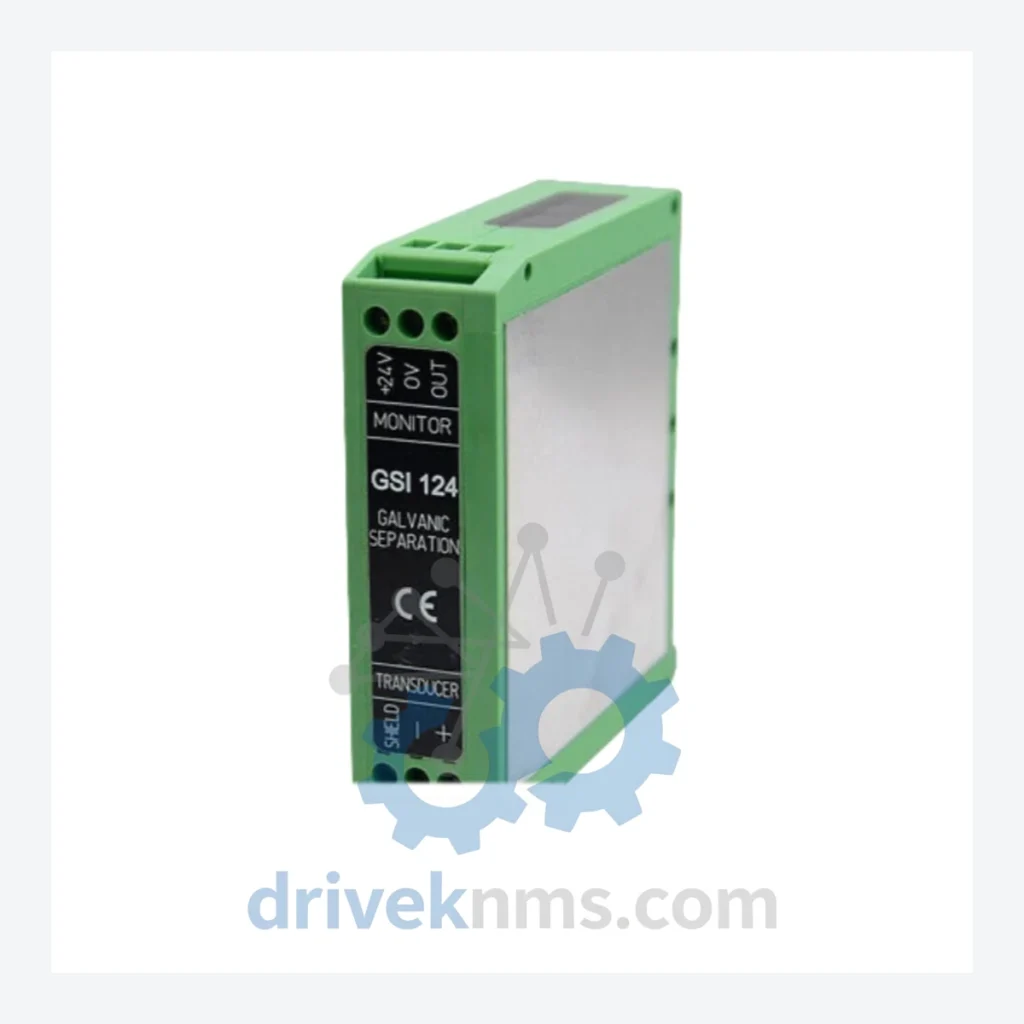
Vibro-Meter GSI124 244-124-000-021 Vibration Sensor – Obsolete GSI Series Spare Part
When a vibration monitoring channel goes dark on a legacy turbomachinery or rotating equipment protection system, the consequences are not limited to a single sensor replacement. Plants running Vibro-Meter GSI-series infrastructure — systems that have been in continuous service for decades — face a hard reality: the GSI124 244-124-000-021 is no longer manufactured. A forced migration to a modern vibration monitoring platform carries engineering, commissioning, and validation costs that routinely exceed six figures. In many cases, the downstream impact on production continuity pushes total exposure into the millions.
DriveKNMS reviews sourcing options for this model through RFQ handling before quotation.
RFQ support for obsolete parts: Send the model number, required quantity and destination so DriveKNMS can confirm sourcing options before quotation.
Technical Specifications
Note: Electrical parameters (sensitivity, frequency range, output impedance) vary by installation configuration. Confirmed specifications are provided upon request with unit serial number verification. No parameters are published here that cannot be independently verified — accuracy on obsolete hardware is a safety matter, not a marketing exercise.
Solving the Discontinued Hardware Crisis
Vibro-Meter's GSI-series sensors were engineered for long-cycle industrial environments — power generation, petrochemical, marine propulsion, and heavy rotating machinery. The GSI124 244-124-000-021 occupies a specific role in these protection architectures: it feeds raw vibration data into monitoring racks that were calibrated and validated against its exact output characteristics. Substituting a modern sensor is not a plug-and-play operation. It requires recalibration of trip thresholds, re-validation of the protection logic, and in regulated industries, formal re-certification of the safety function.
How to Extend Automation Asset Life by 5–10 Years: A Maintenance Strategy for Plant Management
The decision to retire a legacy vibration monitoring system is rarely driven by the system's inability to perform its function. It is driven by parts availability. When critical sensors, signal conditioners, or rack modules become unavailable, the system becomes a liability — not because it has failed, but because the next failure cannot be recovered from.
The following approach has been used by maintenance teams across power generation and process industries to defer costly system replacements by a decade or more:
1. Conduct a single-point-of-failure audit. Identify every component in the monitoring architecture that is either already discontinued or at end-of-life. Prioritize by consequence of failure — a sensor on a critical turbine bearing is not equivalent to one on an auxiliary pump.
2. Establish a strategic spares buffer. For high-consequence, obsolete components, holding two to three units in bonded storage is standard practice. The carrying cost of three GSI124 sensors is a fraction of one day of unplanned production loss.
4. Implement a scheduled inspection cycle. Obsolete sensors in long-term storage or extended service should be inspected on a defined interval for connector corrosion, cable jacket degradation, and housing integrity. Early detection of physical deterioration prevents in-service failures.
5. Document the installed base. Maintain a live register of every obsolete component in service, its installation date, last inspection date, and available spare count. This converts an ad hoc crisis response into a managed maintenance program.
Applied consistently, this approach transforms parts obsolescence from an uncontrolled risk into a scheduled, budgeted maintenance activity.
Condition & Reliability Assurance
Obsolete parts sourced from the secondary market carry inherent uncertainty. DriveKNMS applies a structured 5-step quality process before any GSI124 244-124-000-021 unit is offered for sale:
Step 1 – Visual and Physical Inspection: Full external examination for housing cracks, connector damage, cable jacket integrity, and labeling legibility. Units with physical damage are rejected at intake.
Step 2 – Electrolytic Capacitor Assessment: Long-stored electronics are susceptible to electrolytic capacitor degradation. Internal boards are inspected for signs of capacitor bulging, leakage, or ESR drift where accessible.
Step 3 – Connector and Pin Inspection: All mating connectors are examined under magnification for pin corrosion, bent contacts, and contamination. Corroded pins are cleaned or the unit is downgraded.
Step 4 – Firmware / Configuration Verification (where applicable): For units with embedded firmware or configuration memory, version is recorded and cross-referenced against the customer's system requirements prior to shipment.
Units that do not pass all applicable steps are either downgraded to a lower condition grade or rejected from inventory entirely.
Key Features for System Maintenance
Drop-in replacement: The GSI124 244-124-000-021 is a direct mechanical and electrical substitute for the original installed unit. No modification to the monitoring rack, no reconfiguration of the protection system, and no re-engineering of cable runs is required.
No reprogramming required: Unlike cross-brand substitutions, a like-for-like replacement preserves all existing calibration data, trip setpoints, and alarm thresholds. The system returns to service in its validated state.