Technical Dossier
Product Details And Specifications
VIBRO-METER IQS452 Series Technical Notes
The Evolution of IQS452 Architecture
The IQS452 series succeeded earlier Vibro-Meter signal conditioning platforms including the IQS421 and IQS431 families. The architectural transition introduced modular channel configuration, allowing a single card format to address single-channel, dual-channel, and multi-range measurement requirements through variant suffix coding rather than separate hardware platforms. Early IQS452 variants (suffix -0x1) were optimized for velocity transducer inputs with fixed gain stages. Subsequent revisions introduced programmable gain amplification and extended frequency response to accommodate high-frequency accelerometer inputs required for bearing fault detection (suffix -2xx and -3xx variants). Integration with the VM600 rack's internal communication bus (VME-based backplane) remained consistent across all hardware revisions, ensuring backward compatibility within existing rack installations. As of 2024, the IQS452 series is classified as a mature/end-of-active-production product line. Meggitt has transitioned new installations toward the VM600 MPC4 integrated platform; however, the IQS452 remains the dominant installed module type in legacy VM600 racks globally. No direct plug-compatible replacement exists for the IQS452 form factor, making OEM-equivalent and refurbished spare parts the primary maintenance pathway for operators committed to existing rack infrastructure.
IQS452 Full Catalog & Functionalities (SKU List)
The following SKUs represent the documented IQS452 variant range, classified by channel configuration and input type. Each variant is defined by its 15-digit order code suffix.
IQS452 204-452-000-011: Single-channel velocity input, fixed gain, 4–20 mA output, standard range.
IQS452 204-452-000-021: Single-channel velocity input, extended range, dual output (mA + voltage).
IQS452 204-452-000-031: Single-channel accelerometer input, IEPE/ICP® compatible, programmable gain.
IQS452 204-452-000-041: Single-channel accelerometer input, charge mode (non-IEPE), high-temperature transducer compatible.
IQS452 204-452-000-051: Single-channel displacement proxy input, eddy-current transducer interface, 0–10 V output.
IQS452 204-452-000-111: Dual-channel velocity input, independent gain per channel, 4–20 mA outputs.
IQS452 204-452-000-121: Dual-channel velocity input, extended frequency response (2–1000 Hz), dual mA output.
IQS452 204-452-000-131: Dual-channel IEPE accelerometer input, programmable bandpass filter, dual voltage output.
IQS452 204-452-000-141: Dual-channel charge-mode accelerometer input, isolated signal paths, dual mA output.
IQS452 204-452-000-201: Single-channel, high-sensitivity velocity input, low-noise amplifier stage, SIL-2 rated output.
IQS452 204-452-000-211: Single-channel IEPE input, integrated RMS computation, 4–20 mA RMS output.
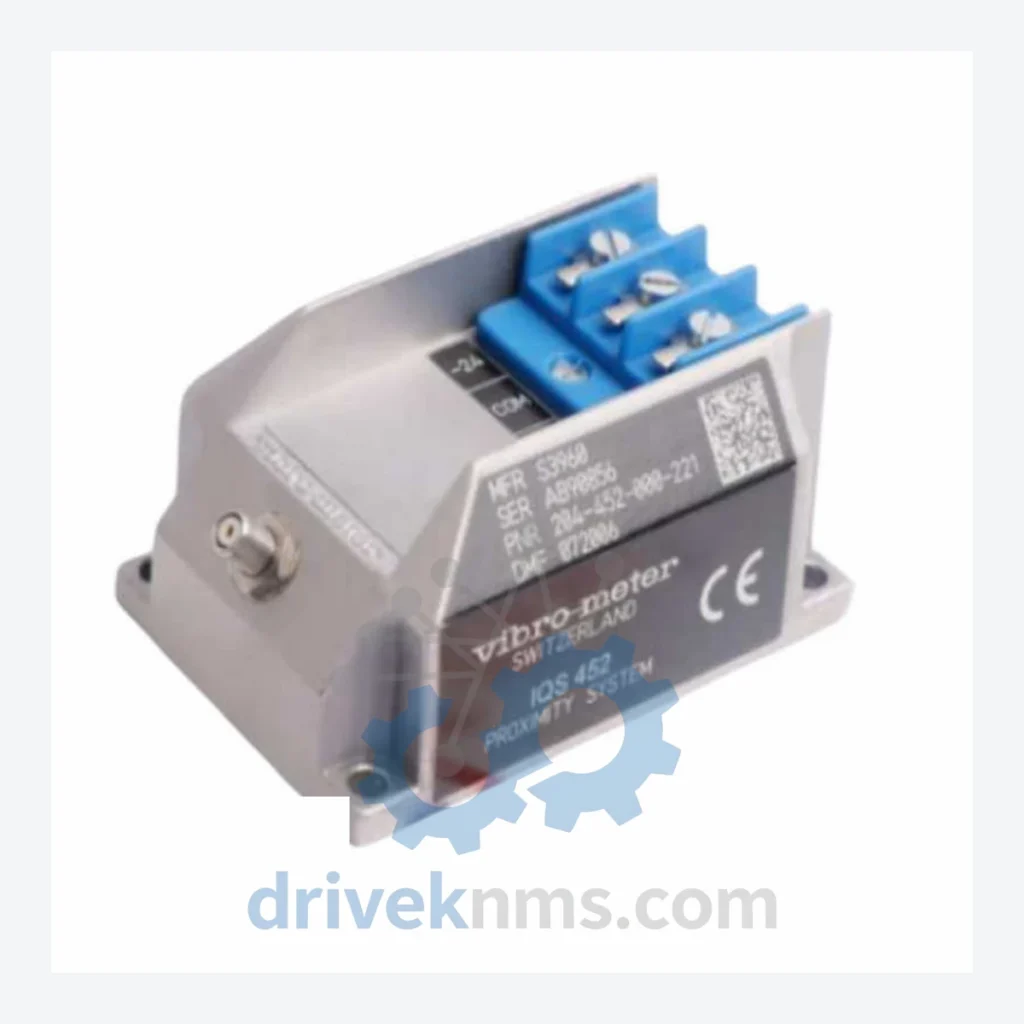
IQS452 204-452-000-221: Single-channel signal amplifier, dual-range velocity/acceleration input, programmable output scaling, VM600 backplane bus interface.
IQS452 204-452-000-231: Single-channel, wide-band accelerometer input, 1 Hz–10 kHz bandwidth, voltage output.
IQS452 204-452-000-241: Single-channel, tachometer/speed input conditioning, pulse-to-analog conversion, 4–20 mA output.
IQS452 204-452-000-301: Dual-channel, mixed input (velocity + displacement), independent signal paths, dual 4–20 mA output.
IQS452 204-452-000-311: Dual-channel, mixed input (IEPE + charge mode), selectable gain, dual voltage output.
IQS452 204-452-000-321: Dual-channel, high-isolation input stage, suitable for hazardous area transducer loops (ATEX-compatible wiring).