A fan can keep turning after its drive stops controlling it. Airflow from another fan, process draft or the inertia of the load can leave the shaft moving when a new start is requested. On a VLT 2800 installation, reviewing how the drive handles that condition is different from checking how it starts a stationary motor. A spare acceptance plan should preserve the approved flying-start behavior without treating the feature as permission for an automatic restart.
Describe the mechanical condition first
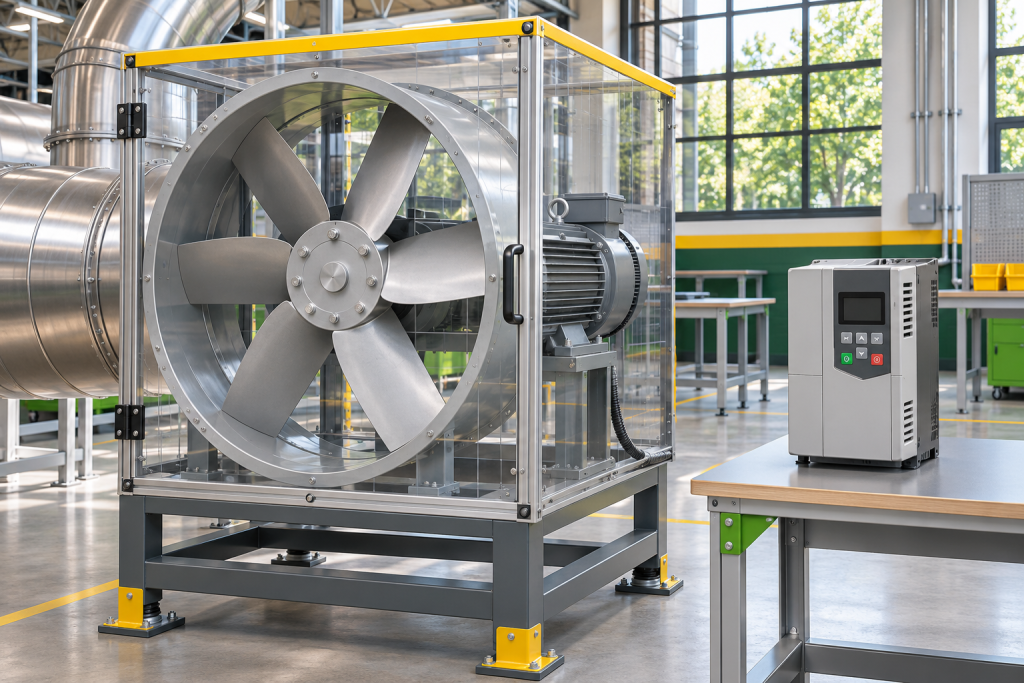
Record whether the application can present a rotating load to the drive and what may cause that motion. A fan in a shared duct is a useful example to investigate, not proof that every fan requires the same setting. Distinguish a normal controlled stop from loss of supply or another condition that leaves the shaft free. The reviewer needs the expected starting condition before judging whether a replacement behaves correctly.
The Danfoss VLT 2800 drive listing identifies the relevant family for the hardware request. Keep the complete installed rating, model and software reference with it. Do not transfer a setting number or an option description from a newer Danfoss platform simply because both documents discuss catching a rotating motor. The applicable manual must match the equipment being assessed.
Separate flying start from start permission
The VLT 2800 Design Guide describes parameter 445 as a function for catching a rotating shaft that is no longer under the converter’s control. Its options distinguish disabled operation, direction-related choices and a DC-braking-related start choice. These are not interchangeable descriptions. Preserve the approved option in the configuration record and refer to the applicable software documentation for its conditions and limitations.
That function addresses how a drive deals with an already moving motor when a start is commanded. It does not decide whether the machine is authorized to start. Record the command owner, permissives and any applicable restart restrictions separately. A successful catch does not prove that the PLC, operator procedure or protective arrangement has granted a valid restart. Avoid collapsing those distinct responsibilities into one line marked automatic recovery.
Make direction part of the evidence
A shaft may be rotating in the intended direction or in the opposite direction when the start request arrives. State which conditions the approved application is designed to handle. Preserve the direction convention used in drawings and commissioning records rather than relying on an observer’s position beside a fan. An acceptance statement such as catches a spinning motor is incomplete if it never identifies the relevant direction and operating conditions.
The practical review question is whether the replacement preserves the accepted transition back into controlled operation. Define the observations that answer that question, including the source of the motion information and the limits of the test. A stationary unloaded bench check may establish basic hardware operation, but it cannot demonstrate the behavior of a windmilling production fan. Keep the bench result useful by describing exactly what it did establish.
Retain the related configuration as a controlled set
Archive the applicable motor identity, approved motor data and relevant start configuration under a dated project reference. Review them together rather than comparing a single parameter in isolation. If the replacement software or available options differ, hold the discrepancy for engineering review. Do not select a similar-looking option just to make two parameter exports appear alike. Preserve the as-found evidence before anyone proposes an adjustment.
The same discipline applies to a proposed retrofit. The earlier VLT 2800 cabinet-space review addresses the physical installation. Space, cooling and mounting acceptance remain necessary, but they do not establish the start behavior of the motor. Keep mechanical fit and functional recovery as separate acceptance items so a physically successful replacement does not conceal an unresolved operating difference.
Plan a controlled test, not an improvised restart
The responsible team should define the test environment, approved conditions and stopping criteria before any motor movement is requested. Account for the driven equipment and people who could be affected by it. Use qualified personnel and the site’s electrical and mechanical safety procedures. This article is a review framework, not a procedure for energizing a drive, changing its settings or causing a rotating load to restart.
Keep the result legible to another shift. Record the configuration reference, the initial condition, the approved command path and the observations made. A test that passes in one direction or at one agreed condition should not be reported as an unlimited recovery capability. Where evidence is missing, name the gap and its owner instead of broadening the claim. Avoid repeated restart attempts as a way to diagnose an unexplained response.
Give procurement a bounded request
A useful DriveKNMS inquiry includes the installed drive identity, supply and motor ratings, required condition evidence and the intended delivery scope. State that the unit supports an application with a defined moving-load start requirement, while retaining the operational configuration in the plant’s controlled systems. A supplier can verify the hardware identity and quote the agreed scope; approval of the machine’s restart behavior remains with its engineering owner.
This approach also clarifies an exchange or repair decision. Physical condition evidence and an agreed functional inspection are valuable, but neither should be described as a complete production acceptance without the necessary application evidence. Keep the hardware finding, the configuration comparison and the machine test result distinct. That gives maintenance a defensible basis for returning the equipment to its approved role without promising more than has been demonstrated.
Frequently asked questions
Does flying start mean the motor is allowed to restart automatically?
No. It concerns the drive’s treatment of an already moving shaft when a start is commanded. Command permission and machine restart requirements must be assessed separately.
Can a stationary bench test prove a windmilling fan application?
No. It can support a limited hardware finding. The approved functional acceptance must address the relevant moving-load conditions without exposing people or equipment to an improvised test.
Can FC-series parameter numbers be copied into a VLT 2800 record?
No. Use the documentation for the exact installed family and software. Similar feature names do not establish identical parameter numbering, available choices or behavior.
What should be retained before a replacement is approved?
Keep the installed identity, controlled configuration, motor reference, approved start requirements and evidence scope. Resolve software or option differences through engineering rather than silently substituting a setting.
Image: AI-generated editorial illustration, not an exact product photograph or installation reference.
© 2026 DriveKNMS. All rights reserved. Official Website: https://driveknms.com Inquiry: sale@driveknms.com | WhatsApp/Tel: +86 18359293191