
Foxboro SPEC-200 Modules | SPEC-200 Display Station Controller
Foxboro SPEC-200 Series: Comprehensive Module Range and Technical Overview The Foxboro SPEC-200 is a panel-mounted analog control system developed by…
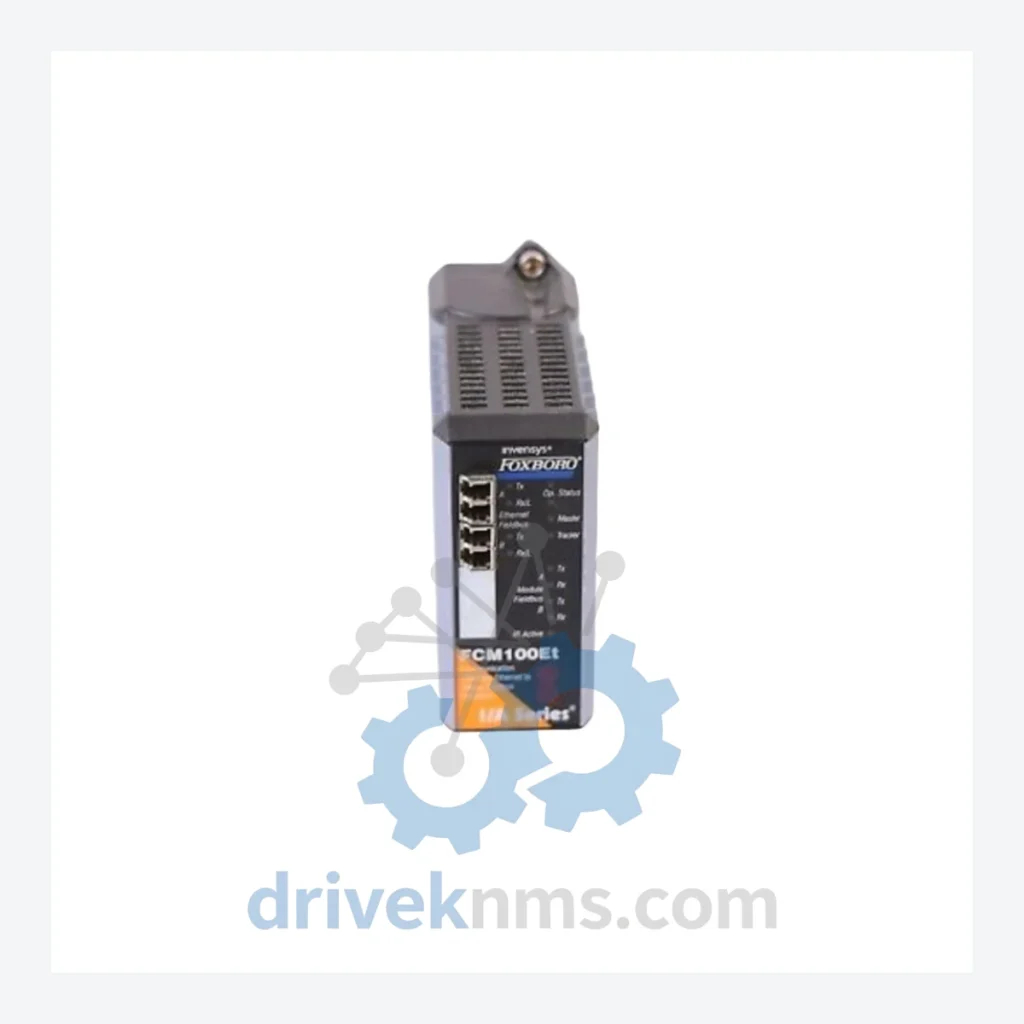
Model: FCM100ET P0926GS
Product Overview
Commercial availability is handled through direct RFQ, model verification and export-oriented follow-up rather than public cart checkout.
Datasheet Preview
Use attached product manuals when available. If the manual is not public yet, request the full file directly through RFQ.
Commercial Path
Product pages on DRIVEKNMS are designed to verify model, brand and series first, then move the buyer into one clean quotation path.
Technical Dossier
The Foxboro I/A Series distributed control system (DCS) represents one of the most widely deployed process automation platforms in global heavy industry. Installed across petrochemical complexes, nuclear power stations, crude oil refineries, and large-scale chemical processing facilities, the I/A Series architecture has maintained a continuous operational footprint since its commercial introduction in the 1980s. The FCM100ET P0926GS is a Fieldbus Communication Module (FCM) variant engineered to bridge Ethernet-based supervisory networks with Fieldbus device segments, serving as a critical node in the I/A Series communication hierarchy. Its deployment is prevalent in facilities where legacy Fieldbus H1 segments must coexist with modern Ethernet infrastructure — a configuration common in brownfield refinery expansions and nuclear plant I&C upgrades.
The Foxboro I/A Series communication architecture has undergone four distinct generational transitions since its inception. The original FBM (Fieldbus Module) generation established the baseline for distributed I/O over proprietary Nodebus. The introduction of the FCM (Fieldbus Communication Module) family marked the transition to IEC 61158-compliant Foundation Fieldbus H1 segment management, enabling direct HART and FF device integration without gateway intermediaries.
The FCM100 sub-family introduced 100 Mbps Ethernet uplink capability, replacing the earlier 10 Mbps Nodebus topology. The FCM100ET variant specifically implements dual-redundant Ethernet ports alongside multi-segment Fieldbus H1 management, supporting up to 16 H1 segments per module in certain configurations. Compatibility constraints are significant: FCM100ET modules require I/A Series software release v8.x or later and are not backward-compatible with CP30 or CP40 controllers without firmware mediation. Migration from FCM10E to FCM100ET requires segment re-addressing and LAN configuration updates within the Foxboro AIM historian and FoxView HMI layers.
The following SKUs represent verified components within the Foxboro I/A Series FCM and associated communication module catalog. Each entry reflects a distinct hardware configuration or firmware variant.
FCM100ET P0926GS: Ethernet-to-Fieldbus communication module, dual Ethernet uplink, multi-H1 segment management, primary variant.
FCM100ET P0926GU: FCM100ET with extended temperature rating for harsh environment enclosures.
FCM100E P0916GS: 10 Mbps Ethernet FCM, single Ethernet port, predecessor to FCM100ET series.
FCM100E P0916GU: FCM100E harsh environment variant, conformal coated PCB assembly.
FCM10E P0904GS: Early-generation Fieldbus communication module, 10BaseT Ethernet, 4-segment H1 capacity.
FCM10E P0904GU: FCM10E with extended operating temperature specification.
FBM201 P0922TW: Foundation Fieldbus H1 I/O module, 2-channel, intrinsically safe segment support.
FBM202 P0922TX: Foundation Fieldbus H1 I/O module, 4-channel configuration.
FBM207 P0926VW: Redundant Fieldbus module for critical loop applications.
FBM214 P0926WW: HART multiplexer interface module, 16-channel HART device polling.
FBM220 P0926XW: Analog input FBM, 8-channel, 4–20 mA with HART pass-through.
FBM230 P0926YW: Analog output FBM, 8-channel, 4–20 mA HART-capable outputs.
FBM237 P0926ZW: Digital input FBM, 32-channel, 24 VDC discrete input module.
FBM242 P0927AW: Digital output FBM, 16-channel, relay output configuration.
CP270 P0972VE: Control Processor 270, primary controller for I/A Series stations, pairs with FCM100ET for Ethernet-based control LAN.
CP280 P0972WE: Control Processor 280, enhanced processing capacity, redundant configuration support.
AW70 P0972XE: Application Workstation 70, FoxView HMI host, interfaces with FCM100ET via control LAN.
P0916YE: I/A Series Nodebus Extender, legacy segment bridging for FCM10E installations.
The FCM100ET P0926GS and the broader FCM100 sub-family have entered the mature-to-declining phase of their product lifecycle. Schneider Electric (which acquired Foxboro from Invensys in 2014) has progressively shifted support resources toward the EcoStruxure Foxboro DCS platform. As a result, OEM lead times for FCM100ET units have extended significantly, and certain firmware-specific variants are no longer available through standard distribution channels.
DriveKNMS maintains a dedicated inventory of I/A Series FCM100ET modules sourced from decommissioned plant assets, controlled-environment warehouses, and verified secondary market channels. All units are cataloged by part number, firmware revision, and hardware revision level. For facilities operating under long-term maintenance agreements (LTMA) or requiring lifecycle extension beyond OEM support windows, DriveKNMS provides documented traceability records and functional test reports for each FCM100ET unit shipped. Inquiries for bulk quantities, emergency replacement, or cross-reference to alternative part numbers are handled directly by our technical sourcing team.
The FCM100ET P0926GS presents specific test challenges due to its integrated dual Ethernet PHY layer, multi-segment H1 bus arbitration logic, and onboard flash memory storing segment configuration tables. DriveKNMS applies the following test protocol to all FCM100ET units prior to shipment:
Ethernet Port Integrity Test: Both Ethernet ports are subjected to 100 Mbps link negotiation verification using calibrated network analyzers. Packet loss, CRC error rate, and auto-negotiation behavior are logged.
H1 Segment Bus Load Test: Each H1 segment port is loaded with a simulated device population to verify bus arbitration, token passing, and LAS (Link Active Scheduler) functionality under rated conditions.
Firmware Revision Verification: Onboard firmware is read and compared against Foxboro revision matrices to confirm compatibility with target I/A Series software releases.
Thermal Cycling: Units are cycled through operating temperature range (0°C to 60°C) to identify latent solder joint failures common in aged backplane connector assemblies.
Backplane Connector Inspection: Physical inspection of the DIN-rail backplane connector pins under 10× magnification, with continuity verification across all signal lines.
Power Rail Verification: Input voltage tolerance and inrush current are measured against Foxboro hardware specification P0926GS Rev. tolerances.
Related Paths
Foxboro SPEC-200 Series: Comprehensive Module Range and Technical Overview The Foxboro SPEC-200 is a panel-mounted analog control system developed by…
Foxboro P0400DA Analog Input Module – Obsolete FBM Series Spare Part When a Foxboro I/A Series DCS analog input module…
Foxboro I/A Series FBM Modules: Comprehensive Module Range and Technical Overview The Foxboro I/A Series (Intelligent Automation Series) represents one…