
Foxboro SPEC-200 Modules | SPEC-200 Display Station Controller
Foxboro SPEC-200 Series: Comprehensive Module Range and Technical Overview The Foxboro SPEC-200 is a panel-mounted analog control system developed by…
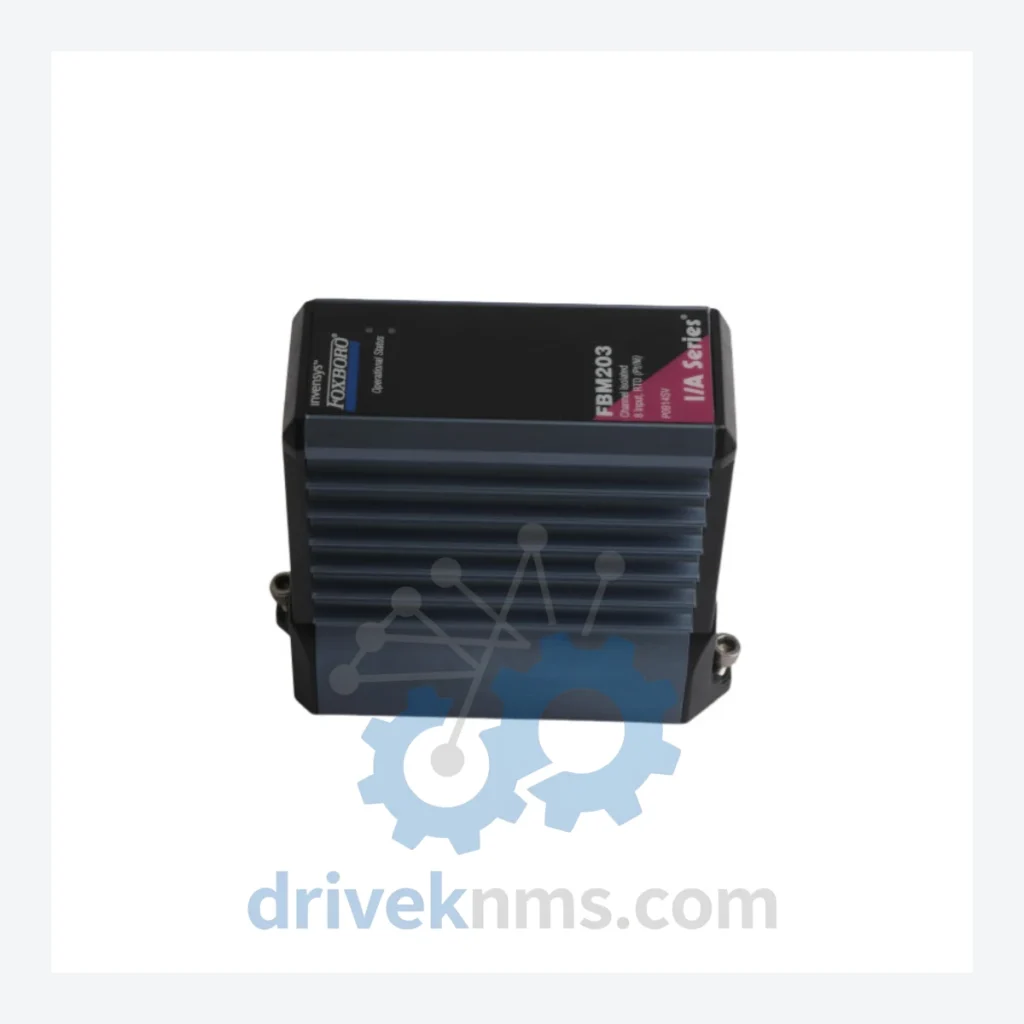
Model: FBM203 P0914SV
Product Overview
Commercial availability is handled through direct RFQ, model verification and export-oriented follow-up rather than public cart checkout.
Datasheet Preview
Use attached product manuals when available. If the manual is not public yet, request the full file directly through RFQ.
Commercial Path
Product pages on DRIVEKNMS are designed to verify model, brand and series first, then move the buyer into one clean quotation path.
Technical Dossier
The Foxboro FBM203 is a Resistance Temperature Detector (RTD) input module belonging to the Foxboro I/A Series Distributed Control System (DCS) — one of the most widely deployed process automation platforms in global heavy industry. Installed across petrochemical complexes, nuclear power stations, offshore platforms, crude oil refineries, and large-scale chemical manufacturing facilities, the I/A Series DCS and its FBM field bus module family represent a multi-decade standard for high-reliability process control. The FBM203, specifically, handles analog temperature measurement inputs via RTD sensors (PT100, PT200, Ni120, and similar), converting raw resistance signals into engineering-unit process variables for the DCS controller. The P0914SV designator identifies the specific hardware revision and configuration variant of this module. Sites running Foxboro I/A Series CP60, CP270, CP40B, or CP30 controllers rely on FBM203 modules as a core component of their temperature monitoring loops.
The Foxboro I/A Series DCS was introduced in the mid-1980s as a distributed, fieldbus-based architecture — a significant departure from the centralized control systems of the prior generation. The FBM (Field Bus Module) family was designed to reside in the field enclosure, close to the process, communicating with the control processor via the Nodebus or Fieldbus infrastructure. Early FBM modules used parallel backplane communication; later generations transitioned to serial Nodebus (75 Mbps coaxial) and ultimately to 100 Mbps Ethernet-based FCP270 architectures. The FBM203 has existed across multiple hardware generations, with revision codes (such as P0914SV) indicating PCB revision, firmware compatibility level, and agency certification status. Compatibility between FBM generations is constrained by the backplane type (ZCP270 vs. ZCP30 enclosures) and the control processor firmware version. Mixing incompatible revisions without validation can result in loss of I/O communication. As the I/A Series has entered its mature/sustaining lifecycle phase, Schneider Electric (which acquired Foxboro from Invensys in 2014) continues to provide limited OEM support, but field replacement units are increasingly sourced from the secondary market.
The following SKUs represent verified, commonly deployed modules within the Foxboro FBM200-series RTD and analog input family. Each entry reflects a distinct hardware configuration or revision:
FBM203 P0914SV: 8-channel RTD input module, PT100/PT200/Ni120 compatible, current hardware revision, I/A Series Nodebus.
FBM203 P0914SW: 8-channel RTD input module, alternate firmware revision, functionally equivalent to P0914SV.
FBM203 P0914ST: Earlier PCB revision of FBM203, compatible with ZCP270 enclosures, sustaining lifecycle.
FBM201 P0914YD: 8-channel thermocouple (TC) input module, J/K/T/E/R/S/B type, Nodebus interface.
FBM201 P0914YE: Thermocouple input module, alternate revision, same functional class as P0914YD.
FBM202 P0914YF: 8-channel millivolt/thermocouple input module, extended range, Nodebus.
FBM204 P0914YG: 8-channel 4–20 mA analog input module, HART-capable, Nodebus interface.
FBM204 P0914YH: 4–20 mA analog input, alternate revision, compatible with CP60/CP270 processors.
FBM205 P0914YJ: 8-channel analog output module, 4–20 mA, Nodebus, used for control valve positioners.
FBM206 P0914YK: 16-channel digital input module, 24 VDC, Nodebus, used for discrete status monitoring.
FBM207 P0914YL: 8-channel digital output module, 24 VDC relay, Nodebus, used for on/off actuator control.
FBM211 P0914YM: Pulse input module, frequency/totalizer inputs, Nodebus, used for flow measurement.
FBM214 P0914YN: 4-channel analog input/output combination module, Nodebus.
FBM220 P0914YP: HART multiplexer interface module, supports HART pass-through to DCS host.
FBM230 P0914YQ: Profibus DP interface module, gateway between I/A Series Nodebus and Profibus field devices.
FBM237 P0914YR: Foundation Fieldbus H1 interface module, 2-segment, Nodebus to FF-H1 gateway.
FBM242 P0914YS: DeviceNet interface module, Nodebus to DeviceNet gateway for motor control centers.
DriveKNMS maintains a dedicated inventory of Foxboro I/A Series FBM modules, including discontinued and hard-to-source revision codes. As Schneider Electric has progressively reduced OEM availability of older FBM hardware, the secondary market has become the primary sourcing channel for sites operating legacy I/A Series systems. DriveKNMS provides: verified pull units from decommissioned DCS systems, tested and certified refurbished FBM203 modules with full functional validation, cross-reference support for identifying compatible replacement revisions when an exact match is unavailable, and long-term lifecycle support agreements for facilities requiring guaranteed spare parts availability over a 5–10 year horizon. All units are shipped with full traceability documentation and are available for immediate dispatch from stock.
The FBM203 and related FBM200-series modules present specific test challenges due to their multi-channel analog front-end circuitry, precision reference resistor networks, and Nodebus backplane communication interface. DriveKNMS applies a structured test protocol for all FBM203 units: (1) Visual inspection of PCB for corrosion, capacitor degradation, and connector pin integrity. (2) Backplane communication test using a live I/A Series test rack to verify Nodebus enumeration and module addressing. (3) Channel-by-channel RTD simulation using a precision resistance decade box across the full PT100 range (0–400 Ω), verifying linearity and accuracy to within ±0.1°C. (4) Firmware version verification and compatibility check against target system processor revision. (5) Burn-in test under simulated process load for a minimum of 24 hours prior to shipment. Units that fail any stage of this protocol are quarantined and not offered for sale.
Related Paths
Foxboro SPEC-200 Series: Comprehensive Module Range and Technical Overview The Foxboro SPEC-200 is a panel-mounted analog control system developed by…
Foxboro P0400DA Analog Input Module – Obsolete FBM Series Spare Part When a Foxboro I/A Series DCS analog input module…
Foxboro I/A Series FBM Modules: Comprehensive Module Range and Technical Overview The Foxboro I/A Series (Intelligent Automation Series) represents one…