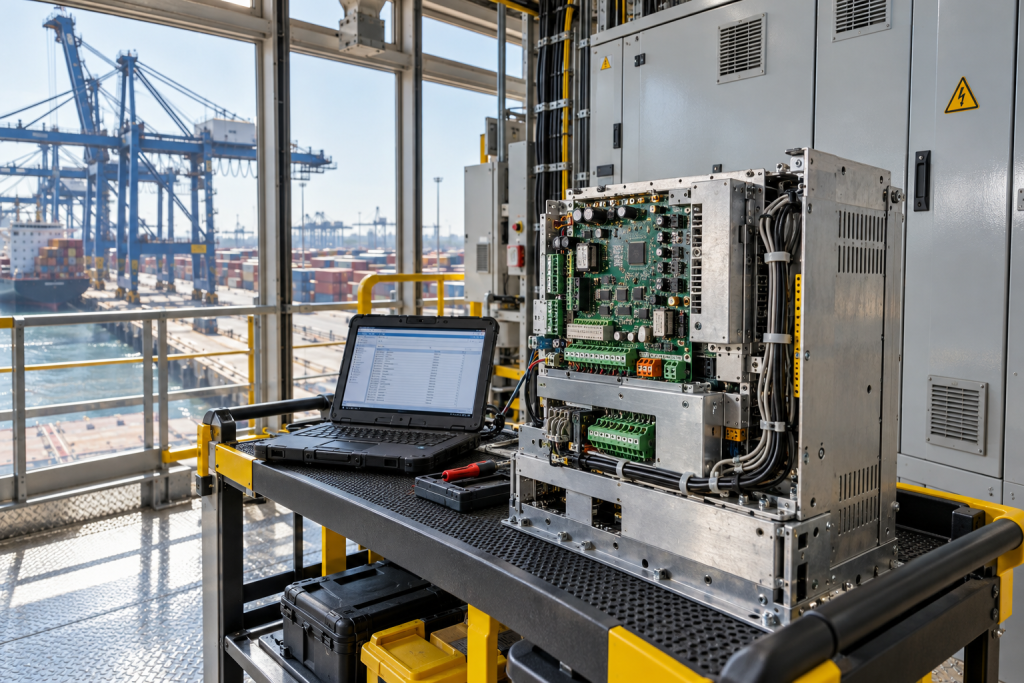
Port automation discussions tend to focus on the next operating model: more connected equipment, better coordination, and improved use of terminal data. The maintenance question underneath is less visible. If a legacy crane drive fails during that transition, does the replacement contain the application needed to operate the crane, or only electronics capable of powering up?
ABB’s TOC Americas event page identifies October 20-22, 2026, in Cartagena and presents port electrification, automation, and operational integration as discussion themes. That provides a timely reason to examine legacy recovery. It is not an announcement of a new ACS800 replacement, nor evidence that a particular crane uses the boards discussed below.
A crane application is part of the spare requirement
Two drive assemblies can share a familiar family name while belonging to different recovery workflows. A stock item may have the expected control hardware but an unknown application history. Another may have been removed from a different machine with settings that look plausible yet do not describe the installed crane. Procurement cannot resolve that uncertainty with current rating alone.
ABB’s ACS800 documentation index lists separate firmware documentation for Crane Control and CraneDrive application programs, alongside other application programs. The limited but important conclusion is that the software identity matters. This does not establish which program, revision, or control board is appropriate for an individual crane.
Record the full drive type code, option codes, control assembly reference, application identification, software revision, and the approved source of recovery files. Keep hardware and software fields separate. A board label is not a substitute for the application record, and a parameter export should not automatically be treated as a complete software recovery package.
Where an RMIO inquiry can go wrong
An inquiry for an ABB RMIO-01C control board should begin with the label on the installed assembly and its role in the drive. Include photographs of associated options and connections when requested by the responsible specialist. Do not assume the quote covers every daughterboard, connector, application program, or configuration required to return the crane to service.
Likewise, a listing for an RMIO-12C spare is a starting point for identifying the requested hardware, not evidence that it replaces RMIO-01C in the existing installation. Short commercial descriptions cannot establish the host-drive and software combination. Any proposed alternative needs an explicit technical review rather than a family-name comparison.
The quotation should distinguish bare hardware from an assembled, configured, and tested recovery solution. Those are different deliverables. A lower-priced board may be perfectly appropriate when the plant already owns the required software, tools, and expertise. It may be inadequate when the missing capability is application restoration rather than hardware supply.
Recover the machine’s behavior, not just its ready signal
A ready indication is only an early checkpoint. A crane’s accepted behavior depends on its engineered control relationships, including the interfaces to brakes, feedback, limits, supervisory controls, and safety functions. Their allocation varies between installations. Do not assume that a drive contains every protective function, or that loading familiar parameters re-establishes all required behavior.
Before the next maintenance window, ask the machine owner to define the acceptance sequence and responsible parties. Which checks can be completed offline? Which require an isolated drive or controlled commissioning environment? Which need the crane specialist and a formally authorized operating test? Answering these questions ahead of failure reduces the temptation to treat an emergency as permission to bypass normal controls.
The spare file should also state what must not be changed during replacement. Network addresses, application options, feedback assignments, and interface settings can affect equipment beyond the failed drive. Preserve the approved baseline and document any intentional deviation through the site’s change process. This is especially important when terminal-wide upgrades and local crane maintenance run on different schedules.
Make the modernization program pay down recovery uncertainty
A wider port project creates an opportunity to recover missing records before hardware becomes an emergency purchase. During planned surveys, capture the installed application identity and locate the supported recovery documentation. Check that the people responsible for legacy cranes can actually access the files and tools, rather than assuming a modernization contractor holds everything.
Separate three work packages in the budget: preserving today’s operation, preparing an approved replacement, and implementing the future architecture. Mixing them in a single line called drive upgrade makes responsibility difficult to assign. The current crane may require a qualified spare even if a future modernization is already funded.
For each critical axis, maintain a short recovery record that answers four practical questions:
- Which exact hardware and application combination is installed?
- Which files, tools, and permissions are needed to restore it?
- Who approves the replacement and performs the required commissioning?
- What evidence demonstrates readiness for service under the site’s procedure?
Do not fill gaps with assumed delivery times or software availability. Mark them as unresolved and assign an owner. A realistic recovery record with visible limitations is more useful than a reassuring spreadsheet containing an unqualified green status.
Practical questions
Does a matching RMIO reference guarantee the crane application is included?
No. Confirm the supply scope explicitly. The delivered hardware, application identity, configuration, licensing or access requirements where applicable, and test evidence need separate agreement. Never infer them from a product title.
Can we restore the crane using only a parameter backup?
Do not assume so. Have the responsible drive specialist determine whether the backup, application software, tools, and hardware form a complete approved recovery set. Parameter data alone may not answer all of those questions.
Should a newer control board be accepted as an automatic upgrade?
No. A proposed change must be evaluated against the host drive, application requirements, options, and machine commissioning scope. Commercial availability is not an engineering approval.
What should purchasing ask for before placing an order?
Request exact hardware identification, condition, supplied accessories, software scope, available test records, and the acceptance and return terms. State that the intended use is a crane application so that unresolved responsibilities are visible before shipment.
Send DriveKNMS the complete drive and control-board labels, application details, and required supply scope for a focused quotation. A clear inquiry helps separate a hardware purchase from the engineering work needed to restore the machine safely.
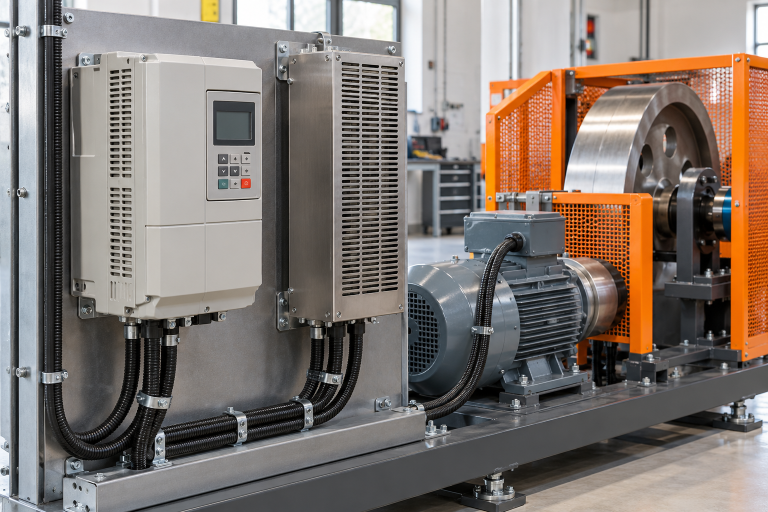
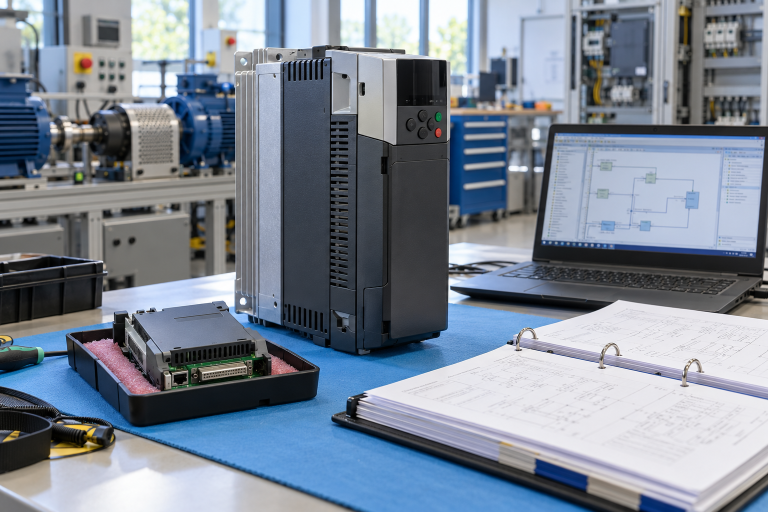
Image: AI-generated editorial illustration, not an exact product photograph or installation reference.
© 2026 DriveKNMS. All rights reserved. Official Website: https://driveknms.com Inquiry: sale@driveknms.com | WhatsApp/Tel: +86 18359293191